
Introduction
Picture this: a family loses a parent unexpectedly and assumes the estate will settle within weeks. Instead, they spend the next 14 months navigating probate court — paying legal fees, watching the process become public record, and waiting for assets that were always meant to be theirs. A properly funded trust could have transferred those assets directly, privately, and without court involvement.
Trusts are among the most versatile tools in estate planning. They help families avoid probate, reduce estate taxes, protect a child with a disability, and preserve wealth across generations. Yet according to Caring.com's 2025 estate planning study, only 13% of Americans have a living trust — meaning most families remain exposed to exactly the kind of delays and complications a trust prevents.
This guide breaks down the primary types of trusts, how each one works, who each is suited for, and how to choose the right structure based on your situation.
Key Takeaways
- A trust is a legal arrangement where a grantor transfers assets to a trustee, who manages them for named beneficiaries according to the trust's terms
- The three foundational categories are revocable, irrevocable, and testamentary — every specialized trust type builds on one of these
- Revocable trusts preserve control and bypass probate; irrevocable trusts can offer asset protection and tax advantages
- Testamentary trusts activate at death through a will — suitable when lifetime trust setup isn't needed
- Specialized trusts — special needs, charitable, spendthrift, and generation-skipping — solve specific family or financial problems
- The right trust depends on your goals, assets, family dynamics, and tax situation — choose based on fit, not popularity
What Is a Trust and Why Does It Matter in Estate Planning?
The Cornell Legal Information Institute defines a trust as a fiduciary relationship in which a trustee holds ownership of assets for a beneficiary. Three roles make it work:
- Grantor — the person who creates and funds the trust
- Trustee — the person or institution who manages the trust assets
- Beneficiary — the person (or people) who receive the benefits
Trusts exist because a will alone has real limitations. A will goes through probate — a court-supervised process that can take months to over a year, according to Nolo's probate guidance. It also exposes estate details to public record and provides no protection if the grantor becomes incapacitated before death.
What Happens Without a Trust
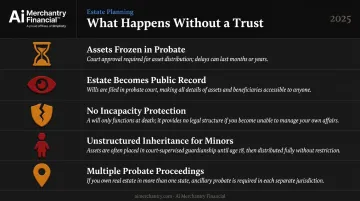
When no trust is in place, families commonly encounter:
- Assets frozen in probate while beneficiaries wait for access
- Estate details — including asset values and family relationships — becoming public record
- No automatic mechanism to manage assets if the grantor becomes incapacitated before death
- Minor children receiving lump-sum inheritances with no structure or guardrails
- Out-of-state property triggering separate probate proceedings in each state where it's held
A trust sidesteps each of these problems by moving asset management and distribution outside the court system entirely — on terms the grantor controls. Understanding which type of trust fits your situation is where that control begins.
The Three Primary Types of Trusts
Every specialized trust structure ultimately traces back to one of three foundational categories. Understanding these gives you the framework to evaluate any trust structure you encounter.
Revocable Living Trust
A revocable living trust is created and funded during the grantor's lifetime. The grantor typically serves as their own trustee, retaining full control to amend, update, or revoke the trust at any time. A successor trustee steps in if the grantor becomes incapacitated or passes away.
Key strengths:
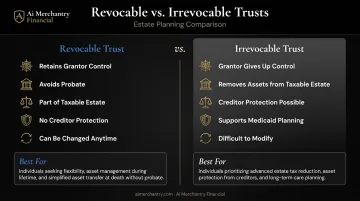
- Assets held in the trust pass directly to beneficiaries without probate court involvement
- Provides continuity of management during incapacity — no court-appointed guardianship required
- Particularly valuable for those who own real estate in multiple states, since it can help avoid ancillary probate in each state
Important limitations:
- Assets remain part of the grantor's taxable estate under IRS rules (IRC Section 2038)
- Provides no protection from creditors or civil judgments
- Does not shelter assets from Medicaid spend-down calculations — federal law treats revocable trust corpus as an available resource
Best suited for: Individuals and families who want to avoid probate, maintain control of assets during their lifetime, and ensure a smooth, private transfer to heirs.
Irrevocable Trust
Once established, an irrevocable trust generally cannot be modified or revoked by the grantor. The assets transferred into it are no longer legally owned by the grantor — they become property of the trust, managed by a separate trustee.
The fundamental trade-off: the grantor relinquishes direct control over transferred assets in exchange for legal protection those assets wouldn't otherwise have.
Key strengths:
- Assets may be removed from the taxable estate when properly structured (note: IRC Sections 2035, 2036, and 2038 can still trigger inclusion if the grantor retains certain rights or transfers powers within three years of death)
- Can provide protection from creditors and civil judgments
- Supports Medicaid planning, though a 60-month look-back period applies to relevant transfers made after February 8, 2006
- Most specialized trusts (ILITs, special needs trusts, charitable trusts) are structured as irrevocable trusts
Important limitations:
- The grantor gives up direct control over transferred assets
- Changes typically require court approval or consent of all beneficiaries (some states permit modification via the Uniform Trust Code or trust decanting statutes)
- Requires careful planning before funding; mistakes are difficult to reverse
Best suited for: Those whose primary goals are estate tax reduction, creditor protection, Medicaid planning, or funding a specialized trust structure.
Testamentary Trust
A testamentary trust is created through the grantor's will and doesn't come into existence until death. Unlike a living trust, it isn't funded during the grantor's lifetime — it activates and is funded through the probate process.
Strengths:
- No trust to maintain or administer while the grantor is alive
- Provides structured distribution terms for specific beneficiaries — minor children, a surviving spouse, or someone with financial vulnerabilities
- Can be a simpler and less costly planning tool during the grantor's lifetime
Limitations:
- Because it's created through a will, the estate must still go through probate
- Probate proceedings become public record
Best suited for: Parents who want controlled inheritance for minor children, or those who prefer simplicity during their lifetime while still setting clear terms for asset distribution after death.
Specialized Trusts for Specific Needs
Beyond the three primary categories, several specialized structures address narrower goals. Most are irrevocable by design and solve a specific problem a general trust cannot.
Special Needs Trust
A special needs trust (also called a supplemental needs trust) provides financial support for a beneficiary with a physical or cognitive disability without disqualifying them from Medicaid or Supplemental Security Income (SSI). Assets held in the trust supplement government benefits rather than replace them.
Two types exist:
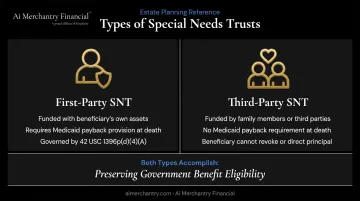
- First-party SNT — holds the beneficiary's own assets; requires a Medicaid payback provision at death under 42 USC 1396p(d)(4)(A)
- Third-party SNT — holds assets contributed by family members; no payback requirement if the beneficiary cannot revoke the trust or direct principal for support
Best suited for: Families supporting a dependent with a long-term disability who relies on government assistance. Failing to plan properly can inadvertently cost a beneficiary their eligibility entirely.
Charitable Trust
A charitable trust allows the grantor to donate assets to one or more charitable organizations in a tax-efficient way. Two common structures:
| Trust Type | Income Flow |
|---|---|
| Charitable Remainder Trust (CRT) | Pays income to the grantor during their lifetime; remaining assets pass to charity at death |
| Charitable Lead Trust (CLT) | Directs income to charity first; remaining assets then pass to family beneficiaries |
Under IRC Section 664, a CRT must pay noncharitable beneficiaries at least 5% and no more than 50% annually, with the actuarial charitable remainder worth at least 10% of initial trust value.
CRTs are generally income-tax exempt, so selling appreciated assets inside the trust doesn't trigger immediate capital gains tax — though income does carry out to beneficiaries under statutory tiers over time.
Best suited for: Philanthropically inclined individuals with significant appreciated assets who want income, a charitable deduction, and an estate tax reduction strategy simultaneously.
Spendthrift Trust
A spendthrift trust protects a beneficiary from their own financial decisions, or from outside creditors. Assets are distributed on a schedule or under conditions the grantor sets, and the beneficiary cannot pledge trust assets as collateral or demand lump-sum distributions.
Protection has limits: it generally ends once funds are actually paid to the beneficiary, and statutory exception creditors may still have access depending on state law.
This structure is particularly useful when a beneficiary — due to age, financial habits, addiction, or other vulnerabilities — may mismanage an inheritance or be targeted by creditors.
Generation-Skipping Trust
A generation-skipping trust (GST) transfers assets directly to grandchildren or beneficiaries at least 37.5 years younger than the grantor, bypassing the children's generation. The goal is to avoid estate taxes being levied twice — once at the children's level and again when assets pass to grandchildren.
Current exemption amounts:
- 2024: $13.61M
- 2025: $13.99M
- 2026: $15M (per IRS guidance following Public Law 119-21)
Best suited for: High-net-worth families focused on preserving multigenerational wealth. GST planning requires careful coordination with a tax professional given the complexity of the generation-skipping transfer tax rules.
How to Choose the Right Trust for Your Situation
There's no universal "best" trust. The right structure depends on the intersection of your assets, family dynamics, tax exposure, timeline, and legacy goals. Many comprehensive estate plans incorporate more than one trust type.
Start With These Questions
- Do you want to retain control of assets during your lifetime? → Revocable living trust
- Is asset protection or estate tax reduction the priority? → Irrevocable trust structure
- Do you have a beneficiary with a disability relying on government benefits? → Special needs trust
- Is charitable giving part of your legacy? → Charitable remainder or lead trust
- Are you concerned about a financially vulnerable beneficiary? → Spendthrift trust
- Do you want to preserve wealth for grandchildren while reducing transfer taxes? → Generation-skipping trust

Consider Estate Size
For smaller or simpler estates, a revocable living trust paired with a will often provides sufficient protection and flexibility. As estate values approach or exceed the federal exemption thresholds — $13.99M in 2025 and $15M in 2026 — irrevocable structures become increasingly relevant for tax planning purposes. That said, the exemption thresholds aren't the only trigger: probate avoidance, incapacity planning, creditor protection, and beneficiary circumstances matter at much lower wealth levels.
Get the Right Team Involved
Trust selection isn't a decision to make alone. It requires coordination among:
- An estate planning attorney to draft and properly structure the document
- A financial advisor to align the trust with your broader wealth plan
- A CPA to model the tax implications before and after funding
Ai Merchantry Financial's Collaborative Planning Network™ connects individuals with estate planning attorneys, financial strategists, and tax professionals to work through these decisions together.
That same advisory team plays a role beyond the initial setup. Marriage, divorce, births, significant asset changes, and shifts in tax law can all alter whether your current structure still fits — making periodic reviews a necessary part of any sound estate plan.
Common Mistakes to Avoid
Even a well-chosen trust can fall short when common execution errors go unaddressed. These three mistakes account for most of the problems people encounter:
1. Choosing based on familiarity instead of fit Revocable living trusts are widely known and frequently recommended, but they provide no asset protection and no estate tax benefit. If your primary goal is either of those, selecting the most familiar option is a costly mismatch.
2. Failing to fund the trust A trust document without assets transferred into it offers no real protection. Property must be re-titled into the trust's name, and beneficiary designations on accounts must be updated accordingly. Unfunded assets still go through probate or follow their beneficiary designation, as if the trust never existed.
3. Underestimating permanence and ongoing costs Irrevocable trusts are difficult to change. Entering one without fully understanding the implications of giving up control can create serious problems later.
Specialized trusts also carry ongoing administrative costs, compliance requirements, and annual filings — all of which should be factored into the decision before funding.
Frequently Asked Questions
What is the best trust for estate planning?
There's no single best trust — it depends on your goals. Revocable living trusts are commonly favored for probate avoidance and flexibility, while irrevocable trusts are preferred when asset protection or estate tax reduction is the priority. Many plans use both.
What are the 4 types of trusts?
Trusts are primarily categorized as revocable, irrevocable, and testamentary. A commonly referenced fourth type is the "living trust" — a revocable trust created during the grantor's lifetime. Specialized trusts such as special needs, charitable, and GST trusts are often treated as distinct categories in comprehensive estate plans.
What is the 5% rule for trusts?
The 5% rule refers to a requirement in Charitable Remainder Trusts: under IRC Section 664, the annual payout to noncharitable beneficiaries must be at least 5% of the trust's initial fair market value. The IRS also requires the charitable remainder to be worth at least 10% of the initial value.
What is the difference between a revocable and irrevocable trust?
A revocable trust can be changed or terminated by the grantor at any time during their lifetime. An irrevocable trust generally cannot be modified once established. In exchange for giving up that flexibility, irrevocable trusts can offer greater asset protection and potential estate tax benefits.
Do I need a trust if I already have a will?
A will and a trust serve complementary but different purposes. A will goes through probate and becomes public record; a trust transfers assets directly to beneficiaries without court involvement. Most estate planners recommend having both as part of a complete plan.
How much does it cost to set up a trust?
Costs vary based on complexity and location. According to the National Council on Aging, a living trust or trust package typically runs $1,000–$4,000, with a full attorney-assisted estate plan often ranging from $2,000–$5,000+.