This scenario plays out thousands of times each year, and it happens across all income levels. Estate planning isn't a wealthy person's exercise — it's a practical necessity for anyone with a bank account, a child, a home, or a preference about their own medical care.
Yet the delays are common. "I'm too young." "I don't have enough to worry about." "I'll get to it eventually." According to Caring.com's 2024 Wills and Estate Planning Study, 68% of U.S. adults don't have a will — and 40% of those without one say they simply don't think they have enough assets to warrant one.
This article cuts through those misconceptions by walking through what estate planning actually does, what's genuinely at stake, and why the benefits matter regardless of your wealth or life stage.
Key Takeaways
- 68% of Americans lack a will, leaving courts — not families — to decide what happens to their assets
- Estate planning covers incapacity too, not just death
- Probate is public, slow, and costly; proper planning can bypass it entirely
- Unmarried partners, stepchildren, and blended families are especially vulnerable without a plan
- Regular reviews matter as much as the initial documents
What Is Estate Planning?
Estate planning is the process of creating legally binding documents that direct what happens to your assets, your dependents, and your healthcare decisions — both during incapacity and after death.
Most people underestimate what counts as their "estate." Per IRS guidelines, your gross estate includes:
- Real estate and vehicles
- Bank accounts, retirement funds, and investment accounts
- Life insurance policies
- Jointly owned property
- Business interests and personal property
- Digital assets — email accounts, domain names, electronic files
If you have a checking account and a dependent, you have an estate worth planning for. That's what estate planning is really about: deciding who receives your assets, who makes decisions if you can't, and what your legacy ultimately reflects.
Key Benefits of Estate Planning
Benefit 1: Protecting Your Loved Ones and Honoring Your Wishes
Without a will or estate plan, state intestacy law determines where your assets go using a fixed formula that prioritizes legal relatives. That formula doesn't account for your actual relationships.
Who gets left out under default law:
- Unmarried partners (regardless of relationship length)
- Unadopted stepchildren
- Close friends
- Charities you care about
Nolo's intestacy guide confirms that unmarried partners and friends typically receive nothing under state intestacy rules. That outcome isn't hypothetical — it's the default if you don't act.
Guardianship: Courts Decide Without You
For parents with minor children, this is where the stakes get personal. A will lets you formally nominate a guardian whose values, parenting style, and relationship with your children you trust. Courts in states like Texas and New York are directed to honor that designation unless there's a compelling reason not to.
Without it, a judge decides. They won't know your preferences, your family dynamics, or your concerns about specific relatives.
Who this benefit protects most:
- Parents with minor children
- Individuals in blended or non-traditional families
- Anyone supporting a dependent with special needs
- People in unmarried partnerships
A clear estate plan protects assets and prevents the kind of ambiguity that turns grief into litigation.
Benefit 2: Minimizing Taxes and Avoiding Probate
The Probate Problem
Probate is the court-supervised process of validating a will and distributing assets. It's public record, it takes time, and it costs money.
The American Bar Association reports an average of 6–9 months for probate completion. California Courts puts formal probate at 9–18 months for uncontested cases alone. Add disputes, and timelines extend further.
California's statutory attorney compensation schedule illustrates the cost structure: 4% of the first $100,000, 3% of the next $100,000, 2% of the next $800,000 before filing fees, appraisals, and publications.
How to Avoid It
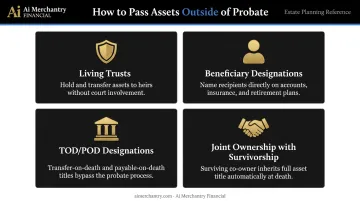
Several tools allow assets to pass directly to heirs, outside of probate entirely:
- Living trusts — assets in a properly funded trust don't go through probate
- Beneficiary designations — retirement accounts and life insurance with named beneficiaries transfer directly
- Transfer-on-death (TOD) and payable-on-death (POD) designations — bank and investment accounts can be structured to pass automatically
- Joint ownership with survivorship rights — property passes directly to the surviving owner
Speed and cost aren't the only advantages. Wills become public record once admitted to probate; a properly funded trust remains private.
Tax Considerations
The federal estate tax exemption sits at $13.99 million in 2025, rising to $15 million in 2026 under Public Law 119-21. Most estates won't hit that threshold.
State-level exposure starts much lower. Oregon's threshold is $1 million. Massachusetts kicks in at $2 million. When you add home equity, retirement accounts, and life insurance together, a $1.5 million estate can cross state thresholds without anyone in the family realizing it.
Tools like irrevocable trusts, annual gifting strategies, and charitable vehicles can reduce taxable estate value legally and substantially, for families at various wealth levels.
Outcomes this benefit protects:
- Wealth preservation
- Speed of asset transfer
- Privacy from public probate records
- Reduced legal fees
- State and federal estate tax savings
Benefit 3: Preparing for Incapacity — Not Just Death
Estate planning isn't only about what happens after you die. It addresses what happens if you can't make decisions for yourself due to illness, an accident, or cognitive decline.
Two documents govern this:
- Durable financial power of attorney — designates someone to manage your finances, pay bills, and handle accounts if you're incapacitated
- Healthcare power of attorney / advance directive — designates someone to make medical decisions and documents your end-of-life care preferences
Without these documents, even a spouse may face legal barriers to accessing accounts or authorizing treatment. Families in that situation must seek court-appointed guardianship or conservatorship — a costly, time-consuming process during an already difficult moment.
The Gap Is Significant
A University of Michigan national poll of adults ages 50–80 found that 54% lacked both a medical durable power of attorney and an advance directive. Among those without either document, 62% said they simply hadn't gotten around to it.
The Social Security Administration notes that a 20-year-old worker has a 1-in-4 chance of becoming disabled before reaching retirement age. Incapacity isn't a senior issue ; it can happen at any stage of life.
Outcomes this benefit protects:
- Continuity of financial management during incapacity
- Clear medical decision authority
- Protection against unwanted medical interventions
- Family harmony during a health crisis
- Avoidance of court-appointed guardianship
Who needs this most: Seniors, pre-retirees, business owners with ongoing financial obligations, individuals with complex medical histories, and anyone living far from immediate family.
What Happens When Estate Planning Is Ignored
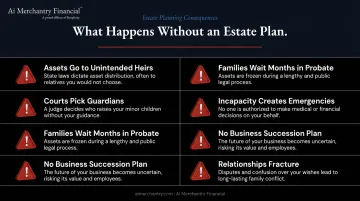
The consequences aren't hypothetical — they're predictable. Here's what skipping an estate plan actually produces:
- Assets go to unintended heirs. State intestacy law distributes property based on legal relationships, not your wishes, leaving out unmarried partners, stepchildren, and charities entirely.
- Courts pick guardians for your children. Without a written nomination, a judge decides who raises your kids without knowing anything about your preferences or family dynamics.
- Families wait months in probate. Even uncontested cases take 6–18 months. Legal fees and court costs reduce what heirs eventually receive.
- Incapacity creates emergencies. Without healthcare and financial directives, families must initiate court proceedings to gain any legal authority, often in the middle of a crisis.
- Business owners leave no clear succession plan. PwC's 2025 U.S. Family Business Survey found succession planning affected 44% of U.S. family firms in the prior year. Without a plan, ownership disputes and operational disruption follow a founder's unexpected death.
- Relationships fracture. Ambiguity, unequal distributions, and legal chaos compound grief. What could have been a clear process becomes a prolonged conflict.
How to Get the Most Value from Your Estate Plan
An estate plan built in isolation — a will drafted without reviewing beneficiary designations, or a trust funded without coordinating tax implications — leaves gaps. The most effective estate plans are built collaboratively.
Ai Merchantry Financial's Collaborative Planning Network™ connects individuals, families, and business owners with vetted attorneys, CPAs, and financial strategists who work across disciplines. Estate planning, life insurance, tax strategy, and legacy planning are treated as integrated components of a single coordinated plan.
Three conditions under which an estate plan delivers maximum value:
Regular reviews — Estate plans should be revisited after marriage, divorce, the birth of a child, a significant change in assets, or a move to a different state (each state has its own estate and inheritance tax rules).
Document coordination — Beneficiary designations on retirement accounts and insurance policies must align with the will and trust. Contradictions between documents get resolved by courts, not families.
Full scope coverage — A plan that addresses only asset distribution leaves incapacity planning undone. Both dimensions — death and disability — need to be covered.
Whether you're a young parent, a business owner planning an exit, or a retiree managing a complex asset picture, a coordinated estate plan builds lasting value over time. Taxes get minimized, probate gets avoided, and the decisions that matter most get made before a crisis forces someone else to make them for you.
Frequently Asked Questions
What is an advantage of having an estate plan?
The most immediate advantage is control: your assets go to the people and causes you choose, rather than being distributed by state law. A properly structured plan also helps your family avoid costly, time-consuming probate proceedings after your death.
Who benefits most from estate planning?
Estate planning benefits people across all income levels and life stages, but it's especially critical for parents with minor children, business owners, individuals in blended or non-traditional families, seniors, and anyone with assets or dependents they want to protect.
What is the 5 by 5 rule in estate planning?
The 5 by 5 rule is a trust provision that allows a beneficiary to withdraw the greater of $5,000 or 5% of the trust's value per year. Under IRC Section 2514(e), lapsed amounts within this limit aren't treated as taxable releases of a general power. This keeps assets outside the beneficiary's taxable estate while still providing annual access to funds.
Is estate planning only for the wealthy?
Far from it. Anyone with a bank account, a vehicle, a retirement fund, or dependents has an estate worth planning for. The tools vary by situation, but the need doesn't disappear below any particular net worth threshold.
When should you start estate planning?
Now, regardless of age. Marriage, children, a home purchase, or a new business are natural prompts, but waiting for one of those triggers is a gamble. Incapacity can happen at any life stage. The documents that protect you while you're living matter just as much as those that distribute your assets after death.
What happens if you die without an estate plan?
Dying without an estate plan means state intestacy law decides who receives your assets — potentially excluding intended beneficiaries. Courts determine guardianship of your children, and your family may face a lengthy, expensive probate process with outcomes that don't reflect your wishes.