

Most business owners don't think about this scenario until it's already unfolding. Yet without a buy-sell agreement in place, this is exactly the kind of disruption that can unravel a business built over decades.
A buy-sell agreement is the legal and financial safety net that keeps your business intact when the unexpected happens. It determines who can buy a departing owner's interest, at what price, and how that purchase gets funded — before any crisis forces those questions under pressure.
This guide covers what buy-sell agreements are, what happens without one, the four main structures, what your agreement must include, how to fund it, and how to create one with the right professional team.
Key Takeaways
- A buy-sell agreement is a legally binding contract governing ownership transfers when a triggering event — death, disability, divorce, or retirement — occurs
- Without one, ownership can pass to unintended parties like a deceased partner's heirs, separating economic rights from management control
- The four main types are cross-purchase, entity-purchase (redemption), hybrid, and wait-and-see — each with different tax implications
- Life insurance is the most common funding mechanism, delivering immediate liquidity when an owner dies
- A sound agreement requires an attorney, CPA, valuation professional, and insurance advisor working together as a coordinated team
What Is a Buy-Sell Agreement and Who Needs One?
Think of a buy-sell agreement as a business prenuptial agreement. It's a legally binding contract between co-owners that answers three critical questions before a crisis forces the issue:
- Who can purchase a departing owner's interest?
- Under what circumstances does the purchase obligation trigger?
- At what price does the transaction occur?
AICPA's The Tax Adviser defines it as a contract that restricts owners from freely transferring their interests and establishes how an interest will be transferred when a specified event occurs — with death, disability, retirement, and divorce among the most common triggers.
Who Should Have One?
Any business with more than one owner needs a buy-sell agreement — regardless of size, industry, or how well the partners get along today. This includes:
- Partnerships (general and limited)
- Closely held corporations (C-corps and S-corps)
- Multi-member LLCs
- Professional practices (medical groups, law firms, accounting practices)
The IRS reported over 4.5 million partnership returns for tax year 2022, representing nearly 28.8 million partners. LLCs accounted for 72.7% of those partnership returns. That's an enormous pool of co-owned businesses — most of which have no formal plan for what happens when an owner exits, voluntarily or otherwise. Waiting until a dispute or health event forces the conversation is far more costly than addressing it at formation.
What Happens to Your Business Without a Buy-Sell Agreement?
The consequences of operating without one are well-documented and serious.
The American Bar Association explains that when an LLC member dies, absent contrary governing provisions, the member's interest splits in a problematic way: economic rights pass to the estate, while management rights terminate. The estate is treated as a transferee — not a member — leaving it without management authority or dissolution rights.
Surviving owners can end up sharing business economics with someone who has no operational role, no expertise, and no stake in the company's future.
The Real Risks
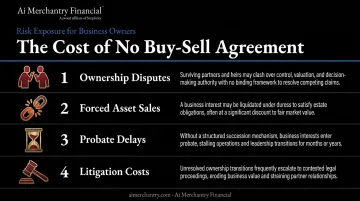
Operating without a buy-sell agreement exposes your business to:
- Ownership disputes — heirs or a surviving spouse may claim rights to the business with no clear resolution mechanism
- Forced asset sales — remaining owners may need to sell business assets or take on costly debt just to regain control
- Probate delays — court proceedings can freeze business decisions for months while operations continue
- Litigation costs — without pre-agreed valuation terms, disputes over what the business is worth often end up in court, draining both money and management attention
These aren't edge cases. A buy-sell agreement is the legal mechanism that prevents a business dispute from becoming a business-ending event — and creating one before a triggering event occurs is the only way it actually works.
The Four Types of Buy-Sell Agreements
Choosing the right structure affects who holds the insurance policies, who gets the tax benefits, and how smoothly the transition executes. The table below provides a quick overview; the breakdowns that follow explain each structure in detail.
| Agreement Type | Who Buys the Interest | Insurance Owner | Best For |
|---|---|---|---|
| Cross-Purchase | Surviving owners | Each individual owner | 2–4 owners |
| Entity-Purchase (Redemption) | The business entity | The company | 5+ owners |
| Hybrid | Entity first, then owners | Both | Mid-sized partnerships |
| Wait-and-See | Determined at trigger event | Flexible | Variable circumstances |
Cross-Purchase Agreements
Each owner purchases a life insurance policy on the other owners. When a triggering event occurs, the surviving owners buy the departing owner's interest directly using those insurance proceeds.
Key advantage: Surviving partners receive cost basis in the interests they purchase, which can reduce capital gains taxes if they later sell their shares. As IRS Publication 551 states, the basis of property you buy is generally its cost — meaning each purchased interest establishes a new, higher basis for the buyer.
This structure works best for small businesses with two to four owners. With more owners, the number of required policies grows quickly — three owners already require six policies — making administration increasingly complex.
Entity-Purchase (Redemption) Agreements
The business entity itself purchases the departing owner's interest using company-owned life insurance policies — one per owner. This simplifies administration since the company manages all policies centrally.
Key limitation: As AICPA's Tax Adviser notes, surviving owners generally receive no corresponding increase in the basis of their existing interests when the entity makes the purchase. Talk through this tax distinction with your CPA before choosing this structure.
For businesses with five or more owners, this approach is typically more practical than managing individual cross-purchase policies.
Hybrid Agreements
A hybrid combines both approaches. The departing owner first offers the interest to the entity. If the entity cannot or declines to purchase, the remaining owners step in. This flexibility makes hybrid agreements popular for mid-sized partnerships where circumstances at the time of a triggering event may vary.
Wait-and-See Agreements
Neither the entity nor individual partners are locked into a purchaser role at the time of signing. Instead, the agreement grants purchase options or obligations in a specified sequence, with the final determination made when a triggering event actually occurs — based on whatever structure is most advantageous at that time.
Some advisors also structure a separate Insurance LLC — an entity established specifically to own life insurance policies on the business owners. This advanced post-Connelly planning strategy, recognized by the National Association of Estate Planners & Councils, requires specialized legal and financial guidance to implement correctly.
What Your Buy-Sell Agreement Must Include
A poorly drafted buy-sell agreement invites the same disputes it was designed to prevent. Vague language leaves gaps, and gaps become courtrooms. Every agreement must clearly address these five elements:
1. All owners and their equity stakes Identify every owner and their exact percentage of ownership. No ambiguity about who is party to the arrangement.
2. Triggering events The specific circumstances that activate the buyout obligation. Common triggers include:
- Death
- Permanent disability
- Divorce
- Bankruptcy or insolvency
- Retirement or voluntary resignation
- Loss of a professional license
Vague trigger definitions create legal loopholes — define each event with precise, enforceable language.
3. Business valuation method The agreement must specify how the purchase price is determined. How you price the buyout matters as much as the trigger itself. Three methods are most common:
| Method | How It Works | Key Consideration |
|---|---|---|
| Fixed price | Owners agree on a set value at signing | Must be updated regularly or it becomes outdated |
| Independent appraisal | A qualified valuator determines value at the time of the triggering event | Most accurate, but slower and more costly |
| Formula approach | Based on financial metrics like book value or an earnings multiple | Flexible, but should evolve as the business grows |
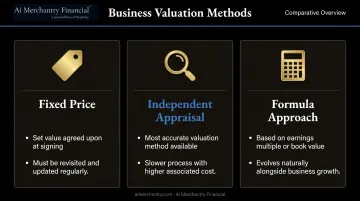
A fixed price set at signing can become inappropriate as the business grows — which is why most financial professionals recommend revisiting the valuation clause every 1-2 years. Agreements can also assign different valuations to different triggers: a bankruptcy buyout, for example, might yield a lower price than a death buyout.
4. Funding mechanism The agreement must specify how the buyout will be financed. Options include life insurance, installment payments, cash reserves, or bank loans — each with distinct cost, tax, and timing trade-offs.
5. Tax and estate planning provisions Both the purchase structure and the funding mechanism carry tax consequences for buying and selling parties. Estate planning attorneys should review these provisions carefully before you sign.
How to Fund Your Buy-Sell Agreement
The best-drafted agreement means nothing without the money to execute it. Choosing the right funding mechanism — and structuring it correctly — is just as important as the agreement itself.
Life Insurance
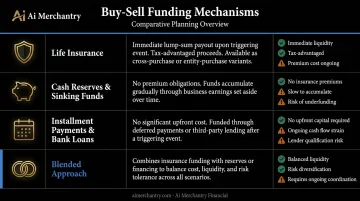
Life insurance delivers an immediate, tax-advantaged lump sum precisely when it's needed — at an owner's death. It's the most frequently recommended funding mechanism for buy-sell agreements for this reason.
- In cross-purchase arrangements, surviving partners own and are the beneficiaries of policies on each other
- In entity-purchase arrangements, the company owns one policy per owner and is the beneficiary
- For disability-triggered buyouts, ordinary life insurance doesn't apply — disability buyout insurance is a separate product designed specifically for this purpose
Cash Reserves and Sinking Funds
Some businesses set aside dedicated cash over time to fund future buyouts.
- Pro: No insurance premiums
- Con: Takes time to accumulate, reduces operating capital, and a buyout event may occur before adequate funds are built up
Installment Payments and Bank Loans
The buyout price is paid in scheduled payments over an agreed period (often five to ten years), or the business borrows funds at the time of the triggering event.
- Pro: No large upfront cost
- Con: Strain on ongoing cash flow; loan interest adds to total cost; the seller's estate is exposed to the buyer's future ability to pay
The Blended Approach
Because each method has limitations, many businesses combine them — using life insurance to cover the initial payout and installment payments to fund any remaining balance. The right mix depends on owner ages, health, business size, and existing coverage.
Getting that mix right typically requires input from insurance professionals, financial strategists, and sometimes legal counsel working together. Ai Merchantry Financial's Collaborative Planning Network connects business owners with that kind of coordinated advisory support — so funding decisions reflect your actual situation, not a generic template.
How to Create a Buy-Sell Agreement: A Step-by-Step Guide
Step 1 — Assemble the Right Advisory Team
Buy-sell agreements sit at the intersection of law, tax, finance, and insurance. No single advisor can cover all of it. You need:
- An attorney — to draft legally sound language and ensure the agreement is enforceable
- **A CPA or tax advisor** — to address the tax implications of the structure and funding mechanism
- A business valuation professional — to establish a fair, defensible value for the business
- An insurance advisor — to structure the funding mechanism and place appropriate policies
These professionals must work collaboratively, not in silos. When they don't communicate, gaps appear — and gaps become disputes later. Ai Merchantry Financial's Collaborative Planning Network™ connects business owners with attorneys, CPAs, valuation professionals, and insurance advisors who coordinate directly — so nothing falls through the cracks.
Step 2 — Agree on Key Terms Before Drafting
The attorney can't draft what the owners haven't agreed on. Before a single word of legal language is written, co-owners must reach consensus on:
- Which triggering events the agreement will cover
- Which valuation method applies (and whether different triggers carry different prices)
- How the buyout will be funded
- Which structure — cross-purchase, entity-purchase, or hybrid — fits the ownership situation
This negotiation phase can take weeks or months. Hard conversations about death, disability, and forced buyouts are uncomfortable — but owners who skip them often discover their disagreements in court rather than at the conference table.
Step 3 — Execute, Fund, and Review Regularly
Once the agreement is signed, activate the funding mechanism immediately. If life insurance is the vehicle, apply for policies right away — health conditions can change, and coverage becomes harder or more expensive to obtain over time.
Schedule a review whenever any of the following occur:
- Addition or departure of an owner
- Significant increase in business value
- Material change in an owner's health
- Relevant changes in federal or state tax law
- Major shifts in business structure or revenue
Those triggers aren't just administrative checkboxes. The AICPA recommends periodic re-evaluation of both the valuation clause and insurance coverage amounts to keep them aligned with the business's current reality. An agreement written five years ago for a $2 million business may be dangerously inadequate for a $7 million business today.
Frequently Asked Questions
What is a buy-sell agreement?
A buy-sell agreement is a legally binding contract between co-owners that specifies what happens to an owner's business interest when a triggering event — death, disability, retirement, divorce — occurs. It defines who buys the interest, at what price, and how the purchase is funded.
What are the four types of buy-sell agreements?
The four types are cross-purchase, entity-purchase (redemption), hybrid, and wait-and-see. The core distinction is who buys the departing owner's interest — individual co-owners, the business entity, or a combination of both.
Who is the beneficiary of a buy-sell agreement?
It depends on the structure. In cross-purchase agreements, surviving owners are the policy beneficiaries; in entity-purchase agreements, the business is. Either way, proceeds fund the buyout of the deceased owner's interest from their estate.
How much does a buy-sell agreement cost to create?
Costs vary based on business complexity, number of owners, and whether an attorney drafts from scratch or works from a template. Ongoing costs include insurance premiums and periodic review fees to keep valuation and funding levels current.
How often should a buy-sell agreement be updated?
Review your agreement after any major business change — a new owner, significant revenue growth, a change in an owner's health, or a relevant shift in tax law. At a minimum, schedule a periodic review with your advisory team to confirm the valuation provisions and funding levels still reflect your business's current reality.