
Introduction
According to Allianz Life's 2025 Annual Retirement Study, 64% of Americans worry more about running out of money than dying. For most people, that's not abstract worry — it's a real question about whether a lifetime of work will actually be enough.
The math behind that fear makes sense. People are living longer. Traditional pensions have nearly vanished from the private sector. Markets swing wildly. And Social Security, while valuable, was never designed to carry the full weight of someone's retirement.
Millions of Americans reach retirement with a 401(k) balance, a Social Security card, and no clear plan for turning those assets into income that lasts 20, 30, or even 40 years.
This guide breaks down what guaranteed retirement income actually means and the four primary sources that provide it. You'll also learn why a 401(k) alone isn't enough, and how to build a layered plan that holds up no matter how long you live.
Key Takeaways
- Guaranteed retirement income comes from specific sources — Social Security, pensions, annuities, and whole life insurance — not from investment accounts alone
- Most retirees need to replace roughly 75–80% of pre-retirement income; Social Security covers only about 40% for average earners
- Unlike a 401(k), guaranteed income sources are designed to pay for as long as you live — your account balance can't run out
- Building a guaranteed income "floor" frees up remaining assets to pursue growth without risking your core living expenses
- The earlier you layer multiple income sources together, the more resilient your retirement becomes
What Is Guaranteed Retirement Income?
Guaranteed retirement income refers to income streams that deliver consistent, predictable payments regardless of market conditions or how long you live. The key distinction: it's not a savings balance you draw down — it's income that keeps coming, whether markets crash or you live to 100.
The Income Floor Concept
Financial planners often describe this as building an "income floor" — a base layer of guaranteed income that covers all essential monthly expenses before you touch a single dollar from investment accounts.
The floor covers:
- Housing costs (mortgage, rent, property taxes)
- Food and utilities
- Healthcare premiums and out-of-pocket costs
- Transportation and basic living expenses
Once essential needs are funded by guaranteed sources, investment accounts can be reserved for discretionary spending, travel, or legacy goals — without the constant anxiety of market swings threatening those essential expenses.
Why This Matters More Now
The retirement landscape has shifted dramatically over the past four decades. Private-sector pensions have nearly disappeared. According to the Bureau of Labor Statistics, only 14% of private-industry workers had access to a defined benefit plan as of March 2025 — down from roughly 38% in the mid-1980s.
That shift puts enormous pressure on the remaining pillars. Social Security faces long-term financing uncertainty, and self-directed accounts like 401(k)s — now the default retirement vehicle — offer no guarantee on how much income they'll actually produce.
The Four Main Sources of Guaranteed Retirement Income
No single source covers everything. The strongest retirement income plans combine multiple guaranteed streams, each filling a different role.
Social Security
Social Security is the most widely available guaranteed income source. Benefits are calculated based on your work history, lifetime earnings, and the age at which you claim — and once claimed, they continue for life with annual cost-of-living adjustments.
The timing decision matters enormously. For workers born in 1960 or later, full retirement age (FRA) is 67. Claiming early or late changes your monthly benefit significantly:
| Claiming Age | Benefit as % of FRA Amount |
|---|---|
| 62 | 70% |
| 65 | 86.7% |
| 67 (FRA) | 100% |
| 70 | 124% |
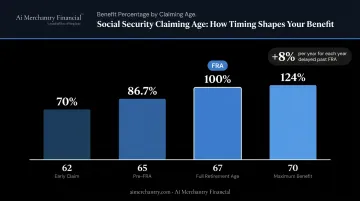
Waiting past FRA adds 8% per year through age 70. That's a permanent increase, not a temporary bonus.
One important reality check: Social Security was designed to supplement retirement income, not replace it. SSA actuarial data shows that a scaled-medium earner claiming at FRA replaces roughly 42.6% of career-average earnings. For higher earners, it's closer to 28%. That gap has to come from somewhere else.
Pensions (Defined Benefit Plans)
Social Security alone won't close that gap. For some workers, a pension does.
A pension pays a fixed monthly amount for life, based on your salary history and years of service. Market conditions don't affect the payment.
The problem: pensions are rare in the private sector. Only 14% of private-industry workers have access to one, compared to 86% of state and local government workers. If you're among the minority with a pension, understanding exactly how it fits into your overall income plan — including survivor benefit options and inflation provisions — deserves careful review.
Annuities
For the majority of workers without pension access, an annuity can fill that role.
An annuity is an insurance contract that converts a lump sum into a guaranteed income stream. Payments continue for life, which directly addresses the risk of outliving your money.
The main types:
- Immediate annuities — You fund it now; income starts within a year
- Deferred annuities — Income begins at a future date; assets grow in the meantime
- Fixed annuities — Insurer credits a stated rate; no market exposure
- Variable annuities — Payments linked to investment performance; more growth potential, less certainty
For the roughly 86% of private-sector workers without pension access, a fixed or immediate annuity can serve as a "personal pension" — a self-funded guaranteed income stream. Many annuities also offer cost-of-living adjustment (COLA) riders, though these typically reduce the starting payment in exchange for inflation protection over time. It's worth noting the scale of adoption: U.S. retail annuity sales reached $434.1 billion in 2024, up 13% year over year, as more Americans seek predictable income outside of market-dependent accounts.
Whole Life Insurance
Whole life insurance builds cash value over time through a combination of premium payments and guaranteed growth. In retirement, that cash value can be accessed through withdrawals or policy loans to supplement other income sources.
A few important considerations:
- Withdrawals up to the amount of premiums paid (your cost basis) are generally not subject to income tax
- Loans from the policy are typically not treated as taxable income, provided the policy remains in force
- Withdrawals and loans reduce both the cash value and the death benefit
- Modified endowment contracts (MECs) carry different tax treatment; consult a tax professional before structuring any strategy
Whole life isn't a monthly income machine on its own. Think of it as a flexible, accessible reserve that complements other guaranteed income sources while simultaneously providing a death benefit.
Why a 401(k) Alone Won't Guarantee Your Retirement Income
A 401(k) is a defined contribution plan. That distinction matters more than most people realize: the plan specifies how much goes in, not how much comes out. Your retirement paycheck depends entirely on market performance, contribution amounts, fees, and timing.
Sequence-of-Returns Risk
This is the 401(k)'s most dangerous vulnerability. If markets drop sharply in the early years of retirement — right when you're making withdrawals — you're selling assets at a loss. The portfolio shrinks faster than normal, and when markets eventually recover, you have less capital to participate in the rebound.
Morningstar's research on sequence risk illustrates why poor early returns are disproportionately damaging compared to the same losses occurring mid-retirement. Guaranteed income sources eliminate this risk entirely — the payment comes regardless of what the market does.
The RMD Problem
At age 73, the IRS requires you to take Required Minimum Distributions (RMDs) from traditional 401(k)s whether you need the money or not. This creates two potential issues:
- Forced withdrawals can push you into a higher tax bracket
- Accelerated drawdowns reduce the account faster than planned
Roth 401(k)s currently have no lifetime RMD requirement, which gives them a tax-planning advantage worth considering.
The Balance vs. Income Problem
Vanguard's 2025 data shows 401(k) participants aged 65 and older have an average balance of $299,442 — but a median of just $95,425. That median balance, withdrawn at Morningstar's 2025 base-case safe withdrawal rate of 3.9%, produces roughly $3,700 per year. That's not retirement income — that's a supplement to a supplement.
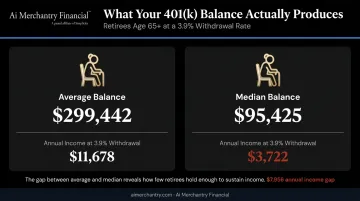
A 401(k) is a powerful accumulation tool — but accumulation alone doesn't create income you can count on. That's where guaranteed income vehicles like annuities, pensions, and Social Security come in, each designed to pay you regardless of what markets do.
How to Build a Guaranteed Income Plan That Lasts a Lifetime
Step 1: Calculate Your Income Floor
Start by adding up essential monthly expenses — housing, food, utilities, healthcare, transportation. This is your target floor. Then identify which guaranteed sources already cover those expenses.
The gap between your floor target and your guaranteed income is where annuities or other products typically step in.
Step 2: Layer Your Sources
Think of it as stacking:
- Social Security — the base, inflation-adjusted, guaranteed for life
- Pension or annuity — fills the income gap between Social Security and your floor
- Whole life cash value or investment accounts — provides flexibility for discretionary spending, healthcare surprises, and legacy goals
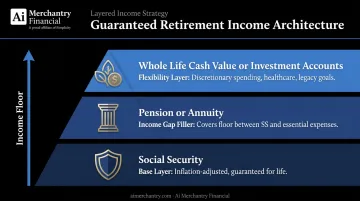
Each layer serves a distinct purpose. The bottom two layers handle necessities. The top layer handles everything else.
Step 3: Optimize Timing and Tax Efficiency
Sequencing matters:
- When to claim Social Security — delaying from 62 to 70 can increase your monthly benefit by 77%
- When to begin annuity income — earlier deferral typically means a higher payout
- Withdrawal order — taxable accounts first, then tax-deferred (401k/IRA), then tax-free (Roth) is a common starting point, though RMDs and bracket management may change the optimal order
Step 4: Plan for Inflation
A fixed-income plan loses purchasing power over time. Address this through:
- Social Security's annual COLA adjustments (2.5% for 2025, 2.8% projected for 2026)
- COLA riders on annuities (at an additional cost)
- Growth-oriented investments in non-guaranteed account layers
Step 5: Work With the Right Team
Each of the steps above touches a different professional discipline. Getting them to work together — not in sequence, not in silos — is what separates a plan that holds from one that doesn't.
A coordinated team typically covers:
- Tax strategy — sequencing withdrawals and managing bracket exposure
- Insurance and annuity contracts — structuring guaranteed income correctly
- Estate planning — ensuring assets transfer efficiently and according to your wishes
- Investment management — aligning growth assets with your income floor and timeline
Ai Merchantry Financial's Collaborative Planning Network™ connects individuals with financial strategists, tax professionals, and estate planning attorneys who work from a shared plan — so nothing falls through the gaps between advisors.
Frequently Asked Questions
How much does a $100,000 annuity pay per month?
It varies based on age, annuity type, payment options, and current interest rates. As a general reference, Blueprint Income's 2025 data shows a 65-year-old male could receive up to approximately $651 per month from a $100,000 immediate annuity — but actual quotes vary by carrier, state, and contract terms. A financial professional can provide a personalized illustration.
How can I get guaranteed income in retirement?
The four main pathways are maximizing Social Security benefits, participating in a pension if available, purchasing an annuity, and accessing whole life insurance cash value. Combining multiple sources creates the most resilient plan — no single source is built to cover everything on its own.
Where can I get a guaranteed 5% return?
The term "guaranteed" depends heavily on the product and current rate environment. Multi-year guaranteed annuities (MYGAs) and fixed annuities may offer competitive fixed rates, but these fluctuate and are tied to specific terms and surrender periods. Consult a financial professional before committing to any product based on a rate alone.
Is Social Security enough to live on in retirement?
For most people, no. Social Security was designed to supplement other income, replacing roughly 42% of career-average earnings for average earners — and less for higher earners. A complete retirement plan requires additional guaranteed income sources alongside Social Security.
What is the difference between an annuity and a pension?
A pension is employer-provided, based on years of service and salary. An annuity is a product you purchase from an insurance company. Both provide guaranteed lifetime income, but annuities offer more control over timing, contribution amount, and features, making them accessible to anyone regardless of employer coverage.
At what age should I start planning for guaranteed retirement income?
As early as possible. Decisions like when to claim Social Security, whether to purchase an annuity, and how to structure savings all carry greater impact the earlier they're made. It's also never too late to review and strengthen a plan, even after retirement has already begun.