

Introduction
Picture this: a 47-year-old passes unexpectedly without a will. Their spouse spends the next 14 months navigating probate court, paying thousands in legal fees, and watching family members dispute who gets what. None of it reflects what the deceased would have wanted — and none of it had to happen.
This isn't a rare story. According to Caring.com's 2025 study, **56% of Americans don't have a will or living trust**. That gap leaves families exposed to court delays, unintended asset distribution, and decisions made by strangers in robes.
That exposure doesn't discriminate by age or income. If you're over 18 with a bank account, a car, a child, or a healthcare preference, you have something worth protecting. This guide walks you through:
- The core documents every estate plan needs
- How to build your plan step by step
- Key tax strategies to preserve what you've built
- Mistakes most people don't catch until it's too late
Key Takeaways
- Estate planning organizes how your assets and affairs are managed during incapacity and after death.
- A complete plan includes a will, trusts, powers of attorney, and healthcare directives — not just one document.
- Anyone over 18 benefits from having a plan, regardless of wealth level.
- Review your plan every 3–5 years and after every major life event.
- Working with legal, financial, and tax professionals together — not separately — leads to a plan that actually holds up.
What Is Estate Planning and Why Everyone Needs One
Estate planning is the legal and financial process of organizing your assets, naming who receives them, appointing decision-makers, and documenting your healthcare wishes — for both incapacity and death. It covers far more than money: guardianship of minor children, medical preferences, digital accounts, and the legacy you leave behind.
The misconception that estate planning is only for the wealthy keeps too many people unprepared. Anyone who owns anything, owes anything, or cares about anyone has a stake in this process.
A Will Is Not an Estate Plan
This distinction matters. A will is one component of a complete estate plan — not the whole thing. A thorough plan typically includes:
- A last will and testament that directs asset distribution and names guardians for minor children
- A trust that manages assets during life and after death, often bypassing the probate process
- A financial power of attorney authorizing someone to handle your finances if you're incapacitated
- A healthcare directive or proxy that documents medical wishes and names a decision-maker
- Beneficiary designations that route specific accounts to named individuals outside of probate
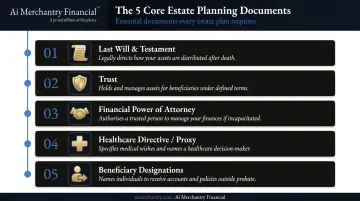
These documents work together. A gap in any one of them can unravel the others — and the most common gap is no will at all.
Without a valid will, state intestate succession laws take over. In New York, for example, a surviving spouse receives the first $50,000 plus half the remaining estate — the children split the rest. That may not be what you'd choose, but the state doesn't ask.
Key Estate Planning Documents You Need
Last Will and Testament
A will is a legally binding document that specifies how your assets are distributed after death, who cares for minor children, and who serves as executor. Without one, the court appoints an administrator and applies state intestate succession rules — outcomes that rarely match personal wishes.
Wills go through probate, the formal court process that validates the document and oversees asset distribution. In California, formal probate typically takes 9–18 months, with administration costs often exceeding $1,000 before attorney and executor fees.
Trusts
A trust is a legal arrangement where a trustee holds and manages assets for beneficiaries. The two most common types are:
| Trust Type | Key Feature | Primary Benefit |
|---|---|---|
| Revocable Living Trust | Can be changed during your lifetime | Avoids probate; provides continuity during incapacity |
| Irrevocable Trust | Cannot generally be changed once created | Asset protection; reduces taxable estate |
A revocable trust doesn't reduce estate taxes on its own — but it keeps assets out of probate court and can significantly simplify administration for your family.
Beyond asset management, two legal documents determine who makes decisions on your behalf if you become incapacitated.
Powers of Attorney
- Financial Durable Power of Attorney — designates someone to manage your financial affairs (paying bills, managing investments, filing taxes) if you become incapacitated. "Durable" means it stays in effect even if you lose mental capacity; without it, your family may need court-ordered guardianship to act on your behalf.
- Healthcare Power of Attorney (Healthcare Proxy) — appoints a trusted person to make medical decisions when you cannot. Choose someone who genuinely understands your values, not just someone geographically convenient — they may face enormous pressure in a crisis.
Advance Healthcare Directives and Living Wills
These documents record your specific treatment preferences — life support, CPR, artificial nutrition — for situations where you can't communicate them yourself.
Three terms get confused regularly:
- Living will — your written instructions about specific medical treatments
- Healthcare proxy — the person authorized to make medical decisions for you
- Advance healthcare directive (AHCD) — an umbrella term that often combines both
State-specific rules govern names, forms, and execution requirements. What's called a "healthcare proxy" in New York may be a "healthcare surrogate" in Florida.
Beneficiary Designations
Life insurance policies, 401(k)s, and IRAs transfer assets directly to named beneficiaries — bypassing the will entirely. This is powerful when designations are current, and dangerous when they're not.
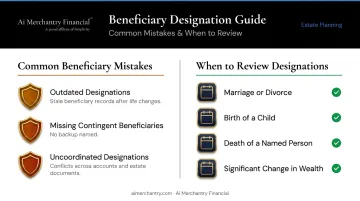
As the ABA has noted, uncoordinated beneficiary designations can interfere with or render ineffective the provisions of a carefully drafted will or trust. Common problems include:
- Outdated designations — naming a deceased parent or ex-spouse can redirect assets regardless of what your will says
- Missing contingent beneficiaries — if your primary beneficiary predeceases you and no backup is named, assets may pass through probate anyway
- Uncoordinated designations — a beneficiary form that conflicts with your trust or will creates confusion and potential legal disputes
Review beneficiary designations whenever you experience a major life change: marriage, divorce, a death in the family, or the birth of a child.
How to Create Your Estate Plan: Step by Step
Step 1 — Inventory Your Assets and Liabilities
List everything you own and everything you owe:
- Assets: Real estate, bank and investment accounts, retirement accounts, life insurance, vehicles, business interests, digital accounts, personal property
- Liabilities: Mortgages, loans, credit card debt, business obligations
This inventory forms the foundation of every decision that follows. Without it, no advisor can give you an accurate picture of what your estate actually looks like.
Step 2 — Assemble Your Planning Team
That inventory tells you what you're working with — now you need the right people to help you plan it. Estate planning is a team effort, and an effective plan typically involves:
- An estate planning attorney to draft and execute legal documents
- A financial advisor to coordinate assets, beneficiary alignment, and long-term planning
- A CPA or tax professional to address estate and gift tax implications
- An insurance specialist for life insurance strategies tied to the estate
Ai Merchantry Financial's Collaborative Planning Network™ connects individuals and families with professionals across all of these disciplines, so each part of your plan is coordinated rather than handled in isolation.
Step 3 — Draft Your Core Documents
Work with your attorney to create, at minimum:
- Last will and testament
- Durable financial power of attorney
- Healthcare directive and proxy
- Revocable living trust (if appropriate for your situation)
Step 4 — Name the Right People
The people you appoint matter as much as the documents themselves. Three key roles:
- Executor — administers the estate after death, pays debts, distributes assets
- Trustee — manages trust assets according to trust terms
- Guardian — cares for minor children if both parents are gone
Name successor agents for each role. If your first choice is unable or unwilling to serve, you need a backup — or the court will appoint one.
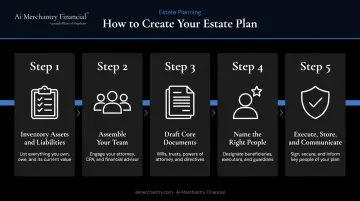
Step 5 — Execute, Store, and Communicate Your Plan
Documents signed incorrectly are legally invalid. Each state has specific witness and notarization requirements, so work closely with your attorney through the execution process. Once signed:
- Store originals in a fireproof safe or with your attorney
- Ensure your executor, POA, and healthcare proxy know their roles and where the documents are
- Schedule reviews every 3–5 years or after major life events: marriage, divorce, birth of a child, death of a named person, relocation to a new state, or a significant change in wealth
Estate Planning and Taxes: What You Need to Know
Most estates won't owe federal estate tax. The 2025 federal estate tax exemption is $13,990,000 per individual — meaning estates below that threshold owe nothing at the federal level. Estates above it face a top rate of 40% on the taxable amount.
State-level taxes are a different story. Twelve states plus D.C. impose estate taxes in 2025 — many with far lower exemption thresholds than the federal limit. Five states impose inheritance taxes (paid by beneficiaries, not the estate). Maryland is the only state with both.
Tax Minimization Strategies
Irrevocable trusts and gifting: Assets transferred into an irrevocable trust are generally removed from your taxable estate. The 2025 annual gift tax exclusion is $19,000 per recipient — meaning you can transfer up to that amount per person each year without triggering gift tax or using your lifetime exemption. The transferred assets and their future appreciation leave your estate.
Charitable giving: Donations to qualified charities — through outright gifts or a charitable remainder trust — reduce the size of your taxable estate. Lifetime gifts can also generate a current income tax deduction, so you reduce your taxable estate while lowering your income tax bill in the same year.
Life insurance as an estate planning tool: Life insurance death benefits are generally excluded from the beneficiary's gross income. Beyond income replacement, life insurance can serve as a precision tool for estate planning:
- Cover estate tax liabilities so heirs don't need to liquidate assets
- Fund buy-sell agreements for business owners
- Equalize inheritances when one heir receives a business or illiquid asset
An irrevocable life insurance trust (ILIT) can keep policy proceeds outside the taxable estate while still directing funds to intended beneficiaries.

Common Estate Planning Mistakes to Avoid
No Plan at All
Dying intestate means the state controls asset distribution and guardianship decisions. Courts don't know your family dynamics, your relationships, or your preferences — they apply statutes. Even families who agree on everything face court delays and legal costs without a plan in place.
Outdated Beneficiary Designations
Life events — divorce, remarriage, the birth of a child, the death of a named beneficiary — routinely make existing designations outdated. In Kennedy v. Plan Administrator for DuPont, the U.S. Supreme Court upheld distribution of retirement benefits to a participant's former spouse despite a divorce decree, because the plan documents controlled. Beneficiary forms override your will. Review them whenever life changes.
Gaps in Digital and Incapacity Planning
Keeping your beneficiary designations current is only part of the picture. Most estate plans focus on death — but illness or injury can leave you incapacitated long before then. Plans should address:
- A digital fiduciary authorized to access online accounts, social media, and stored files
- Explicit authorization for fiduciaries to manage digital assets (required in many states)
- A financial POA that is durable, so it survives mental incapacity
Missing incapacity planning can leave a spouse or adult child with no legal authority to act during a medical crisis — even when the need is urgent.
Frequently Asked Questions
What are the 7 steps in the estate planning process?
- Inventory your assets and liabilities
- Assemble a professional team (attorney, financial advisor, CPA)
- Draft your core documents (will, trust, POA, healthcare directive)
- Name beneficiaries and guardians
- Execute and notarize all documents per state requirements
- Store and communicate the plan to key people
- Schedule reviews every 3–5 years
What is the 5 by 5 rule in estate planning?
The 5 by 5 rule allows a trust beneficiary to withdraw up to the greater of $5,000 or 5% of the trust's assets per year without triggering gift tax consequences. It's commonly built into irrevocable trust structures to give beneficiaries limited access without compromising the trust's tax benefits.
What is the most common inheritance mistake?
Failing to keep beneficiary designations current. An outdated designation on a retirement account or life insurance policy can send assets to a deceased person or an ex-spouse. Beneficiary forms control those assets directly, overriding even a carefully drafted will.
Do I need an attorney to create an estate plan?
For simple situations, basic online tools may suffice. But for trusts, business interests, blended families, or significant assets, working with an estate planning attorney is worth it. Documents that don't meet state execution requirements can be invalidated entirely, forcing families to start over with no plan in place.
What is the difference between a will and a trust?
A will takes effect only after death and goes through probate court. A trust can be active during your lifetime, allows assets to pass to beneficiaries without probate, and gives you greater control over when and how assets are distributed — including protections for minor children or beneficiaries with special needs.
When should I update my estate plan?
Review your plan every 3–5 years at minimum, and immediately after: marriage or divorce, birth or adoption of a child, death of a named beneficiary or executor, relocation to a different state, or a significant change in your financial situation.