

Introduction
Most business owners are exceptional at running their business. Hiring, selling, delivering — those skills come with the territory. The financial foundation underneath it all is where things tend to slip, and slipping leads to reactive money management instead of a plan.
According to the Federal Reserve's 2024 Small Business Credit Survey, 56% of employer firms struggled to pay operating expenses, and 51% dealt with uneven cash flow — challenges that compound quickly without a structured plan in place.
This guide walks through how to build a business financial plan from scratch, which tax and retirement strategies matter most for self-employed owners, how to protect what you've built, and where most owners go wrong. Whether you're running a $500K service business or managing a $5M operation, the core principles apply.
Key Takeaways
- Effective financial planning spans cash flow, budgeting, tax strategy, retirement, and risk management — far beyond bookkeeping alone
- A financial plan is a living document — revisit and adjust it as your business evolves
- Separating personal and business finances is non-negotiable — not optional
- Tax and retirement planning require proactive decisions unique to self-employed owners
- Working with CPAs, financial advisors, and attorneys leads to stronger, more confident decisions
Why Financial Planning Matters for Business Owners
Business financial planning operates on a different level than personal budgeting — the stakes, the complexity, and the consequences are all higher.
For most owners, the business is the largest financial asset they have. A Raymond James survey of 540 private-company owners found that 44% had more than half their net worth tied up in the business, and 90% had at least a quarter of their wealth concentrated there. That's significant concentration with little protection in place for most owners.
Without a structured plan, that exposure creates compounding risk:
- Cash crunches that hit without warning
- Tax surprises at year-end that drain reserves
- No clear exit path when it's time to step back
- Unplanned expenses that derail growth momentum
A structured financial plan turns that risk into a manageable picture. It addresses four outcomes directly:
- Financial stability — consistent cash flow and adequate reserves
- Strategic growth — spending aligned with realistic goals
- Risk reduction — protection against events that can erase years of progress
- Personal financial security — building wealth beyond the business itself

The Core Components of a Business Financial Plan
Cash Flow Management
Cash flow is the operational pulse of a business. You can be profitable on paper and still run out of money — and that's where most owners get into trouble.
JPMorgan Chase Institute research covering 1.4 million small businesses found that 50% had fewer than 15 cash-buffer days — meaning half of small businesses could not cover two weeks of expenses from cash on hand alone.
Effective cash flow management means:
- Tracking all inflows and outflows weekly, not monthly
- Timing receivables and payables strategically to avoid gaps
- Building a cash reserve — most financial experts recommend 3–6 months of operating expenses, adjusted based on your industry and revenue consistency
- Identifying seasonal patterns before they become crises
Budgeting and Forecasting
A budget that actually works separates fixed costs (rent, salaries, subscriptions) from variable costs (marketing spend, supplies, contract labor). That distinction matters because when revenue dips, you need to know which costs you can adjust quickly.
Strong budgeting practice follows a few consistent rules:
- Build projections from historical data — not best-case scenarios
- Pair conservative revenue estimates with realistic expense tracking
- Review forecasts monthly and adjust quarterly
- Treat any budget untouched since January as already outdated by March
Understanding where your money actually goes starts with reading the right documents.
Financial Statements Every Owner Must Understand
Three documents reveal the true health of your business:
| Statement | What It Shows |
|---|---|
| Profit & Loss (P&L) | Revenue vs. expenses over a specific period |
| Balance Sheet | Assets vs. liabilities at a point in time |
| Cash Flow Statement | Actual money moving in and out of the business |
Reading these regularly — not just at tax time — helps you spot trends early, flag problems before they escalate, and make decisions based on facts rather than intuition.
Business Valuation
Most owners either overestimate or underestimate what their business is worth. Both errors carry real consequences. A 2024 RBC Wealth Management report found 41% of business owners had never completed any valuation analysis — meaning nearly half were making major financial decisions without knowing what their primary asset was actually worth.
A professional valuation uses three primary approaches (per SBA guidance):
- Income approach — based on projected earnings
- Market approach — based on comparable business sales
- Asset approach — based on net asset value
Knowing your business's value informs decisions around partnerships, borrowing, succession, and sale timing. It also creates a meaningful benchmark to measure growth against year over year.
A Step-by-Step Guide to Building Your Business Financial Plan
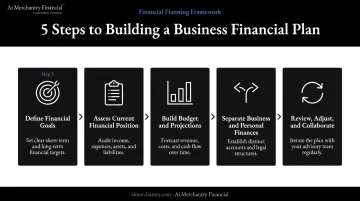
Step 1 — Define Your Financial Goals
Every solid plan starts with clarity on what you're actually building toward. Growth targets, debt elimination, a sustainable owner salary, or a planned exit in seven years — whatever it is, your goals should be specific, time-bound, and connected to both business and personal priorities. Without that specificity, the plan has no real anchor.
Step 2 — Assess Your Current Financial Position
Before building anything, gather your baseline data:
- All revenue streams and their consistency
- Monthly and annual operating expenses
- Outstanding debts and their terms
- Current cash on hand and reserves
This audit is your foundation. Faulty assumptions at this stage undermine everything built on top of them.
Step 3 — Build a Realistic Budget and Projections
Categorize fixed versus variable costs. Set aside an emergency buffer. Build monthly, quarterly, and annual forecasts using conservative revenue estimates that account for seasonal swings and market shifts.
If your business has slow months, those need to appear in the projection — not get smoothed over with best-case-scenario thinking.
Step 4 — Separate Business and Personal Finances
Dedicated business bank accounts, business credit cards, and a separate accounting system aren't just organizational best practices — they're foundational. The SBA explicitly recommends this separation as a core requirement for any business owner.
Mixed finances create three specific problems:
- Inaccurate records that distort business performance
- Complicated tax filing with higher error risk
- No clear view of what the business is actually earning
Step 5 — Review, Adjust, and Collaborate
A financial plan is a living document. Build in regular checkpoints at two levels:
- Monthly: Review cash flow and budget-versus-actuals
- Annually: Cover goals, tax strategy, retirement contributions, and insurance coverage
This is also where outside perspective adds the most value. Ai Merchantry Financial's Collaborative Planning Network™ connects business owners with CPAs, financial strategists, and advisors who provide objective review at each planning cycle — helping owners catch blind spots they'd otherwise miss when working in isolation.
Tax Planning and Retirement Strategies for Business Owners
Tax Obligations by Business Structure
Your business structure determines how you're taxed, and those differences go beyond just your rate:
| Structure | Federal Tax Treatment |
|---|---|
| Sole Proprietorship | Profit reported on Schedule C; net earnings face self-employment tax |
| Partnership | Files Form 1065; income passes through to partners via K-1 |
| LLC | Varies — disregarded entity, partnership, or corporate election |
| S Corporation | Files Form 1120-S; income passes through to shareholders |
| C Corporation | Files Form 1120; taxed as a separate entity |
Entity selection affects more than just your tax rate — it shapes your filing obligations, self-employment tax exposure, and retirement contribution options. A qualified tax professional can evaluate which structure fits your situation.
Once your structure is set, the next leverage point is knowing which expenses you can deduct.
Tax Deductions Business Owners Should Know
The IRS defines a deductible business expense as one that is "ordinary and necessary" — meaning common in your trade and helpful for your business. Key categories owners frequently underutilize:
- Home office — $5 per square foot up to 300 sq. ft. using the simplified method (IRS Publication 587), or actual expenses via Form 8829
- Vehicle use — standard mileage rate or substantiated actual expenses (IRS Topic 510)
- Self-employed health insurance — eligible premiums may be deductible as an income adjustment
- Retirement contributions — deductibility varies by plan type (IRS Publication 560)
- Equipment — Section 179 expensing allows immediate deduction of eligible property costs
Retirement Planning for Self-Employed Owners
Only **34% of entrepreneurs had a retirement savings plan** according to SCORE research — a significant gap given that business owners have no employer match, no pension, and no automatic enrollment to fall back on.
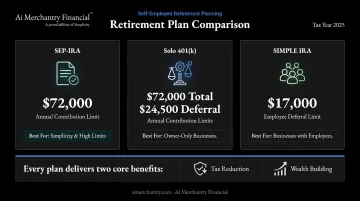
The three primary retirement vehicles for business owners, with 2026 IRS limits:
| Plan | 2026 Contribution Limit | Best For |
|---|---|---|
| SEP-IRA | Lesser of 25% of compensation or $72,000 | Simplicity; high limits |
| Solo 401(k) | Up to $72,000 total; $24,500 employee deferral | Owner-only businesses; flexibility |
| SIMPLE IRA | $17,000 salary deferral; catch-up available | Businesses with employees |
Each plan serves a dual purpose: building personal retirement wealth and reducing taxable income in the current year. Choosing the right plan requires weighing your income level, business structure, and whether you have employees — factors that interact in ways that aren't always obvious.
Ai Merchantry Financial's Collaborative Planning Network™ connects business owners directly with CPAs and financial strategists who specialize in exactly this intersection: aligning retirement plan selection with your current tax position and long-term financial goals.
Protecting Your Business: Risk Management and Insurance
Financial planning without a protection layer is incomplete. A lawsuit, illness, property event, or the unexpected loss of a key person can erase years of financial progress without the right coverage in place.
Core coverage types every business should evaluate:
- General liability — bodily injury, property damage, legal defense
- Professional liability (E&O) — errors and negligence for service providers
- Business interruption — lost earnings and continuing expenses after a covered loss
- Workers' compensation — work-related injury costs (requirements vary by state)
- Property insurance — physical assets and equipment
Two often-overlooked protections:
Key Person Life and Disability Insurance
This coverage pays the business if a critical team member — or the owner — becomes unable to work. For owner-operated businesses especially, it protects against sudden revenue loss when the person driving the business can no longer work.
Buy-Sell Agreement Funding Through Life Insurance
A funded buy-sell agreement creates a clear financial exit plan when a partner dies or departs. Two common structures:
- Cross-purchase: Owners hold policies on each other and use proceeds to buy the departing owner's interest
- Entity-redemption: The business holds the policies and redeems the interest directly
Both require careful tax planning. Death benefits are generally excluded from gross income, but premiums are typically not deductible when the business is the beneficiary.
Succession Planning
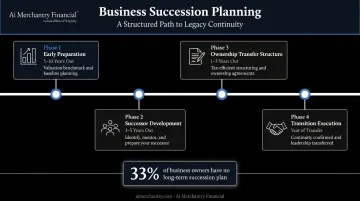
Buy-sell funding addresses the immediate financial mechanics of a departure — but succession planning addresses what comes next for the business itself. A succession plan documents how ownership transitions (to family, employees, or an outside buyer) and what happens to the business's value and continuity throughout that process.
Gallup's 2024 survey found 33% of business owners had no long-term plan or were unsure of their path forward. Among those who did have intentions, 74% planned to sell, give away, or take the business public. Having an intention is not the same as having a plan. A documented succession strategy should include a transition timeline, a valuation approach, and a clear funding mechanism.
Common Financial Planning Mistakes Business Owners Make
Mixing Personal and Business Finances
Blurred financial lines create inaccurate records, complicate tax filing, and make it impossible to measure true business performance. Distorted numbers lead to distorted decisions — and those decisions compound over time. Separate accounts aren't a best practice. They're the foundation everything else is built on.
Overestimating Revenue and Underestimating Expenses
Optimistic projections feel good in January and hurt in August. Cash shortfalls, distorted budgets, and poor investment timing all trace back to forecasts built on best-case scenarios rather than historical data and realistic market assumptions.
Anchor your plan to what you can verify:
- Prior-year revenue trends (not projected growth)
- Fixed and variable expenses at current, not ideal, levels
- Seasonal cash flow patterns specific to your industry
Neglecting Retirement and Succession Planning Until It's Too Late
Most owners defer these conversations because daily operations demand attention. By the time they're ready to exit, options have narrowed — valuations may have peaked, health may have changed, and potential successors were never developed.
Starting the conversation five to ten years before a planned exit creates room to improve business value, reduce tax exposure on the sale, and structure a transition that actually holds together.
Frequently Asked Questions
What are the 7 steps of financial planning in business?
The CFP Board's framework identifies seven steps: clarifying your circumstances, setting goals, analyzing options, developing and presenting recommendations, implementing them, and monitoring progress over time. In a business context, these steps form a continuous planning cycle — not a one-time exercise.
What is the 50/30/20 rule in business?
The 50/30/20 framework is primarily a personal finance budgeting tool. When adapted for business use, it suggests roughly 50% of revenue covering operating costs, 30% reinvested into growth, and 20% set aside for savings, debt repayment, or taxes. The actual split varies significantly by business type, stage, and margin structure — your industry margins and growth stage matter far more than any preset ratio.
Is $200,000 enough to work with a financial advisor?
Many fee-only planners — including NAPFA-affiliated advisors — charge hourly, by retainer, or flat fee, so access doesn't hinge on a minimum asset threshold. The more relevant question is whether you have financial goals worth planning for. Most business owners do.
How often should a business owner review their financial plan?
At minimum, review core financials — cash flow, budget vs. actuals — monthly. Conduct a comprehensive annual review of goals, tax strategy, retirement contributions, and insurance coverage. Major business changes (a new hire, a significant contract, a pivot in services) should trigger an additional review outside the regular cycle.
What is the difference between personal financial planning and business financial planning?
Business financial planning addresses the health, operations, and sustainability of the business entity. Personal financial planning covers the owner's individual goals — retirement, wealth accumulation, legacy. For most business owners, the two are inseparable: the business is the primary wealth asset, and personal financial security depends heavily on how business-level decisions are made.
When should a business owner start succession planning?
As early as possible — ideally years before any intended exit. That lead time allows for a defensible valuation, identifying and preparing a successor, structuring the ownership transfer tax-efficiently, and aligning the plan with personal retirement goals.