

Both concerns are valid. Both point toward different solutions.
The wrong policy can leave your family underprotected, drain your budget with premiums that don't match your actual needs, or leave you uninsured right when coverage becomes harder to qualify for. This guide breaks down how term and whole life insurance actually work, where each one fits, and how to decide which makes sense for your situation.
Key Takeaways
- Term life provides temporary, affordable protection for a set period — typically 10 to 30 years — with no cash value component.
- Whole life provides permanent coverage, guaranteed cash value growth, and a death benefit that never expires as long as premiums are paid.
- Whole life premiums on a $500,000 policy run 23–27× higher than term for a healthy 35-year-old.
- Term suits high-responsibility years — mortgages, young families, income replacement, and business debt.
- Whole life suits permanent needs — estate planning, lifelong dependents, and tax-advantaged cash growth.
Term vs. Whole Life Insurance: Quick Comparison
| Feature | Term Life | Whole Life |
|---|---|---|
| Coverage Length | Fixed period: 10, 15, 20, or 30 years | Lifetime, as long as premiums are paid |
| Monthly Cost | Significantly lower | Substantially higher |
| Cash Value | None | Builds at a guaranteed rate, tax-deferred |
| Death Benefit | Paid only if death occurs during the term | Guaranteed regardless of when you die |
| Flexibility | Choose term length; conversion options available | Coverage never expires; loans available against cash value |
| Dividends | Not applicable | Possible with mutual insurer policies (not guaranteed) |
What Is Term Life Insurance?
Term life insurance is exactly what the name suggests: coverage for a defined period. If the insured person dies during that term, beneficiaries receive a lump-sum death benefit — generally income-tax-free under IRC Section 101(a). If they outlive the policy, coverage ends with no payout and no refund.
Premiums are level throughout the term, meaning your monthly cost stays fixed from day one. What determines that cost at purchase: your age, health status, the coverage amount, and the length of the term. A 28-year-old in excellent health qualifies for far lower rates than a 45-year-old with a few health flags, and that gap grows wider with each passing decade.
How the Numbers Actually Look
Policygenius October 2024 rate data shows average monthly costs for a $500,000, 20-year term policy for preferred nonsmokers:
| Age | Woman | Man |
|---|---|---|
| 30 | $22.98 | $29.32 |
| 40 | $35.27 | $42.94 |
| 50 | $78.29 | $102.50 |
| 60 | $194.16 | $268.04 |
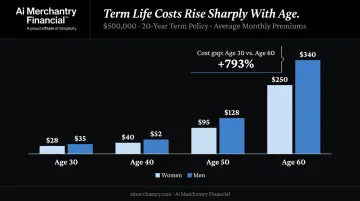
Buying early locks in the lowest possible rate for the entire term — a 30-year-old pays roughly one-ninth what a 60-year-old does for the same coverage.
Policy Options Worth Knowing
- Term lengths: Most commonly 10, 20, or 30 years
- Convertibility rider: Allows conversion to a permanent policy before the term expires — no new medical exam required
- Renewal: Possible after term expiration, but premiums reset based on your current age, often substantially higher
- Return-of-premium rider: Refunds premiums if you outlive the term (available on some policies; increases the cost)
When Term Life Makes the Most Sense
Term is built for a specific problem: protecting people who depend on your income during the years they need it most.
- Replacing income if a primary earner dies while children are still at home
- Covering a mortgage so a surviving spouse isn't forced to sell
- Protecting a business partner through a buy-sell agreement during the growth years
- Paying off debt that would otherwise fall to a surviving spouse or co-signer
The key thread: these are time-bound financial obligations. Once the mortgage is paid, the kids are independent, or the business debt is cleared, the need for that specific coverage level often decreases.
What Is Whole Life Insurance?
Whole life insurance doesn't expire. As long as premiums are paid, the death benefit remains in force regardless of when the insured person dies — at 62 or 94. That guaranteed payout is the defining feature, and it's what justifies the significantly higher cost.
The Cash Value Component
Every whole life premium payment splits into two places: the cost of insurance coverage and a cash value account. That account grows at a guaranteed fixed rate, tax-deferred, and accumulates over the life of the policy. Policyholders can access it through loans or withdrawals while alive.
A few important mechanics:
- Loans against cash value are generally not treated as taxable income for non-Modified Endowment Contracts (MECs) — though lapsed policies with outstanding loans can trigger tax liability
- Withdrawals above the policy's cost basis are subject to income tax
- Outstanding loans at death reduce the death benefit paid to beneficiaries
- The accumulated cash value itself generally does not pass separately to beneficiaries — the insurer pays the stated death benefit amount
Some whole life policies issued by mutual insurance companies may also pay annual dividends — not guaranteed, but available options include taking them as cash, reducing premiums, or reinvesting to grow cash value further.
The Cost Reality
Forbes Advisor's 2026 rate data shows average monthly premiums for a $500,000 whole life policy at age 35: $481 for a healthy woman, $571 for a healthy man. Compare that to $18–$21 per month for a 20-year term policy at the same age and coverage amount.
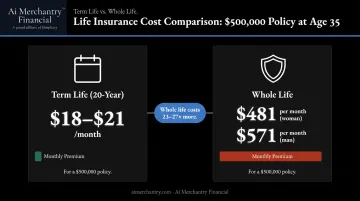
Whole life costs more because the insurer is guaranteeing a payout — not just the possibility of one — and because part of every premium builds cash value. For that premium to make sense, there needs to be a specific, long-term need that outlasts any fixed term.
When Whole Life Makes the Most Sense
- Supporting a dependent with special needs indefinitely — where trust structure also matters for SSI preservation
- Covering estate taxes or funding an irrevocable life insurance trust, especially given the 2025 federal estate tax threshold of $13,990,000
- Building tax-deferred cash value as part of a high-net-worth financial strategy
- Funding executive bonus plans under Section 162, buy-sell agreements, or split-dollar arrangements requiring permanent coverage
For business owners navigating buy-sell agreements or executive bonus structures, the term vs. permanent decision carries real legal and financial consequences — the kind where working with an advisor familiar with both insurance and business planning makes a measurable difference.
Term vs. Whole Life Insurance: Which One Is Right for You?
Neither policy type is inherently better. The right choice depends on three things: how long you need coverage, what your financial goals are, and what you can realistically sustain in premiums.
Choose Term Life If:
- Your primary need is income replacement during peak earning and responsibility years
- You have a specific time horizon — a 20-year mortgage, children who will be independent by a certain age, a business loan with a defined payoff date
- Budget is a constraint and you want maximum coverage per premium dollar
- You plan to invest the difference in premiums separately through retirement accounts or other vehicles
- You're in the early years of building wealth and need efficient protection now
Choose Whole Life If:
- You have a permanent coverage need that doesn't disappear — a lifelong dependent, estate tax exposure, a guaranteed inheritance goal
- You're older or have health concerns that may make future coverage harder or more expensive to obtain
- You want a conservative, guaranteed savings component within your insurance policy
- You want coverage that cannot expire regardless of how long you live
The Hybrid Approach
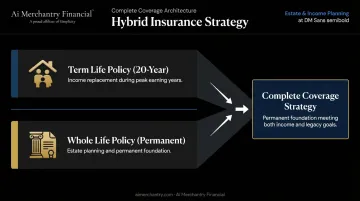
Many business owners and high-net-worth individuals use both. A 20-year term policy handles income replacement during peak earning years. A smaller whole life policy provides a permanent foundation for estate planning or guaranteed legacy. The two serve different functions. Treating them as competitors misses the point — for the right client, they work better together.
The Advisor Question
This decision involves more moving parts than most people expect — debts, dependents, retirement accounts, business structure, and long-term goals rarely point in the same direction at once. An advisor who evaluates all of those factors together, rather than treating insurance in isolation, will get you to a more accurate answer faster.
Ai Merchantry Financial's Collaborative Planning Network™ connects individuals with insurance, tax, and estate planning professionals who evaluate these decisions together. The firm's LifeLink™ tool provides instant insurance estimates for a quick starting point. For a more structured evaluation, the Insurance Needs Analysis walks through your specific situation before you speak with an advisor.
Conclusion
Term life is the right tool when you need maximum protection for a defined period at a manageable cost. Whole life fits when coverage needs to be permanent — when guaranteed cash value matters, or when estate planning goals require certainty.
Neither is universally better. The right policy depends on where you are in life: what you owe, who depends on you, and how long those responsibilities will last.
One thing is consistent regardless of which type fits your situation: life insurance doesn't get cheaper or easier to qualify for as time passes. Every year of delay means higher premiums and, if your health changes, potentially fewer options.
When you're ready to get clear on what makes sense for your situation, connect with Ai Merchantry Financial. Use the Insurance Needs Analysis tool to evaluate your coverage needs, or reach out directly at (844) 626-2246 to connect with a licensed professional through the Collaborative Planning Network™.
Frequently Asked Questions
Is it better to have whole life or term life insurance?
Neither is universally better. Term life is typically the right fit for most people seeking affordable income replacement during high-responsibility years. Whole life suits those with permanent coverage needs, estate planning goals, or a desire to build guaranteed, tax-deferred cash value.
What happens to a 20-year term life insurance policy after 20 years?
The policy expires — coverage ends, no death benefit is paid, and no premiums are refunded unless a return-of-premium rider was included. Some policies allow renewal at a higher rate or conversion to a permanent policy, but those options must typically be exercised before the term ends.
Can you convert a term life insurance policy to whole life?
Many term policies include a convertibility option allowing the policyholder to switch to permanent coverage before the term expires, without requiring a new medical exam. Premiums will increase to reflect the permanent policy type and your current age. Conversion deadlines and eligible products are contract-specific.
What happens to the cash value in a whole life policy when you die?
In most whole life policies, beneficiaries receive the stated death benefit — not the death benefit plus the accumulated cash value separately. Any outstanding loans against the cash value are deducted from the death benefit payout before it's paid to beneficiaries.
Does whole life insurance have tax advantages?
Yes. Cash value grows tax-deferred, and the death benefit is generally income-tax-free to beneficiaries under IRC Section 101(a). Policy loans on non-MEC contracts are typically not treated as taxable income, though withdrawals above the policy's cost basis are.
How much life insurance coverage do I need?
A common starting guideline is 10 to 12 times your annual income, though the accurate figure depends on your debts, number of dependents, income replacement needs, and long-term goals. An insurance needs analysis or conversation with a financial advisor will produce a more precise number for your specific situation.