

The core tension is real: you want to protect your current spouse and provide for your children from a prior relationship. Without deliberate planning, state default laws and outdated documents will override those intentions entirely — often in ways that surprise and hurt surviving family members.
This article covers the most common pitfalls blended families face, the legal tools that actually work (trusts, beneficiary designations, marital agreements), and how to build an advisory team that keeps everything coordinated.
Key Takeaways
- Standard wills and outdated estate plans from prior marriages rarely reflect blended family realities
- Beneficiary designations on retirement accounts and life insurance supersede your will — updating them after remarriage is non-negotiable
- Specialized trusts — QTIP, bypass, and irrevocable life insurance trusts — are the primary tools for balancing a surviving spouse's needs against children's inheritance rights
- Stepchildren have no automatic inheritance rights under most state laws unless legally adopted or explicitly named
- Coordinated advice from an attorney, CPA, and financial advisor working together is essential — siloed planning creates conflicting documents
What Happens Without a Plan
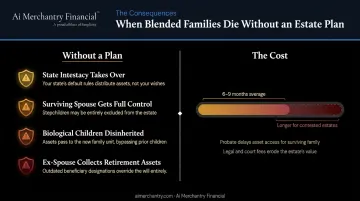
When someone in a blended family dies without an updated estate plan, state intestacy laws take over. Those laws rarely align with blended family wishes.
Depending on your state, the surviving spouse may receive full control over all assets — potentially leaving biological children from a prior relationship with nothing. In other scenarios, the estate gets divided among heirs in ways that feel arbitrary and create immediate family conflict.
An outdated will from a previous marriage compounds the problem rather than solving it. Common gaps include:
- References to an ex-spouse that were never removed
- A current spouse omitted entirely from the document
- Assets acquired after the divorce that the will doesn't cover
- Beneficiary designations on retirement accounts or life insurance still naming a former partner
The financial and emotional toll compounds quickly. The American Bar Association reports that the average estate takes 6 to 9 months to clear probate — and contested blended-family estates often run longer. During that window, assets are frozen, legal fees accumulate, and family members who are already grieving find themselves in court.
The Most Common Pitfalls in Blended Family Estate Planning
Leaving Everything to the Surviving Spouse with No Safeguards
The "I'll leave it all to my spouse and trust them to take care of my kids" approach feels intuitive. It's also legally risky.
Once assets transfer outright to a surviving spouse, that person has full legal control. They can:
- Change beneficiary designations on inherited assets
- Remarry and redirect the estate to a new partner
- Spend down assets, leaving biological children with nothing
Age gaps compound this risk. When a second spouse is close in age to the first spouse's adult children, those children may realistically never inherit. Assets outlast their patience, or the surviving spouse's own estate plan redirects everything elsewhere.
Failing to Update Beneficiary Designations
Retirement accounts (401(k)s, IRAs) and life insurance policies pass outside your will directly to whoever is named as beneficiary. If you remarried and never updated those designations, your ex-spouse may still be in line to collect.
One important distinction: 401(k) spousal protections are federal law, not just a community property state rule. Under federal regulations, a qualified plan's death benefit is payable to the surviving spouse unless the spouse provides written, witnessed consent to designate someone else.
IRAs operate under different rules and generally don't carry this automatic spousal protection. That makes beneficiary review critical for both account types.
Commingling Separate and Marital Assets
Separate property — assets you owned before marriage, inheritances, gifts — can lose its protected status when mixed with marital funds. Depositing inherited money into a joint account, or using separate property to purchase jointly-titled real estate, blurs ownership lines in ways that trigger disputes among heirs later.
Keep meticulous records of the origin of separate assets and consult an attorney before combining funds.
Assuming Stepchildren Are Automatically Included
They aren't. Under most U.S. state laws, unadopted stepchildren have no automatic inheritance rights. Even under the Uniform Probate Code — adopted in part by approximately 18 states — stepchildren only appear as a distant fallback after all higher-priority family classes have been exhausted.
If you want stepchildren to inherit, name them explicitly in your will, trust, or beneficiary designations. If you don't want them to inherit, make that equally explicit. Silence creates ambiguity, not protection.
Neglecting Incapacity Planning
Estate planning isn't only about what happens after death. Powers of attorney and healthcare directives determine who makes decisions for you while you're alive but incapacitated.
After remarriage, these documents must be updated. Without revision, a former spouse or an adult child from a prior relationship may still hold authority over your medical and financial decisions — and your current spouse may have no legal standing at all.
Essential Estate Planning Strategies for Blended Families
Prenuptial and Postnuptial Agreements
A marital agreement is one of the most direct ways to prevent future estate conflicts. It can define:
- Which assets remain separate property
- What support obligations from prior relationships look like
- How property will be treated at death or divorce
Under the 2012 Uniform Premarital and Marital Agreements Act, enforceable agreements require voluntary execution, financial disclosure, and ideally independent legal counsel for both parties. Enforceability remains state-specific, so working with a local attorney matters.
Updating and Aligning Beneficiary Designations
After remarriage, audit every account with a beneficiary designation:
- Retirement accounts — 401(k)s, IRAs, 403(b)s
- Life insurance policies — employer-provided and individually owned
- Bank and brokerage accounts — payable-on-death (POD) and transfer-on-death (TOD) designations
- Annuities — often overlooked, always contractual
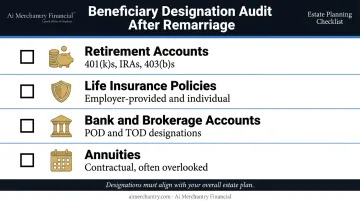
The goal isn't just updating names — it's ensuring designations **align with your overall estate plan**. A beneficiary form that contradicts your trust creates confusion and litigation.
Life Insurance to Balance Competing Inheritances
Life insurance is a practical tool for resolving the "same pool of assets, multiple heirs" problem without forcing heirs to compete. The strategy:
- Designate the current spouse as beneficiary of a life insurance policy
- Keep investment accounts, real estate, and business interests available for children from prior relationships
- Each group of heirs receives their intended share without fighting over the same assets
For larger estates, an Irrevocable Life Insurance Trust (ILIT) holds the policy outside the taxable estate. Proceeds go directly to named beneficiaries — without probate and without passing through the surviving spouse's control.
Making Lifetime Gifts
The IRS annual gift tax exclusion is $19,000 per recipient in 2025 (up from $18,000 in 2024). Gifting assets to children from a prior relationship during your lifetime:
- Reduces estate complexity at death
- Ensures those children receive their intended inheritance now, without waiting for a surviving spouse to pass
- Removes assets from potential estate tax exposure
This strategy works best when coordinated with your overall estate plan so gifts don't inadvertently undermine trust funding or tax strategies.
Clearly Documenting Intent
All the strategies above — from marital agreements to lifetime gifting — can unravel if your reasoning isn't recorded. A disputed estate plan is an expensive one.
Document your intent in the plan itself and in a separate letter of instruction. When beneficiaries understand why assets were distributed a certain way, disputes are less likely to escalate — and courts have clearer guidance if they do.
Trust Structures Designed for Blended Families
A simple will transfers assets outright. A trust lets you control how, when, and to whom assets are distributed — sometimes decades after your death. For blended families navigating competing inheritances, that level of control is often what keeps the plan intact.
Qualified Terminable Interest Property (QTIP) Trust
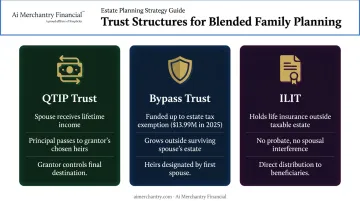
A QTIP trust provides the surviving spouse with income from the trust assets for their lifetime. When the surviving spouse dies, the principal passes to the grantor's designated beneficiaries — typically biological children from the prior relationship.
The key distinction: the grantor — not the surviving spouse — determines who ultimately receives the assets. The surviving spouse cannot redirect the principal to new heirs or a future spouse. This makes the QTIP trust one of the most commonly used structures in blended family planning.
Bypass Trust (Family Trust)
A bypass trust is funded at the first spouse's death with assets up to the federal estate tax exemption — $13.99 million in 2025, with a $15 million base amount set for 2026. Assets in the bypass trust:
- Grow outside the surviving spouse's taxable estate
- Remain available to benefit the surviving spouse during their lifetime (in many structures)
- Pass to the first spouse's designated heirs at the surviving spouse's death
Families with estates nearing or exceeding the exemption threshold should evaluate this structure early — waiting until the first death limits your options significantly.
Irrevocable Life Insurance Trust (ILIT)
An ILIT holds a life insurance policy outside the taxable estate. At death, proceeds go directly to the named beneficiaries with three distinct advantages:
- No probate delay — proceeds distribute directly to named beneficiaries
- No estate tax inclusion — the policy sits outside the taxable estate
- No spousal interference — assets bypass the surviving spouse entirely
For blended families with children from prior relationships, this makes the ILIT one of the more straightforward tools for separating inheritance streams without court involvement.
Bloodline and Spendthrift Trusts
Two additional provisions worth knowing:
- Bloodline trusts keep assets within biological descendants, protected from a child's future divorce or creditors — useful when a child's marriage is unstable
- Spendthrift provisions restrict a beneficiary's ability to prematurely access or assign their inheritance — relevant when heirs have their own financial complications
Both can be layered into existing trust structures rather than requiring separate documents. Choosing the right combination depends on your family's specific configuration — the number of children from prior relationships, the size of the estate, and how much ongoing control you want to retain after your death.
Beneficiary Designations and Retirement Accounts
The SECURE Act (effective January 1, 2020) fundamentally changed inherited IRA rules. Most non-spouse beneficiaries — including adult children from prior relationships — must now withdraw the entire inherited IRA balance within 10 years of the account owner's death.
Under final regulations effective in 2025, if the account owner died on or after their required beginning date, beneficiaries must also take annual distributions in years one through nine — not just deplete the account by year 10. As the AICPA's Journal of Accountancy notes, this compression bunches ordinary income into fewer tax years.
The result: beneficiaries face a larger tax bill, often pushed into higher brackets during the withdrawal period.
Planning options include:
- Naming a properly structured see-through (IRA Legacy) trust as the IRA beneficiary — this adds control over distributions while still complying with SECURE Act rules, though it requires careful drafting to maintain designated beneficiary status
- Considering Roth conversions during the account owner's lifetime to reduce the tax burden on inherited funds
- Coordinating IRA distributions with other income sources in the beneficiary's financial plan
IRAs aren't the only account type that demands careful attention. With 401(k) plans, federal law automatically grants the surviving spouse inheritance rights unless a written, notarized spousal consent form designates another beneficiary. In blended families where part of the 401(k) is intended for children from a prior relationship, this consent process requires an attorney's involvement — it cannot be handled informally.
Building Your Blended Family Planning Team
Blended family estate planning is not a one-professional job. Siloed advice is where most plans break down. An estate planning attorney drafts documents without knowing the tax implications. A financial advisor recommends beneficiary designations that contradict the trust. A life insurance policy gets structured without accounting for estate tax treatment.
Getting those professionals coordinated — around the same goals, at the same time — is what separates a plan that holds from one that unravels. A complete planning team for a blended family typically includes:
- Estate planning attorney — drafts wills, trusts, powers of attorney, and healthcare directives
- CPA or tax professional — models the tax impact of trust structures, IRA distributions, and lifetime gifts
- Financial advisor — aligns investment accounts, retirement planning, and insurance with the estate plan
- Professional fiduciary (when appropriate) — serves as a neutral trustee when family member trustees would create conflict
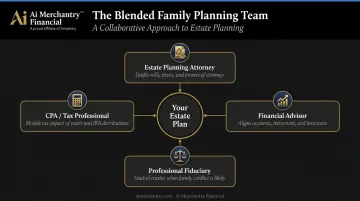
This is the model behind Ai Merchantry Financial's Collaborative Planning Network™ — connecting families with estate planning attorneys, CPAs, and financial strategists so that documents, tax strategies, and insurance solutions are built in concert. For blended families with competing priorities across two households, having a single point of coordination keeps the plan from pulling in opposite directions.
When to revisit your plan:
- Immediately upon remarriage
- Birth or adoption of a child
- Death of a spouse or beneficiary
- Significant change in assets
- Any major tax law change
A general rule: review your plan every three to five years, or whenever a major life event occurs.
Frequently Asked Questions
What is considered a blended family?
A blended family is one in which at least one partner brings children from a previous relationship into a new marriage or partnership. It may also include children born to the current couple. Default inheritance rules are built around traditional family structures, so this distinction carries real legal weight when planning your estate.
How does inheritance work in blended families?
Without a specific estate plan, state intestacy laws control distribution. These laws may exclude stepchildren entirely or give the surviving spouse full control over all assets — potentially cutting off biological children from a prior relationship without any court intervention required.
How can I protect my assets from stepchildren in an estate plan?
QTIP trusts, bypass trusts, and specific beneficiary designations allow you to provide for a current spouse while directing designated assets to your biological children. These tools create legally enforceable boundaries that a surviving spouse cannot override.
Do stepchildren have automatic inheritance rights?
In most U.S. states, no. Unadopted stepchildren must be explicitly named in a will, trust, or beneficiary designation to inherit. Whether you want them included or excluded, the documents must name them explicitly.
What is the 5-by-5 rule in estate planning?
The 5-by-5 rule lets a trust beneficiary withdraw the greater of $5,000 or 5% of the trust's value each year. Withdrawals within that ceiling generally avoid gift tax treatment under IRC §2514(e), giving a surviving spouse limited liquidity without eroding the principal set aside for other heirs.
When should I update my estate plan after remarrying?
Immediately. Remarriage is one of the highest-priority triggers for a full estate plan review, covering wills, trusts, beneficiary designations, powers of attorney, and healthcare directives. Any major life event after that should prompt another review.