
Choosing the wrong vehicle — or misunderstanding how each works — can mean unexpected tax bills in retirement, restricted access to your savings at the wrong time, or an IUL policy that fails to deliver on its tax-free promise because it was poorly structured.
This guide compares both side by side: how each is taxed, what each costs, who benefits most, and how to decide which belongs in your plan.
Key Takeaways
- 401(k) contributions get an upfront tax deduction; IUL distributions come out tax-free via policy loans
- 401(k)s have IRS contribution limits ($23,500 in 2025) and mandatory RMDs; IULs have neither
- IUL cash value has a 0% floor against index losses; 401(k) balances are fully market-exposed
- An underfunded or lapsing IUL forfeits its tax-free advantage — design and funding discipline matter
- For most people, the two are complementary: capture the employer match first, then evaluate whether an IUL adds a meaningful tax-free layer
IUL vs. 401(k): Quick Comparison
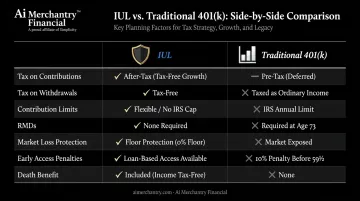
Here's how IULs and traditional 401(k)s compare on the factors that shape retirement decisions:
| Factor | IUL | Traditional 401(k) |
|---|---|---|
| Tax on Contributions | After-tax (no deduction) | Pre-tax (reduces taxable income now) |
| Tax on Income/Withdrawals | Policy loans generally not taxable while in force | All withdrawals taxed as ordinary income |
| Annual Contribution Limits | No IRS dollar cap; limited by MEC threshold (IRC 7702A) | $23,500 employee limit; $7,500 catch-up (age 50+) |
| RMDs Required | No | Yes — begins at age 73 (or 75, depending on birth year) |
| Market Loss Protection | 0% floor on index crediting | Fully exposed to market losses |
| Early Access Penalties | Surrender charges in early years (often 10–15 years) | 10% penalty + income tax before age 59½ |
| Death Benefit | Yes — income-tax-free under IRC 101(a) | No inherent death benefit |
| Best Suited For | High earners seeking tax-free income layer; legacy planning | Most workers — especially those with employer match |
What Is an IUL?
An Indexed Universal Life (IUL) policy is a permanent life insurance contract with a cash value component that earns interest linked to a stock market index — most commonly the S&P 500 — without directly investing in it.
The policyholder doesn't participate in index losses because of a guaranteed 0% floor on index crediting. In exchange, gains are subject to a cap and participation rate set by the carrier. As a reference point, current capped strategies from carriers like Nationwide and Securian show cap rates ranging from roughly 9.25% to 10.75% on standard S&P 500 strategies — though these figures are carrier-specific and subject to change.
The Tax Advantage Structure
IUL's appeal in retirement planning rests on three tax code provisions working together:
- IRC 72(e) — governs the tax treatment of distributions from life insurance contracts
- IRC 7702A — defines a Modified Endowment Contract (MEC) and the seven-pay test that separates tax-advantaged IULs from those that aren't
- IRC 101(a) — generally excludes death benefit proceeds from the beneficiary's gross income
The result: cash value grows tax-deferred, policy loans are generally not treated as taxable income while the policy stays in force, and the death benefit passes income-tax-free. This is structurally different from a traditional 401(k), where every dollar coming out is taxed.
Flexibility the IRS Doesn't Restrict
Unlike qualified retirement plans, IUL has no government-mandated contribution ceiling. The practical limit is the MEC threshold under IRC 7702A — a contract-specific calculation tied to the death benefit, insured's age, and statutory assumptions. This means high earners can potentially fund an IUL well beyond what a 401(k) allows.
There are also no RMDs and no age-59½ penalty structure — though surrender charges in the early years (often a 10–15 year schedule) do limit liquidity.
According to LIMRA, IUL reached $4.5 billion in new premium in 2025 — up 17% year over year — and represented 25% of all U.S. individual life insurance new premium. Those numbers confirm it's a mainstream retirement planning tool, not a niche workaround.
How IUL Builds Tax-Free Retirement Income
The mechanism that makes IUL work as a retirement vehicle is the policy loan, not a traditional withdrawal.
Rather than withdrawing cash value directly — which triggers basis-first (FIFO) treatment under IRC 72(e) — policyholders borrow against the cash value instead. The loan itself is not taxable income while the policy remains in force, and the balance is settled against the death benefit at the end.
That's the actual mechanics behind "tax-free retirement income" from an IUL.
What goes wrong:
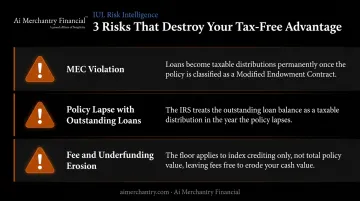
- If cumulative premiums cross the MEC threshold under IRC 7702A, loans are treated as taxable distributions — the tax-free advantage is permanently gone
- If a policy lapses with outstanding loans, the IRS treats the outstanding balance as a distribution; the taxable gain is the amount received minus the policyholder's investment in the contract, reported as ordinary income (per IRS Revenue Ruling 2009-13)
- Insurance charges, fees, and underfunding can erode cash value even with a 0% crediting floor — the floor applies to index crediting, not total policy value
Proper IUL design — minimum death benefit, funding below the MEC limit, consistent premiums over 20+ years — determines whether the strategy delivers on its promise or unravels before retirement.
What Is a 401(k)?
A 401(k) is an employer-sponsored, tax-qualified defined-contribution retirement plan. Workers contribute pre-tax dollars (traditional) or after-tax dollars (Roth 401(k)), with traditional contributions reducing taxable income in the year they're made.
The Tax Structure in Plain Terms
- Traditional 401(k): Lower tax bill today; every dollar withdrawn in retirement — principal and growth — is taxed as ordinary income
- Roth 401(k): No upfront deduction; qualified withdrawals are tax-free
For 2025, IRS Notice 2024-80 sets the employee deferral limit at $23,500, with a catch-up contribution of $7,500 for those 50 or older — bringing the potential employee total to $31,000.
Key constraints to know:
- RMDs begin at age 73 for those born 1951–1959; age 75 for those born 1960 or later (per SECURE 2.0)
- Withdrawals before age 59½ trigger a 10% additional tax plus ordinary income tax (with statutory exceptions)
- Investment choices are limited to what the employer's plan offers
How a 401(k) Grows Your Retirement Savings
The 401(k)'s most powerful feature is the employer match. According to Vanguard's How America Saves 2025, the average promised employer match is 4.6% of pay — an immediate, guaranteed return that no other retirement vehicle replicates.
Capturing the full match before exploring any other vehicle is the right move. A 4.6% match on a $60,000 salary is $2,760 in free contributions annually, before your own money compounds a single day.
The real vulnerability appears at retirement, not during accumulation. A 401(k) is fully invested in market assets, which creates sequence of returns risk: withdrawals taken after early market losses remove assets before they can recover. Morningstar's 2025 research found that nearly 70% of modeled retirement failures involved portfolio losses in the first five years of retirement. When the portfolio gained in all of the first five years, the probability of depletion dropped to roughly 4%.
An IUL with a 0% floor eliminates that specific vulnerability — but only on the index crediting side, and only if the policy is properly funded.
IUL vs. 401(k): Which Strategy Fits Your Retirement?
There's no universal winner here. The right choice depends on income level, current tax bracket, retirement tax outlook, employer benefits, time horizon, and whether legacy planning matters to you. The goal is decision clarity.
When IUL Makes Sense
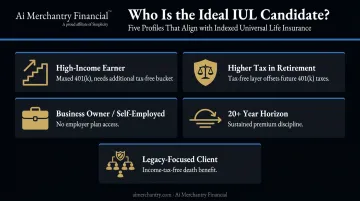
IUL tends to add the most value for:
- High-income earners who've already captured the full employer match and maxed — or nearly maxed — their 401(k), and want additional tax-advantaged accumulation with no contribution ceiling
- Individuals expecting higher taxes in retirement than today, where a tax-free income layer offsets projected 401(k) withdrawal taxes
- Business owners and self-employed professionals without access to employer-sponsored plans who need a vehicle that functions similarly without IRS contribution restrictions
- Those with a 20+ year horizon who can sustain consistent premiums long enough for the strategy to perform as designed
- Legacy-focused clients who want the death benefit to pass income-tax-free to heirs under IRC 101(a)
There's also a Social Security angle: IUL income from policy loans doesn't count as provisional income for Social Security taxation purposes. A well-designed IUL can help keep a larger share of those benefits tax-free.
This kind of multi-layered evaluation — weighing an IUL against a 401(k) and an estate plan simultaneously — is where coordinated planning matters most. Ai Merchantry Financial's Collaborative Planning Network™ connects a financial advisor, CPA, and estate attorney through a single process, producing an integrated strategy rather than three disconnected conversations.
When a 401(k) Is the Better Choice
A 401(k) is the right first priority for:
- Anyone with an employer match — that's free money no other vehicle can replicate, full stop
- Early-career professionals with 30+ years to recover from market volatility
- Those who need the immediate tax deduction — the pre-tax 401(k) contribution reduces taxable income in years when that relief matters most
- Workers below income thresholds where Roth options are available and attractive
IUL is not a 401(k) replacement. Moving 401(k) assets into an IUL prematurely — especially if it eliminates an employer match or creates a MEC — is a documented source of financial harm.
Rollover recommendations of any kind are subject to SEC and FINRA best-interest scrutiny. The SEC's 2022 Staff Bulletin on standards of conduct specifically requires broker-dealers to document why a rollover serves the client's interests, including cost comparisons and alternatives. If someone is pushing you to roll a 401(k) into a life insurance product, ask hard questions.
Real-World Scenarios: Seeing Both Strategies in Action
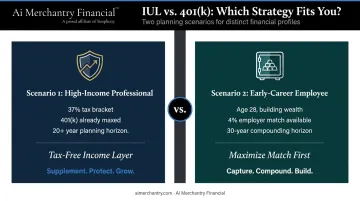
Scenario 1 — The High-Income Professional (IUL adds value)
Consider a professional in the 37% federal bracket who has maxed their 401(k) and is still accumulating significant income with no additional tax-advantaged bucket to fill. An IUL, properly structured over 20+ years with minimum death benefit and MEC-compliant funding, creates a tax-free income layer in retirement.
The key advantages here are specific: policy loans don't trigger RMDs and don't push up the income threshold that determines how much of Social Security gets taxed. The metric to watch is the projected tax-free income stream from the IUL against the projected tax burden from 401(k) withdrawals alone at the same income level.
Scenario 2 — The Early-Career Employee (401(k) is the anchor)
A 28-year-old with a 4% employer match and 30 years to retirement gets the most mileage from maximizing the 401(k) first. Adding an IUL before capturing the full match — or without stable, long-term income to sustain consistent premiums — introduces real exposure: underfunded policies can lapse, erasing years of premiums. Time horizon matters enormously with IUL: a policy that's surrendered or underfunded at year 12 isn't a retirement strategy; it's an expensive lesson.
For most people, the real planning question isn't which vehicle wins — it's what their retirement income picture looks like when they rely on only one of them. That reframe alone often makes the case for a layered approach.
If you're ready to explore what a multi-vehicle retirement strategy looks like for your specific situation, Ai Merchantry Financial's Collaborative Planning Network™ connects you with the right mix of financial professionals, tax advisors, and estate planning specialists — with education and collaboration driving the process, not product selection. Schedule an Ai Meeting™ at aimerchantry.com or call (844) 626-2246 to start the conversation.
Frequently Asked Questions
Is an IUL better than a 401(k)?
Neither is universally better. The 401(k) wins for employer match access and upfront tax deduction; the IUL wins for tax-free income flexibility, no RMDs, and legacy planning. The right answer depends on your income, expected retirement tax bracket, and time horizon.
Is an IUL a good investment for retirement?
An IUL is a life insurance product, not a traditional investment. It can play a meaningful retirement income role when properly designed, funded consistently over 20+ years, and used alongside other retirement accounts rather than as a standalone strategy.
Are IULs really tax-free?
The tax-free treatment applies specifically to policy loans (not withdrawals beyond your basis) while the policy stays in force and hasn't become a MEC. If the policy lapses with outstanding loans, those loans become a taxable distribution — triggering ordinary income tax at the worst possible time.
What are the contribution limits for a 401(k) versus an IUL?
For 2025, the 401(k) employee deferral limit is $23,500, with a $7,500 catch-up for those 50 and older. IUL has no IRS dollar cap. The practical ceiling is the contract-specific MEC threshold under IRC 7702A, which varies by death benefit size, insured age, and carrier.
Can I have both an IUL and a 401(k)?
Yes, and for many high-income earners, using both is the recommended approach. Maximize the employer 401(k) match first, then fund an IUL to build a separate tax-free income layer without RMD obligations or market exposure.
What happens to my IUL if the policy lapses?
A lapsed policy with outstanding loans creates a taxable event. The IRS treats the loan balance as proceeds received, and the taxable gain — your proceeds minus your cost basis — is reported as ordinary income. This often arrives as an unexpected tax bill at retirement.