

They are not the same document. They do not serve the same purpose. And using the wrong one — or missing one entirely — can leave your family in exactly the kind of scramble no one wants.
According to Caring.com's 2025 Wills and Estate Planning Study, **56% of American adults have neither a will nor a living trust**. The consequences of that gap are real: when someone dies without a will, state law determines who gets what — and that rarely matches what the person would have wanted.
This guide covers all three documents — last will and testament, living trust, and living will — explaining what each does, what it doesn't do, and how to determine which combination fits your situation.
Key Takeaways
- A last will and testament directs asset distribution after death but must go through probate court.
- A living trust holds assets during your lifetime, typically avoids probate, and can manage finances if you become incapacitated.
- A living will is a healthcare document — it records medical preferences if you can't communicate them; it has nothing to do with distributing property.
- Wills cost less upfront; trusts provide privacy, faster distribution, and probate avoidance for larger or more complex estates.
- Most estate planning professionals recommend combining all three documents into a coordinated plan.
Living Will vs. Will vs. Living Trust: At a Glance
Here's how all three documents compare at a glance — before the details, the differences:
| Feature | Last Will & Testament | Living Trust | Living Will |
|---|---|---|---|
| When it takes effect | After death | During life and after death | During incapacity |
| Avoids probate | No | Yes (for funded assets) | N/A |
| Names a guardian | Yes | No | No |
| Becomes public record | Yes | No | No |
| Covers medical decisions | No | No | Yes |
| Manages incapacity | No | Yes | Yes (healthcare only) |
| Requires ongoing management | No | Yes (must be funded) | No |
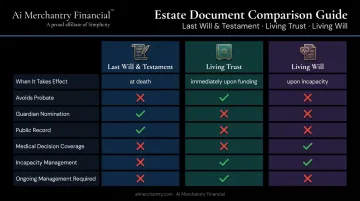
One important note the table doesn't capture: several asset types transfer completely outside any will or trust. Retirement accounts, HSAs, life insurance policies, and jointly held property with right of survivorship all pass directly to named beneficiaries or co-owners — regardless of what your will or trust says. A complete estate plan coordinates beneficiary designations with these documents — because a mismatch between them can override your intentions entirely.
What Is a Last Will and Testament?
A last will and testament is a legal document that specifies how your assets — property, savings, investments, personal belongings — will be distributed after your death. It names beneficiaries, appoints an executor to carry out your wishes, and allows you to nominate a guardian for minor children or dependents.
A will is the only document that lets you nominate a guardian for minor children — though the probate court makes the formal appointment.
How Probate Works
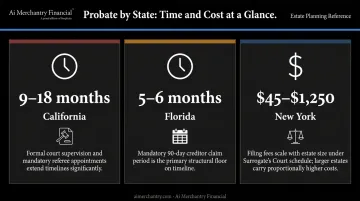
Once a will is submitted to court after death, it enters the probate process — a state-supervised procedure that validates the document, settles outstanding debts and taxes, and transfers assets to beneficiaries. Timelines vary by state:
- California: Formal probate typically takes 9–18 months
- Florida: Even a simple estate generally takes 5–6 months due to mandatory creditor periods
- New York: Surrogate's Court filing fees range from $45 for smaller estates to $1,250 for estates of $500,000 or more
These timelines and costs explain why multi-state property owners and larger estates often prioritize probate avoidance as a core planning goal.
What Happens Without a Will
Dying "intestate" — without a will — means state law decides who inherits your assets. In New York, for example, a surviving spouse receives $50,000 plus half the residue, with descendants receiving the balance. An unmarried partner receives nothing, regardless of the relationship's length or depth.
For blended families, unmarried couples, and business owners, the state's default rules rarely reflect what you'd actually choose.
Limitations Worth Knowing
- A will only takes effect at death — it provides no guidance during incapacity
- It becomes public record through probate
- Assets not titled to the estate — like accounts with named beneficiaries — pass outside the will entirely
Use Cases for a Will
A will is the right starting point for:
- Parents with minor children who need a guardian nominated
- People with straightforward asset structures
- Anyone who wants a foundational document in place quickly
Consider a young couple with two children and a home. Without a will, a court — not the parents — would decide who raises those children. For most parents, that possibility is reason enough to make a will their first estate planning step.
What Is a Living Trust?
A revocable living trust is a legal arrangement created during your lifetime. You (the grantor) transfer ownership of assets into the trust and typically serve as your own trustee, keeping full control.
When you die or become incapacitated, a named successor trustee manages and distributes those assets according to the trust's terms — without going through probate.
Key Advantages Over a Will
- Assets pass directly to heirs without court involvement or delays
- If you're incapacitated, the successor trustee steps in immediately — a will cannot do this
- Trust details never become public record, unlike a probated will
- Owning real estate in multiple states? A trust avoids a separate probate proceeding in each one
Revocable vs. Irrevocable Trusts
| Type | Can Be Changed | Probate Avoidance | Estate Tax Benefit |
|---|---|---|---|
| Revocable | Yes, at any time | Yes (for funded assets) | No — assets remain in your taxable estate |
| Irrevocable | Generally no | Yes | Potentially yes, depending on structure |
A revocable trust offers flexibility but does not remove assets from your taxable estate. An irrevocable trust may offer estate tax advantages, but outcomes depend on the trust's specific terms and retained powers. The federal estate tax filing threshold for 2026 is $15 million, though several states set significantly lower thresholds — Oregon's, for instance, applies at $1 million.
What Can and Cannot Go in a Trust
Can be transferred into a trust:
- Bank accounts and investment accounts
- Real estate (via a new recorded deed)
- Business interests
- Securities
Should NOT go into a trust:
- IRAs and 401(k)s — these are federally regulated retirement accounts with their own beneficiary designation rules; naming a trust as lifetime owner creates complications
- Health savings accounts — nonspouse beneficiaries generally recognize the full fair-market value as taxable income
For retirement accounts and HSAs, beneficiary designations handle the transfer directly — which is also why a pour-over will matters.
The Pour-Over Will Connection
Most people with a living trust also have a pour-over will — a companion document that directs any assets left outside the trust at death to be transferred into it. The catch: those assets still go through probate before reaching the trust. This is why actually funding the trust (retitling assets into it) matters as much as creating it.
Use Cases for a Living Trust
A living trust makes particular sense for:
- People who own real estate in multiple states
- Those who want to plan for potential incapacity
- Individuals with larger or more complex estates who prioritize privacy
- Business owners who want to transfer business interests without court interference
What Is a Living Will?
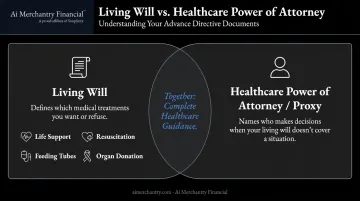
A living will — also called an advance directive or healthcare directive — is a legal document that outlines your medical preferences if you become incapacitated and cannot communicate them yourself. This covers decisions like life support, resuscitation, feeding tubes, and organ donation.
A living will has nothing to do with financial assets or property distribution. It exists entirely to guide medical decision-making.
A living will is typically paired with a healthcare power of attorney (also called a healthcare proxy), which designates a specific person to make medical decisions on your behalf. The distinction matters:
- The living will records what you want
- The healthcare proxy names who decides when situations arise that your living will doesn't specifically address
Together, these documents give your loved ones clear guidance — reducing the burden of guessing what you would have wanted. Research from the Mayo Clinic confirms that clear advance directives help family members avoid conflict and guilt during already difficult moments.
State requirements vary — New York requires two adult witnesses but no notary; Oregon permits notarization or two qualified witnesses. Wherever you live, completed forms should go to your healthcare providers, close family members, and the person named as your proxy, not just stored somewhere no one can find them.
AARP provides free advance directive forms for every state as a starting point.
Which Estate Planning Document Do You Need?
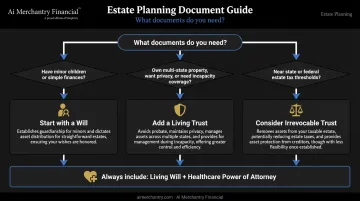
For most people, the answer isn't one document — it's a combination. Here's a practical decision framework:
Start with a will if you:
- Have minor children who need a guardian nominated
- Have straightforward finances and want a foundational document in place
- Are earlier in the planning process and need to get something done quickly
Add a living trust if you:
- Own real estate in multiple states
- Want to avoid probate and the public record it creates
- Need incapacity protection beyond what a will provides
- Have a blended family with specific distribution intentions
- Are a business owner concerned about succession
Consider an irrevocable trust if:
You have estate tax concerns and your estate approaches state or federal thresholds
You have specific asset protection or Medicaid planning goals
Include a living will and healthcare power of attorney — regardless of age, wealth, or complexity. These documents are relevant to every adult.
Do You Need Both a Will and a Trust?
A revocable living trust paired with a pour-over will is a strong starting point for most situations. The trust handles the bulk of your assets and keeps them out of probate. The pour-over will catches anything left outside the trust — and, unlike a trust, it lets you nominate a guardian for minor children.
Estate Planning Isn't a One-Time Event
Getting the right documents in place is step one. Keeping them current is step two. Major life changes should prompt a review:
- Marriage or divorce
- Birth or adoption of a child
- Death of a named beneficiary or executor
- Significant new assets or business interests
- Moving to a different state
Ai Merchantry Financial's Collaborative Planning Network™ connects individuals, families, and business owners with estate planning attorneys, CPAs, and financial strategists who can assess your specific situation and help determine the right combination of documents. For personalized guidance, visit aimerchantry.com/collaborativeplanningnetwork or reach them at (844) 626-2246.
Conclusion
A will, a living trust, and a living will each serve a distinct purpose. Treating them as interchangeable is where most estate planning mistakes begin.
The right plan depends on your family structure, asset complexity, privacy preferences, and healthcare wishes. Most people need more than one document. The real goal is understanding which combination of tools fits where you are today and where you're headed.
Acting before a health crisis or family dispute forces the decision gives your loved ones clarity when they need it most. To connect with estate planning professionals through Ai Merchantry Financial's Collaborative Planning Network™, visit aimerchantry.com or call (844) 626-2246.
Frequently Asked Questions
Which one is better, a will or a living trust?
Neither is universally better. A will is simpler and less costly to create but requires probate; a living trust avoids probate and addresses incapacity but costs more upfront and must be properly funded. Many people benefit from having both, with the trust handling most assets and a pour-over will covering the rest.
What is the best way to leave your house to your children?
Placing a home in a revocable living trust is often the most efficient method, as it avoids probate and transfers property directly to heirs. A will can also transfer a home, but the property must pass through probate first. State-specific rules apply, so working with an estate planner is advisable.
What is the difference between a living will and a regular will?
A last will and testament governs how your financial assets and property are distributed after death. A living will is a healthcare document that records your medical preferences if you become incapacitated. They serve completely different purposes and most adults benefit from having both.
Do I need both a will and a living trust?
Many estate planning attorneys recommend both. A living trust manages and transfers most assets while avoiding probate; a pour-over will captures anything left outside the trust and nominates guardians for minor children, which a trust cannot do.
What assets cannot be placed in a trust?
Retirement accounts like IRAs and 401(k)s should generally not be placed in a trust, as they operate under federal rules with their own beneficiary designation system. HSAs carry similar restrictions. These accounts should use beneficiary designations rather than trust ownership.
What happens if I die without a will or trust?
State intestacy laws determine how your assets are distributed, typically prioritizing a spouse or closest relatives — an unmarried partner usually receives nothing. Guardianship of minor children would also be decided by a court, making a will especially critical for parents.