

According to LIMRA's 2025 Insurance Barometer, healthy adults ages 18–30 estimate the cost of a $250,000, 20-year term policy at 10–12 times its actual cost. That gap between perception and reality is why roughly 100 million Americans remain uninsured or underinsured — leaving families exposed to financial hardship they never anticipated.
Term life insurance is the most straightforward, affordable form of life insurance available. But "affordable" and "simple" don't mean there's nothing to understand. The type you choose, the term length you select, and when you buy all affect both what you pay and how well the policy actually protects your family.
This article covers what term life insurance is, how it works, the main types available, what it costs at different ages, and how it compares to whole life — so you can make a more informed decision.
Key Takeaways
- Term life insurance pays a death benefit if you die within a set coverage period (10–30 years), with no cash value component
- Premiums are locked in at purchase — buying younger and healthier means lower rates for the entire term
- A healthy 30-year-old can get $500,000 in coverage for roughly $23–$30/month
- Level-premium term is the most common type; return-of-premium, decreasing, and convertible term serve specific needs
- Term life costs significantly less than whole life — permanent coverage can run 5–15 times more for the same death benefit
What Is Term Life Insurance and How Does It Work?
Term life insurance is a contract between you and an insurer: you pay regular premiums, and if you die during the policy's coverage period, your named beneficiaries receive a lump-sum death benefit. The "term" refers to how long coverage lasts — not how large the benefit is.
Most policies run 10, 15, 20, 25, or 30 years. Some carriers (Protective and Banner among them) offer 35- and 40-year terms for younger applicants. If you outlive the term, the policy simply ends with no payout.
The Core Mechanics
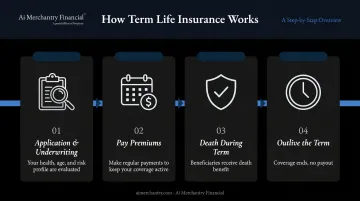
A term policy works in four straightforward stages:
- You apply and are underwritten — the insurer evaluates your age, health history, gender, smoking status, occupation, and hobbies to set your premium
- You pay premiums — typically monthly or annually, for the full term
- If you die during the term — your beneficiaries receive the death benefit, which is generally excluded from federal gross income under IRS Publication 525
- If you outlive the term — coverage ends; no money is returned (unless you have a return-of-premium policy)
Underwriting Paths
Insurers use three main approaches to assess risk:
- Fully underwritten — Requires a medical exam, blood/urine tests, and detailed health history. Typically results in the lowest premiums for healthy applicants
- Simplified issue — No exam required, but health questions are asked. Some carriers offer this path for coverage up to $2 million for qualified applicants
- Guaranteed issue — No exam, no health questions. Easier to qualify for, but premiums are higher and benefit caps are lower (often $50,000–$100,000 depending on the carrier and your age)
Beneficiaries and Death Benefit Use
You name one or more beneficiaries — a spouse, children, a business partner, or a charity. There are no restrictions on how beneficiaries use the funds. Common uses include:
- Replacing lost income
- Paying off a mortgage
- Covering education costs
- Handling funeral and final expenses
- Settling outstanding debt
Unlike permanent life insurance, term policies carry no savings or investment component. That single difference is why term premiums run significantly lower: you're buying a defined window of financial protection, nothing more.
Types of Term Life Insurance
Not all term policies work the same way. The right type depends on what you're protecting and for how long.
Level-Premium Term
The most common type. Both the death benefit and premium stay fixed for the entire policy period. Available in 10-, 15-, 20-, 25-, and 30-year terms (some carriers extend to 35 or 40 years). Locking in a level premium while young and healthy produces the most affordable long-term cost.
Annual Renewable Term (YRT)
A one-year policy that renews annually without a new medical exam, but premiums increase each year as you age. Best suited for short-term or bridge coverage needs. Over a longer period, costs become prohibitive compared to level-term.
Decreasing Term
The death benefit declines over time on a set schedule while premiums stay level. Most commonly used for mortgage protection, where the shrinking benefit mirrors the decreasing principal on a home loan.
Return-of-Premium (ROP) Term
If you outlive the term, all or a portion of your premiums are refunded. The catch: Policygenius reports ROP typically costs 2–3 times a standard level-term policy; NerdWallet puts the range at 3–5 times. Whether that trade-off makes sense depends on your alternatives — for many people, the difference in premium invested elsewhere outperforms the refund.
Note: Early cancellation or missed payments can forfeit the refund entirely.
Convertible Term
Includes a rider allowing you to upgrade to a permanent policy before a set deadline, without a new medical exam. This is valuable if your health changes during the term.
- Conversion windows vary by carrier
- Pacific Life, for example, uses the earlier of the first 10 policy years or age 70
- Once the window closes, the option expires regardless of health status
Group Term
Employer-sponsored coverage, often subsidized, with benefits expressed as a salary multiple (1x or 2x is common). Key limitations to know:
- Coverage is tied to your employment status
- Leaving the job typically ends coverage
- Some plans allow portability or conversion — confirm before relying on it
Understanding which type fits your situation is the first step. How these policies are structured — and priced — shapes the decision from there.
How Much Does Term Life Insurance Cost?
Several factors determine what you'll pay:
- Age — the single biggest driver; premiums rise substantially each year you wait
- Gender — women typically pay less due to longer average life expectancy
- Health status and smoking/tobacco use
- Term length and coverage amount
- Occupation or high-risk hobbies
Premiums lock in at the time of application — the rates in the table below show exactly what waiting a decade can cost you.
Sample Rates: $500,000, 20-Year Term
The figures below are illustrative sample rates from Policygenius' October 2024 carrier composite for Preferred-class nonsmokers. These are not guaranteed quotes.
| Age | Female | Male |
|---|---|---|
| 30 | $22.98/month | $29.32/month |
| 40 | $35.27/month | $42.94/month |
| 50 | $78.29/month | $102.50/month |
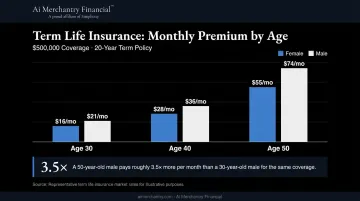
A 50-year-old male pays roughly 3.5 times more than a 30-year-old for identical coverage. Every year of delay narrows your options and raises your rate.
Coverage Breakpoints
Insurers often price policies more favorably at round coverage amounts — Banner Life, for instance, structures premium bands at $100K, $250K, $500K, and $1M. Choosing a breakpoint amount can produce a lower per-dollar cost than an off-round figure.
Estimating the Right Coverage Amount
Once you understand how pricing tiers work, the next question is how much coverage you actually need. Two common approaches:
- 10x rule — Multiply your annual income by 10 (a useful starting point, not a personalized calculation)
- DIME formula — Add up Debt + Income replacement needed + Mortgage balance + Education costs for dependents
The DIME formula tends to produce a more accurate number because it accounts for your actual financial obligations rather than a fixed multiple of income.
Term Life Insurance vs. Whole Life Insurance
The core differences between term and whole life insurance are duration, cost, and whether the policy accumulates any value over time.
| Term Life | Whole Life | |
|---|---|---|
| Coverage period | 10–30 years (fixed term) | Lifetime |
| Cash value | None | Builds over time |
| Premium level | Significantly lower | Significantly higher |
| Cost comparison | Baseline | 5–15x more (up to 21x in some cases) |
The "whole life costs X times more" range is wider than many sources suggest. Policygenius' life insurance statistics put permanent coverage at 5–15 times the cost of term; some comparisons show as much as 21 times more depending on age, gender, and coverage amount.
When Term Life Makes More Sense
- Coverage is tied to a time-limited obligation (mortgage, raising children, a business loan)
- Budget is a primary constraint and maximum coverage per dollar is the goal
- You want strong protection during peak earning and family-building years
When Permanent Life Insurance May Be Worth Considering
- You need lifelong coverage that won't expire
- Estate planning or legacy goals require a guaranteed death benefit
- You want a policy with a cash value component you can access during your lifetime
Neither option is universally superior. The right fit depends on where you are in life — what you owe, who depends on you, and how long that exposure lasts. A financial advisor can map those specifics to a structure that actually serves your situation.
Who Should Consider Term Life Insurance?
Strong Candidates
- Parents with young or school-age children — coverage that lasts until children are financially independent
- Primary breadwinners — one in four U.S. adults says their household would feel the financial impact of the primary earner's death within one month
- Homeowners with a mortgage — coverage aligns the term with the remaining loan period
- Business owners — key-person coverage protects the business if a critical owner or employee dies; SBA loans for owner-dependent businesses may also require life insurance as a condition when a loan is not fully secured
- Young professionals — locking in rates while healthy maximizes long-term value
The common thread: financial obligations with a defined end date.
Less Suitable Candidates
- Individuals with no financial dependents
- Those who have accumulated enough savings to cover family expenses without insurance
- Anyone nearing the end of a major financial obligation where coverage needs are diminishing
Those in this group are often better served by a permanent policy or a targeted coverage review rather than a new term policy.
Ai Merchantry Financial's Collaborative Planning Network™ connects individuals, families, and business owners with insurance professionals, financial strategists, and advisors who can map coverage to your actual situation. Start with an Insurance Needs Analysis or get matched with an advisor through the Advisor iMatch™ service.
What Happens When Your Term Policy Ends?
When a term policy approaches expiration, you have four main options:
- Let it lapse — appropriate if your financial obligations have been met and coverage is no longer needed
- Renew annually — most contracts permit year-by-year renewal at higher age-based premiums; only practical if declining health makes requalifying impossible
- Apply for a new policy — premiums will reflect your current age and health; still the best option if you're in good health and need extended coverage
- Convert to permanent coverage — if your policy includes a convertible rider, you can upgrade before the deadline without a new medical exam
The Laddering Strategy
Rather than waiting for a policy to expire, some policyholders plan ahead using a laddering strategy — structuring coverage to shrink naturally as financial obligations wind down.
Laddering means buying multiple overlapping term policies with different lengths at the same time, such as a 20-year and a 30-year policy. As shorter terms expire, total coverage decreases alongside obligations that have ended. Longer-term coverage stays in place for ongoing needs like income replacement during later working years.
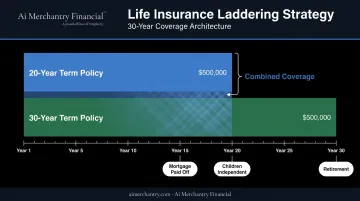
Key reasons this approach works well:
- Costs less overall than carrying a single large policy throughout
- Aligns coverage amounts with actual financial milestones (mortgage payoff, children's independence, retirement)
- Avoids paying for protection you no longer need
Frequently Asked Questions
What is term life insurance?
Term life insurance is a policy that pays a death benefit to your named beneficiaries if you die within a set coverage period — typically 10 to 30 years. It has no cash value component, which is why it's one of the most affordable forms of life insurance available.
How much is a $100,000 term life insurance policy?
Cost depends on your age, gender, health class, and term length. As a rough baseline, a healthy 30-year-old can expect to pay well under $20 per month for a $100,000, 20-year term policy — often less. An advisor or online quote tool can provide a figure based on your specific profile.
Which is better, term life or whole life insurance?
Neither is universally better. Term suits people who want affordable, time-limited coverage tied to specific financial obligations. Whole life fits those who need permanent protection or want a policy with a cash value component. The right answer depends on your goals, budget, and timeline.
At what age can you no longer get term life insurance?
Maximum issue ages vary by carrier and term length. Among major insurers, overall caps generally fall between 75 and 80 — but longer terms carry much lower limits. Protective's Classic Choice, for example, caps the 30-year term at age 58 for non-tobacco classes. Premiums rise sharply with age, making earlier purchase consistently more cost-effective.
Can you convert term life insurance to whole life?
Many term policies include a convertible rider letting you convert to permanent coverage before a set deadline — no new medical exam required. Conversion windows vary — some carriers use the earlier of 10 policy years or age 70. Converting preserves your original health rating even if your health has declined.
Do you get money back if you outlive your term policy?
Standard term policies do not return premiums if you outlive the coverage period. Return-of-premium policies refund all or part of what you paid — but they cost significantly more upfront (typically 2–5 times the cost of a standard policy). Early cancellation typically forfeits the refund.