

Introduction
Someone turning 65 today has almost a 70% chance of needing some form of long-term care services, according to the Administration for Community Living. And that care isn't cheap — 2024 national median costs run $77,792 annually for a home health aide and up to $127,750 for a private nursing home room, per CareScout's 2024 Cost of Care Survey.
Traditional long-term care insurance puts families in a difficult spot. Premiums are ongoing, rate increases are common, and if you stop paying, the coverage disappears — along with every dollar you put in. You're essentially renting protection you may never use.
That's where asset-based long-term care strategies offer a different path. Instead of paying into a policy with no residual value, you reposition existing assets into a structure that covers care costs or passes wealth to your heirs — built to deliver value either way.
This guide covers what asset-based LTC is, how both primary structures work, how it compares to traditional LTC insurance, who it fits best, and how to fund a policy.
Key Takeaways
- 56% of Americans turning 65 will develop a disability serious enough to require long-term care services, according to HHS/ASPE's 2022 projection
- Asset-based LTC eliminates the "use it or lose it" problem — benefits go to care or to heirs
- Two primary structures: permanent life insurance with accelerated LTC benefits, or a fixed annuity with an LTC rider
- Common funding sources include low-yield savings, existing life insurance, or annuities repositioned through a tax-advantaged 1035 exchange
- Ages 45–60 is the optimal purchase window — health qualifications are easier to meet and premiums are lower
What Is Asset-Based Long-Term Care?
Asset-based LTC is a hybrid financial strategy combining long-term care benefits with either a life insurance policy or an annuity. Unlike standalone LTC insurance, these structures guarantee that the money you commit will produce value — either as care benefits during your lifetime or as a death benefit to your beneficiaries.
What These Policies Cover
Coverage scope varies by carrier and contract, but most asset-based LTC policies pay for:
- In-home care and home health aides
- Assisted living and memory care facilities
- Nursing home care (semi-private or private)
- Respite care for family caregivers
- Adult day services
How Claims Are Triggered
Under IRC Section 7702B, a claim is typically activated when a licensed health care practitioner certifies that the insured cannot perform at least two of the six Activities of Daily Living (ADLs) (eating, bathing, dressing, continence, transferring, and toileting) — and that this limitation is expected to last at least 90 days. Severe cognitive impairment serves as an alternative trigger.
Certification doesn't have to come from a physician. The statute recognizes registered nurses, licensed social workers, and other qualified practitioners.
The Elimination Period
Most policies include an elimination period — commonly 30, 60, or 90 days — during which you cover care costs out of pocket before the policy begins paying. Think of it as a deductible measured in time rather than dollars. Keep that window in mind when sizing your cash reserves.
Asset-Based LTC vs. Life Insurance with an LTC Rider
These aren't the same thing. In a true asset-based LTC policy, care benefits come first — the structure is built primarily to fund long-term care, with any remaining value passing as a death benefit. A life insurance policy with an LTC rider is structured the other way around: life insurance is the primary product, and LTC is a secondary feature added on. The priority of benefits differs structurally, and that distinction matters when you're actually filing a claim.
How Asset-Based Long-Term Care Works
Two primary product structures exist. Both are living benefits — meaning the policyholder accesses them during their lifetime, not just at death.
Permanent Life Insurance Structure
The most common life-based structure works like this:
- You make a lump-sum or limited-pay premium deposit into a permanent life insurance policy (typically whole life or universal life)
- The policy accumulates cash value over time
- If you need care, the death benefit is accelerated — monthly payments fund your care costs
- If you never need care, the full death benefit passes to your beneficiaries income tax-free at death
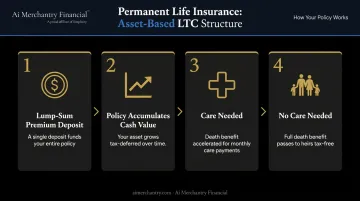
The death benefit essentially does double duty: it's a care fund while you're alive and a legacy asset when you're gone.
The annuity-based structure takes a different approach — one better suited for people who prefer guaranteed growth over a life insurance component.
Annuity-Based Structure
The annuity structure uses a single-premium deferred annuity paired with an LTC benefit rider:
- You deposit a lump sum into a fixed annuity
- If care is needed, the account value becomes accessible for qualified LTC expenses; an optional extension-of-benefits rider can continue payments after the account value is exhausted
- If you stay healthy, the annuity retains its value — it can be passed to heirs or surrendered
How much leverage an annuity provides depends on contract terms, your age, health classification, and the specific rider structure. Benefit pools vary significantly by product — review contract details carefully rather than assuming any fixed multiplier applies.
According to LIMRA's 2025 analysis, annuity-LTC combination sales hit a record in 2024, rising more than 50% year over year — reflecting growing demand from pre-retirees who want asset protection without sacrificing liquidity.
Return of Premium Provisions
Many asset-based LTC policies include a return of premium or surrender provision: if your needs change or you decide you no longer want the coverage, you can cancel and recover a meaningful portion — often 80–100% — of the original premium. This stands in direct contrast to traditional LTC insurance, where stopping payments means forfeiting everything you've paid in.
Asset-Based LTC vs. Traditional Long-Term Care Insurance
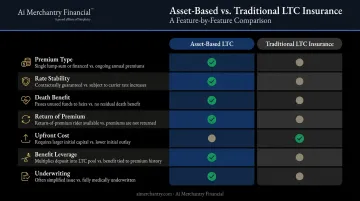
The table below highlights how these two approaches differ across the features that matter most to most planning conversations.
| Feature | Asset-Based LTC | Traditional LTC Insurance |
|---|---|---|
| Premium type | Lump sum or limited pay | Ongoing annual premiums |
| Rate stability | Locked at issue — cannot change | Subject to carrier rate increases |
| Death benefit | Yes — remaining value passes to heirs | No residual value |
| Return of premium | Often available | Not available |
| Upfront cost | Higher | Lower |
| LTC benefit leverage | Lower (must fund guaranteed death benefit) | Higher (premiums are smaller relative to benefit pool) |
| Underwriting | Varies; annuity-based often less intensive | Typically more stringent |
Advantages of Asset-Based LTC
- Guaranteed rates — premiums and policy terms lock in at issue and cannot be raised
- Death benefit — unused care benefits pass to beneficiaries, preserving family wealth
- Return of premium — liquidity option if circumstances change
- Dual-purpose structure — eliminates the "use it or lose it" concern that plagues standalone policies
- Underwriting flexibility — annuity-based products often involve less intensive underwriting than life-based combination products
Disadvantages of Asset-Based LTC
- Large upfront capital requirement — repositioning $50,000+ can strain liquidity if not properly planned
- Lower benefit leverage — because the carrier guarantees a death benefit payout regardless, the LTC coverage pool is smaller relative to premium than standalone policies
- Complexity — hybrid products require careful comparison; contract terms vary significantly across carriers
When Traditional LTC Insurance May Still Be the Better Choice
Standalone LTC insurance isn't obsolete. It may still make sense for individuals who:
- Have limited liquid assets and cannot fund a large single premium
- Prioritize the maximum LTC benefit pool relative to annual cost
- Prefer to keep their insurance and investment strategies separate
Neither approach is universally superior. The right fit depends on your asset position, health profile, and what you most want protected — your benefit pool, your estate, or your flexibility.
Key Benefits of Asset-Based Long-Term Care Strategies
Rate Stability
Traditional standalone LTC policies have a documented history of premium increases. The GAO reported that a 2010 rate increase in the Federal Long Term Care Insurance Program affected approximately 66% of enrolled policyholders, with increases reaching 5%–25% for those affected. Asset-based LTC eliminates this risk entirely: your premium is set at the time of purchase and contractually guaranteed.
Tax Advantages
Asset-based LTC policies carry notable tax benefits under IRC Section 7702B:
- Benefits received are generally excluded from gross income
- Eligible premiums may be counted as medical expenses for itemized deduction purposes, subject to age-based IRS limits
For 2026, IRS Revenue Procedure 2025-32 sets the following eligible-premium limits:
| Age at end of 2026 | Maximum eligible premium |
|---|---|
| 40 or younger | $500 |
| 41–50 | $930 |
| 51–60 | $1,860 |
| 61–70 | $4,960 |
| 71 or older | $6,200 |

These are ceilings on the premium amount you can include as a medical expense — not automatic deductions. The full hybrid premium is not deductible, and LTC charges drawn from a policy's cash value are not separately deductible under Section 213. Confirm your specific situation with a CPA.
Legacy and Estate Planning Value
For clients focused on generational wealth, asset-based LTC does something standalone insurance cannot: it functions as both a care fund and a wealth transfer vehicle simultaneously.
Key advantages for legacy-focused planning:
- Unused LTC benefits pass as a tax-free death benefit to named beneficiaries
- Preserves family assets whether or not a care event ever occurs
- Integrates directly into estate planning alongside trusts and other wealth transfer tools
Who Should Consider Asset-Based Long-Term Care and When
The Ideal Candidate Profile
Asset-based LTC works best for individuals who:
- Are ages 45–65, with the sweet spot around 45–60 per AALTCI guidance
- Have $50,000 or more in repositionable liquid assets — cash, CDs, low-yield savings, or existing life insurance and annuity contracts
- Want to protect retirement savings from catastrophic care costs without sacrificing legacy value
- Are in moderate to good health and can meet underwriting requirements
The application and underwriting process typically takes 45–90 days. Waiting until health declines significantly can eliminate eligibility or substantially increase costs.
Situations Where Asset-Based LTC Fits Especially Well
Beyond the baseline profile, certain life circumstances make this strategy a particularly strong match:
- Married couples concerned about one spouse depleting joint assets and leaving the survivor financially exposed
- High-net-worth individuals prioritizing estate preservation alongside care protection
- People with low-yield assets — CDs, money market accounts, or dormant whole life policies — sitting idle rather than generating meaningful returns
- Individuals who couldn't qualify for traditional LTC insurance, since annuity-based products typically require simplified underwriting compared to traditional LTC policies

Who May Not Be a Strong Fit
Asset-based LTC isn't the right solution for everyone. These situations generally point toward other planning strategies:
- Individuals with insufficient liquid assets to fund a lump-sum premium without undermining other financial priorities
- Those in poor health who cannot meet underwriting requirements for any hybrid product
- Younger individuals early in wealth-building who may benefit more from term coverage or traditional LTC while their assets are still accumulating
The right strategy depends on your asset profile, health status, and planning timeline. A qualified advisor can run a side-by-side comparison to show exactly what repositioning your assets could fund — and what gaps remain.
How to Fund Your Policy and Get Started
Common Funding Sources
| Asset Type | 1035 Exchange Eligible? |
|---|---|
| Cash savings / money market | No — treated as ordinary premium payment |
| Certificates of deposit (CDs) | No — treated as ordinary premium payment |
| Existing life insurance policy | Yes — may exchange directly into a qualified LTC contract |
| Nonqualified annuity | Yes — may exchange directly into a qualified LTC contract |
| Existing qualified LTC contract | Yes — may exchange into another qualified LTC contract |
A 1035 exchange allows you to reposition an existing life insurance policy or nonqualified annuity into a qualified LTC contract without triggering a taxable event. This is one of the most commonly used funding strategies for asset-based LTC — particularly for clients holding older whole life policies with accumulated cash value. If that value isn't working toward a clear goal, repositioning it into LTC coverage may be worth exploring.
The Case for Collaborative Planning
Asset-based LTC sits at the intersection of tax law, estate planning, insurance structuring, and retirement strategy. Decisions made in isolation — without accounting for how a policy interacts with your overall financial picture — can create unintended tax consequences or gaps in coverage.
This is where Ai Merchantry Financial's Collaborative Planning Network™ becomes relevant. Rather than treating LTC planning as a standalone insurance transaction, the network connects individuals with insurance professionals, financial strategists, tax professionals, and estate planning attorneys. Together, they evaluate whether an asset-based LTC strategy fits within your broader retirement and legacy plan. The We~LL Care Living™ program is one of the firm's dedicated frameworks for these conversations.
Actionable Next Steps
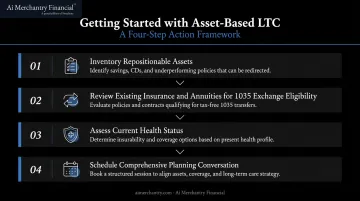
- Inventory your repositionable assets — identify cash, CDs, and existing insurance or annuity contracts that may be underperforming
- Review existing life insurance and annuity contracts for 1035 exchange eligibility with a qualified advisor
- Assess your current health status — the earlier you act, the more options remain open
- Schedule a comprehensive planning conversation before age or health changes narrow your eligibility
To start that conversation, you can reach Ai Merchantry Financial at (844) 626-2246, book a consultation through their Ai Meeting™ scheduling platform, or explore the We~LL Care Living™ resource at aimerchantry.com/well-care-living.
Frequently Asked Questions
What assets can be used to fund an asset-based long-term care policy?
Common funding sources include cash savings, CDs, existing life insurance policies, and nonqualified annuities. Life insurance and annuity contracts can be repositioned via a tax-advantaged 1035 exchange, which transfers those assets into a qualified LTC contract without triggering a taxable event. CDs and savings accounts are not 1035-eligible and are treated as ordinary premium payments.
What triggers a long-term care insurance claim?
Most policies activate when a licensed health care practitioner certifies the insured cannot perform at least two of six Activities of Daily Living (such as bathing, dressing, or transferring) for 90+ days. Severe cognitive impairment qualifies as an alternative trigger.
How is asset-based LTC different from a life insurance policy with a long-term care rider?
Asset-based LTC is built primarily to fund care, with any remaining value passing as a death benefit. A life insurance policy with an LTC rider is structured primarily as life insurance; LTC is a secondary benefit. The priority of what gets paid first differs, and that structure matters when an actual claim occurs.
What happens if I never need long-term care?
The death benefit passes to named beneficiaries income tax-free. Many policies also include a return of premium provision, letting you surrender the policy and recover a significant portion of what you paid. Either way, you avoid the complete loss of premium that traditional LTC insurance carries.
Is asset-based long-term care tax-deductible?
LTC benefits are generally income tax-free under IRC Section 7702B, and eligible premiums may count as medical expenses subject to IRS age-based limits ($500–$6,200 for 2026). The full hybrid premium is not automatically deductible, so consult a CPA to confirm how your specific policy applies.
When is the best age to purchase asset-based long-term care coverage?
The optimal window is typically ages 45–60, when health qualifications are more easily met and pricing is more favorable. Waiting significantly increases the risk of being declined due to health changes or facing substantially higher costs. The application process typically takes 45–90 days, so acting before health issues arise is critical.