

Tax-Free Retirement Accounts (TFRAs) exist specifically to change that outcome. By structuring retirement savings so withdrawals aren't subject to ordinary income tax, TFRAs offer a level of predictability that traditional pre-tax accounts simply can't match.
One important clarification upfront: "TFRA" is used two ways. Broadly, it refers to any account generating tax-free retirement income — Roth IRAs, Roth 401(k)s, HSAs. More narrowly, financial professionals use it to describe a strategy built around a max-funded permanent life insurance policy under Section 7702 of the Internal Revenue Code. This guide covers both, so you can make a fully informed decision.
Key Takeaways
- TFRAs include Roth IRAs, Roth 401(k)s, HSAs, and Section 7702 life insurance plans — each funded with after-tax dollars
- Qualified withdrawals from Roth accounts are completely income-tax-free when IRS rules are followed
- Section 7702 plans carry no fixed IRS contribution cap like Roth accounts do — limits are set by policy-specific actuarial rules instead
- Policy loans from a non-MEC Section 7702 plan stay out of your AGI — protecting Social Security taxation and Medicare premium calculations
- The right TFRA (or combination) depends on your income, health, time horizon, and long-term goals
What Is a Tax-Free Retirement Account (TFRA)?
A TFRA is a retirement savings vehicle structured so that money you withdraw in retirement isn't subject to federal income tax. Either you pay taxes on contributions upfront, or the account's legal structure allows tax-free access through a specific mechanism.
The Two Primary Categories
- Tax-exempt accounts (Roth IRA and Roth 401(k)): You pay taxes before contributing. Qualified withdrawals in retirement are completely tax-free.
- Section 7702 Life Insurance Plans: Cash value grows tax-deferred inside a permanent policy. Retirement income is accessed through policy loans, which the IRS generally doesn't treat as taxable income for non-MEC policies — provided the policy stays in force.
What a TFRA Is NOT
- An official IRS account category — no IRS publication formally defines "TFRA" as a statutory label
- A way to eliminate taxes entirely — you either pay them upfront or structure access carefully
- A loophole — Section 7702 is a long-standing provision of the tax code, not a gray area
Other Tax-Advantaged Vehicles Worth Knowing
Understanding what a TFRA is not also highlights where other vehicles fit. Health Savings Accounts (HSAs) offer a triple tax advantage: deductible contributions, tax-deferred growth, and tax-free withdrawals for qualified medical expenses. For retirees with significant healthcare costs, an HSA can offset expenses that would otherwise erode taxable retirement income.
Social Security benefits may also be partially or fully tax-free. According to IRS Publication 915, benefits begin entering the taxable calculation when combined income exceeds $25,000 for single filers or $32,000 for married filing jointly. Up to 85% of benefits may be taxable above $34,000 (single) or $44,000 (joint). Managing other retirement income sources carefully can keep Social Security benefits below these thresholds.
How Does a TFRA Account Work?
Roth IRA and Roth 401(k)
Roth accounts are funded with after-tax dollars. Growth is tax-free. Qualified withdrawals (taken after age 59½ with the account open at least five years) are completely tax-free.
2025 contribution limits (IRS Notice 2024-80):
| Account | Standard Limit | Age 50+ Catch-Up | Ages 60–63 Special Catch-Up |
|---|---|---|---|
| Roth IRA | $7,000 | +$1,000 = $8,000 | N/A |
| Roth 401(k) | $23,500 | +$7,500 = $31,000 | +$11,250 = $34,750 |
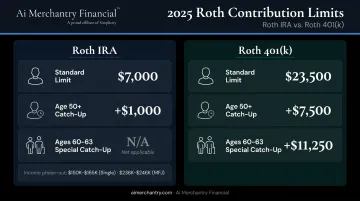
Roth IRA income phase-out (2025):
- Single/head of household: $150,000–$165,000
- Married filing jointly: $236,000–$246,000
Above those thresholds, Roth IRA contributions phase out entirely. Roth 401(k)s have no income restriction.
RMD update: Under SECURE 2.0, designated Roth accounts in employer plans (like Roth 401(k)s) no longer require lifetime RMDs, effective for tax years beginning after December 31, 2023. Roth IRAs have never had owner-lifetime RMDs.
Health Savings Accounts (HSAs): The Triple Tax Advantage
Roth accounts address income taxes on growth and withdrawals — HSAs go further, layering tax benefits at contribution, accumulation, and distribution.
HSAs deliver three federal tax benefits at once:
- Contributions are tax-deductible (or excluded from income if employer-funded)
- Earnings grow tax-deferred inside the account
- Withdrawals for qualified medical expenses are tax-free at any age
2025 HSA limits: $4,300 for self-only coverage; $8,550 for family coverage. Those 55+ can add $1,000.
After age 65, non-medical withdrawals are taxed as ordinary income — the 20% penalty that applies before age 65 drops away entirely. HSAs effectively become a supplemental retirement account once your healthcare costs are covered.
Section 7702 Life Insurance Plans (IUL-Based TFRAs)
These strategies use permanent life insurance (typically an Indexed Universal Life, or IUL, policy) funded with after-tax premiums. The structure works in three stages:
- Premiums paid with after-tax dollars
- Cash value grows tax-deferred inside the policy (IUL policies typically link growth to a market index with a 0% floor, meaning no losses in down markets)
- Retirement income accessed via policy loans — loans the IRS does not treat as taxable income for non-MEC policies, provided the policy remains in force
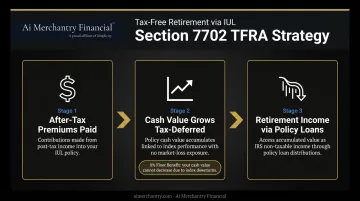
The MEC rule matters. Under Section 7702A, if you fund a policy too aggressively in the first seven years, it becomes a Modified Endowment Contract (MEC). MEC distributions follow LIFO treatment (income first), and a 10% additional tax applies before age 59½. A properly structured policy stays below the MEC threshold — proper design from an experienced advisor is essential.
Key requirements unique to Section 7702 TFRAs:
- Medical underwriting is required (unlike Roth accounts)
- The policy must remain in force throughout the distribution period
- Unpaid policy loans reduce the death benefit and can cause lapse if not managed
- Surrendering or lapsing the policy can trigger ordinary taxable income on any recognized gain
- Designed as a long-term strategy : optimal distributions typically require 10+ years of policy growth
TFRA vs. 401(k) vs. Roth IRA: How They Compare
| Feature | Section 7702 TFRA (IUL) | Traditional 401(k) | Roth IRA |
|---|---|---|---|
| Contribution limits | Policy-specific actuarial limits; no fixed IRS dollar cap comparable to $7,000/$23,500 | $23,500 employee deferral (2025) | $7,000 / $8,000 age 50+ (2025) |
| Income restrictions | None | None | Phases out at $150K–$165K (single); $236K–$246K (MFJ) |
| Tax on contributions | After-tax | Pre-tax | After-tax |
| Tax on growth | Tax-deferred | Tax-deferred | Tax-free |
| Tax on withdrawals | Non-MEC policy loans generally not taxable income | Ordinary income tax | Tax-free (qualified distributions) |
| RMDs | No IRS RMD rule identified in primary sources for owner-held cash value | Age 73 (born 1951–1959) or 75 (born 1960+) | None |
| Early withdrawal penalty | No early withdrawal penalty on policy loans | 10% penalty before 59½ | 10% on earnings before 59½ |
| Downside protection | 0% floor in IUL policies | No floor; full market exposure | No floor; full market exposure |
| Death benefit | Yes | No | No |
The Tax Deferral vs. Tax Elimination Distinction
A traditional 401(k) reduces your taxes today — but every dollar you withdraw in retirement is taxed as ordinary income at rates you cannot control or predict. A TFRA removes that uncertainty by eliminating the tax on the back end.
Still, the 401(k) employer match is valuable and should be captured first before directing additional dollars into a TFRA. Leaving matching contributions on the table is a hard mistake to recover from, regardless of tax strategy.
Where the Roth IRA Falls Short for High Earners
With a $7,000–$8,000 annual limit and income phase-outs, the Roth IRA is insufficient — or unavailable — for many high earners. A Section 7702 plan has no government-imposed contribution ceiling comparable to those fixed dollar amounts, making it the primary tax-free vehicle for those who have maxed out or been excluded from Roth IRAs.
A Hidden Advantage: IRMAA and Social Security Taxation
Traditional 401(k) RMDs add to your adjusted gross income. That higher AGI can push more of your Social Security benefits into taxable territory and trigger IRMAA — the Income-Related Monthly Adjustment Amount that increases Medicare Part B and Part D premiums. Schwab notes that the start of RMDs can cause a surge in taxable income and move retirees into higher IRMAA tiers.
Policy loan income from a properly structured, non-MEC Section 7702 plan doesn't appear in your AGI. In practical terms, that means:
- Policy loans generally don't affect Social Security taxability thresholds
- They typically don't count toward IRMAA income calculations
- Neither benefit applies to MEC loans or gains recognized after a lapse or surrender
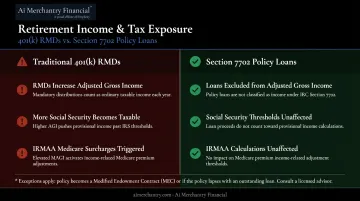
Policy maintenance matters. A lapsed or surrendered policy can convert previously tax-advantaged income into a taxable event, negating these advantages.
Pros and Cons of a TFRA Account
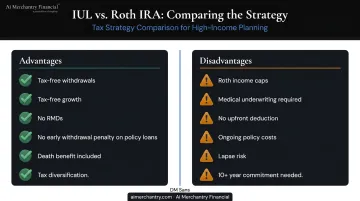
Advantages
Both Roth accounts and Section 7702 policies share a core benefit: keeping more of your retirement income out of the IRS's reach. Here's what they offer:
- Tax-free withdrawals — qualified Roth distributions and non-MEC policy loans carry no income tax
- Tax-free growth in both Roth accounts and properly structured Section 7702 policies
- No required minimum distributions for Roth IRAs and Roth 401(k)s (eliminated under SECURE 2.0); Section 7702 policy cash value isn't subject to IRS RMD rules either
- No early withdrawal penalty on Section 7702 policy loans when structured correctly outside MEC status
- Section 7702 plans include a death benefit, addressing protection and retirement savings in a single vehicle
- Combining a TFRA with a traditional 401(k) creates tax diversification — giving you more control over your taxable income in retirement
Disadvantages
These strategies aren't a fit for everyone. The main limitations to weigh:
- Roth IRA contribution limits and income caps restrict access for high earners — phase-outs begin at $146,000 (single) and $230,000 (married filing jointly) in 2024
- Section 7702 plans require medical underwriting — health conditions can raise costs or disqualify you entirely
- No upfront tax deduction on contributions — neither strategy reduces your taxable income today
- Section 7702 plans carry ongoing policy costs, including mortality charges, insurance fees, and administrative expenses that reduce net returns
- Lapse risk is real — missed premiums or unpaid loans can collapse a policy and trigger a taxable event on accumulated gains
- Section 7702 strategies need 10+ years to optimize — they're a long-term commitment, not a short-term solution
Who Should Consider a TFRA?
Who Benefits Most from a Roth-Based TFRA
- Younger earners currently in a lower tax bracket who expect income to grow
- Anyone who values tax-free flexibility and wants to avoid RMDs in retirement
- Those with household income below the Roth IRA phase-out thresholds
Who Benefits Most from a Section 7702 TFRA
- High-income earners who've maxed out their 401(k) and Roth IRA — or who exceed Roth income limits
- Business owners seeking flexible, scalable retirement savings without government-imposed caps
- Individuals who need life insurance coverage and want one strategy to serve both purposes
- Those specifically concerned about rising tax rates or RMD-driven tax exposure in retirement
Vanguard's 2025 How America Saves report found that 49% of participants earning over $150,000 hit the 401(k) deferral maximum, compared to just 1% of those earning $50,000–$74,999. For that high-earning group, a Section 7702 plan is often the logical next layer of tax-free accumulation.
That said, Section 7702 strategies aren't the right fit for everyone — and understanding the exclusions is just as important as knowing the benefits.
Section 7702 TFRAs Are NOT Right For
- People with significant health conditions that make underwriting cost-prohibitive
- Those with short investment time horizons (under 10 years)
- Lower-income earners for whom a simple Roth IRA is more efficient and cost-effective
How to Get Started with a TFRA
Setting up a Roth IRA or Roth 401(k) is relatively straightforward — through a brokerage or your employer's plan. A Section 7702 plan is a different matter entirely.
It must be max-funded and carefully structured to stay below the MEC threshold. Improperly designed policies underperform and can lose their tax advantages. This is not a DIY process. It requires a licensed insurance professional who specializes in IUL policy design.
The best starting point is a comprehensive financial review that examines:
- Your current tax situation and marginal rate
- Existing retirement accounts and contribution headroom
- Income trajectory and expected retirement tax bracket
- Life insurance needs
- Time horizon and health status
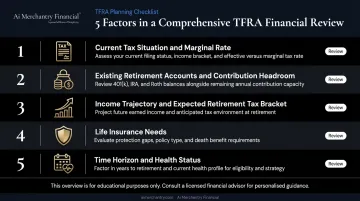
The findings from that review point toward the right path — whether that's a Roth IRA, a Section 7702 plan, or both working together.
Ai Merchantry Financial's Collaborative Planning Network™ connects individuals with CPAs, insurance professionals, and financial strategists who can help design a tax-free retirement strategy built around your goals — not around a product.
Frequently Asked Questions
What retirement accounts are tax-free?
Tax-free retirement accounts include Roth IRAs, Roth 401(k)s, HSAs (for qualified medical expenses), and properly structured Section 7702 life insurance plans. The key distinction: tax-free accounts eliminate the tax on the back end, while tax-deferred accounts (like traditional 401(k)s) simply postpone it.
Is a TFRA the same as a Roth IRA?
Not exactly. "TFRA" can refer to any tax-free retirement vehicle, including Roth IRAs. But in financial planning circles, the term often refers specifically to a Section 7702 life insurance plan — which has no fixed IRS contribution cap (unlike the Roth IRA's $7,000 annual limit) and no income restrictions, making it structurally different from a Roth IRA.
What is the difference between a TFRA and a 401(k)?
A 401(k) defers taxes — every withdrawal in retirement is taxed as ordinary income, and RMDs begin at age 73 or 75 depending on birth year. A TFRA generates tax-free income through qualified Roth withdrawals or non-MEC policy loans.
Who qualifies for a TFRA account?
Roth IRAs have income limits ($150,000–$165,000 single; $236,000–$246,000 married filing jointly for 2025). Section 7702 plans have no income restrictions but require medical underwriting. Anyone in good health who can commit to a long-term premium strategy may qualify for a Section 7702 plan.
Are TFRA strategies legitimate and IRS-approved?
Yes. Roth accounts are governed by Sections 408A and 402A of the Internal Revenue Code. Section 7702 life insurance strategies are governed by Section 7702, with MEC rules under Section 7702A. Both are established, legal strategies — not loopholes.
Can I contribute to a TFRA and a 401(k) at the same time?
Yes, and many people should. A common approach: contribute to your 401(k) up to the employer match, then direct additional savings into a Roth IRA or Section 7702 plan. This creates tax diversification — some income taxed going in, some taxed coming out, some not taxed at either point.