

Introduction
Social Security is likely the largest financial asset most Americans will ever own — yet an NBER study found that more than 90% of workers ages 45–62 would benefit from delaying their claim to age 70, while the median modeled lifetime loss from suboptimal claiming was $182,370.
The core tension is straightforward: claim early and get income sooner, but permanently lock in a smaller monthly check. Delay, and you'll collect more each month for the rest of your life — if you can afford to wait.
There's no universal right answer. Health, marital status, income needs, and longevity expectations all shape the decision. This guide covers what you need to make that decision with confidence:
- How your benefit is calculated and what drives the dollar amount
- What each claiming window actually means in monthly and lifetime terms
- How health, marriage, and income change the math
- What you can do before — and after — you claim to protect your outcome
Key Takeaways
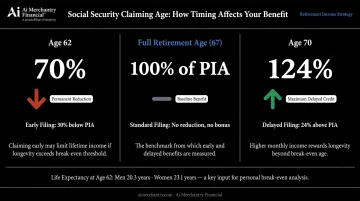
- Claiming at 62 permanently reduces your benefit by up to 30%; waiting until 70 can pay up to 124% of your FRA benefit
- Full Retirement Age (FRA) — 66 to 67 depending on birth year — is the benchmark for all claiming decisions
- Married couples can add tens of thousands in lifetime household income through coordinated claiming strategies
- Your optimal claiming age depends on the earnings test, federal taxation rules, and how long you expect to live
- Delaying Social Security past 62 requires a plan to cover income in the interim — annuities are one tool that can fill that window
Social Security Basics: FRA, PIA, and How Your Benefit Is Calculated
Two terms drive every Social Security conversation: Full Retirement Age and Primary Insurance Amount.
Full Retirement Age (FRA) is the age at which you receive 100% of your calculated benefit. For anyone born in 1960 or later, FRA is 67. For those born between 1955 and 1959, it ranges from 66 and 2 months to 66 and 10 months. You can look up your specific FRA using the SSA's Retirement Age Calculator.
Primary Insurance Amount (PIA) is the monthly benefit you'd receive at FRA — your baseline, not your maximum. Every early or delayed claiming adjustment is calculated as a percentage of this number.
How the SSA Calculates Your Benefit
The calculation follows a straightforward sequence:
- Index your earnings — SSA adjusts your lifetime wages for inflation
- Select your top 35 years — only your highest-earning years count toward your Average Indexed Monthly Earnings (AIME)
- Apply the bend point formula — SSA runs your AIME through a tiered formula to produce your PIA
- Adjust for claiming age — your PIA is then reduced if you claim early or increased if you delay
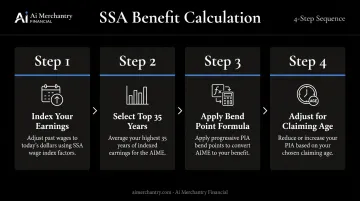
If you worked fewer than 35 years, zero-income years are averaged in, which directly lowers your PIA. Every additional year of work that replaces a zero — or a low-earning year — raises it.
One important note on cost-of-living adjustments (COLA): they apply to your PIA after eligibility begins, even before you start collecting. Because COLA is a percentage of your monthly benefit, a higher base from delaying means each annual adjustment adds more in absolute dollars. That compounding effect is a significant part of why waiting pays off.
The Claiming Age Decision: Early, On Time, or Late?
According to 2024 SSA data, about 22% of men and 23.3% of women claimed at 62, while only 8.4% and 9.1% respectively were newly entitled in the ages 70–74 range. Most people claim well before they need to.
Here's what each window actually delivers:
Claiming at 62 — The Early Option
For anyone born in 1960 or later, claiming at 62 permanently reduces the FRA benefit by 30%. A $1,000/month FRA benefit becomes $700/month — for life. The reduction follows a specific formula: 5/9 of 1% per month for the first 36 months early, then 5/12 of 1% for each additional month.
Early claiming makes sense when:
- You have a serious health condition that shortens your expected lifespan
- You have no other income source and genuinely need the money
- You've run the break-even math and determined you won't live long enough for delay to pay off
Claiming at Full Retirement Age
Claiming at FRA means collecting 100% of your PIA with no reduction or bonus. This works well for people who need income but have limited ability to delay further, or those with a moderate health outlook who don't want to gamble on living well into their 80s.
Delaying Until 70 — Maximizing Monthly Income
Delayed retirement credits grow your benefit by 8% per year (or 2/3 of 1% per month) for every year you wait past FRA, up to age 70. For someone with an FRA of 67, that's three additional years of credits — producing 124% of their PIA at 70.
Two critical rules here:
- Delayed credits only apply to your own retirement benefit, not spousal benefits
- There is no advantage to waiting past 70 — credits stop accruing
Understanding the Break-Even Age
J.P. Morgan's 2026 Guide to Retirement models the FRA-versus-70 crossover at roughly 80 years and 8 months — though that figure depends on specific COLA and earnings assumptions, not a universal rule.
Financial planners often use a "plan-to age" instead: a conservative longevity estimate that accounts for the real risk of outliving your assets. SSA's 2023 period life table puts remaining life expectancy at age 62 at 20.3 years for men and 23.1 years for women, putting many retirees past typical break-even thresholds.
Claiming Strategies for Different Life Situations
The right claiming strategy depends heavily on your household structure. Here's how the math changes by situation.
Strategies for Single Individuals
For singles, the decision comes down to two factors: personal health outlook and financial resources to bridge any delay gap.
- Good health, adequate savings: Delaying to 70 functions as longevity insurance — the higher monthly check protects against depleting other assets in your 80s and 90s
- Poor health or immediate income need: The break-even calculation matters more; if you're unlikely to collect for 20+ years, earlier claiming may be rational
- Divorced after 10+ years of marriage: You may be eligible to claim on your ex-spouse's record (up to 50% of their PIA) without affecting their benefits — worth checking if that amount exceeds your own earned benefit
The survivor benefit dimension doesn't apply for singles, which simplifies the decision — but the longevity insurance argument for delaying remains just as valid.
Strategies for Married Couples
Married couples have more moving parts, and more opportunity to optimize.
Spousal benefits allow a lower-earning spouse to receive up to 50% of the higher earner's PIA, but only if they claim at their own FRA. Claiming before their FRA permanently reduces the spousal amount. Note that the higher earner's delayed credits don't increase the spouse's maximum — it stays capped at 50% of the worker's PIA.
Under the Bipartisan Budget Act of 2015, deemed filing applies to anyone born on or after January 2, 1954. Filing for retirement benefits automatically triggers a simultaneous spousal benefit claim — the old "restricted application" strategy is no longer available to most retirees.
The split strategy is the most common optimization approach for couples:
- The lower earner claims first (at FRA or earlier if needed) to generate household income
- The higher earner delays to 70, maximizing their delayed retirement credits
- Once the higher earner files, the lower-earning spouse evaluates whether switching to a spousal benefit makes sense
Example: If the higher earner's PIA is $2,500 and they delay to 70 (FRA of 67), their monthly benefit grows to approximately $3,100/month. The lower earner collects their own benefit in the interim. When the higher earner files, the lower-earning spouse can receive up to $1,250/month in spousal benefits if that exceeds their own earned amount.

The survivor benefit dimension is the most underappreciated piece. When one spouse dies, only the larger of the two benefits continues. The higher earner's delay decision directly determines the surviving spouse's income floor — potentially for decades.
Strategies for Surviving Spouses
Survivor benefits follow different rules than retirement or spousal benefits — keep them separate.
- Surviving spouses can claim as early as age 60 (or 50 with a qualifying disability)
- Benefits start at 71.5% of the applicable worker benefit and rise with filing age, reaching 100% at survivor FRA
- Survivor FRA differs slightly from retirement FRA — those born in 1962 or later have a survivor FRA of 67, but earlier birth years have earlier survivor FRAs (see SSA survivor FRA table)
- Survivor benefits do not grow past survivor FRA — no delayed credits apply to the survivor for waiting longer
The key switching strategy depends on which benefit will ultimately be larger:
- Your own benefit will be larger: Claim survivor benefits early and let your own retirement benefit grow via delayed credits until 70
- The survivor benefit will be larger: Claim your own benefit early and switch to survivors at survivor FRA, when they reach their peak
Tax, Earnings Test, and Other Factors That Impact Benefits
The Earnings Test
If you claim before FRA and continue working, the earnings test applies. In 2025, SSA withholds $1 for every $2 earned above $23,400. In the year you reach FRA, the limit rises to $62,160, and only earnings before your FRA month count.
The critical clarification: withheld benefits are not lost permanently. At FRA, SSA recalculates your benefit upward to credit the months that were withheld.
Social Security Taxation
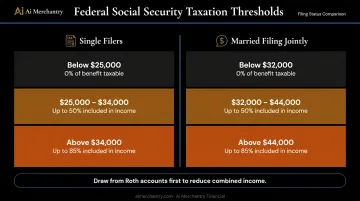
Up to 85% of your Social Security benefits may be included in federal taxable income, depending on your "combined income" (AGI + tax-exempt interest + 50% of Social Security benefits):
| Filing Status | 50% Included | 85% Included |
|---|---|---|
| Single | $25,000–$34,000 | Above $34,000 |
| Married Filing Jointly | $32,000–$44,000 | Above $44,000 |
At the state level, eight states currently tax some residents' Social Security benefits: Colorado, Connecticut, Minnesota, Montana, New Mexico, Rhode Island, Utah, and Vermont — though each provides income- or age-based relief.
That combined tax exposure — federal and potentially state — makes account sequencing worth planning ahead. Drawing from Roth accounts before you claim, rather than tax-deferred accounts like traditional IRAs or 401(k)s, can reduce your combined income and lower the taxable portion of your benefit.
The Redo and Suspension Options
If you want to change course after claiming, two reset options are available:
- Withdrawal: Within 12 months of your first month of entitlement, you can withdraw your application, repay all benefits received, and refile later at a higher amount. Limited to once per lifetime.
- Voluntary suspension: From FRA until 70, you can suspend benefits and allow delayed credits to accumulate. Payments resume on request or automatically at 70. Note that benefits payable to others on your record (excluding a divorced spouse) also stop during suspension.
How to Maximize Social Security Before and After You Claim
Before You Claim
- Work at least 35 years. Zero-income years in your history drag down your PIA. Extending your career or returning to work can replace those zeros with positive earnings.
- Maximize recent earnings. SSA recalculates automatically — if a recent high-earning year ranks in your top 35, your benefit goes up.
- Review your earnings record at SSA.gov. Errors in your earnings history directly reduce your future benefit. Log into your my Social Security account to verify the record is accurate.
After You Claim
SSA reviews every working beneficiary's record annually. If new earnings rank among your highest 35, SSA recomputes your benefit and pays the increase retroactively to January of the following year. Continuing to work in retirement, even part-time, remains a legitimate way to increase your monthly benefit.
That benefit optimization doesn't happen in isolation — it works best when coordinated with your broader retirement income plan.
Coordinating Social Security with Your Broader Retirement Plan
Delaying Social Security creates an opportunity to draw down tax-deferred accounts (401(k)s, traditional IRAs) during the gap years before claiming. This approach can:
- Reduce future Required Minimum Distribution (RMD) balances
- Keep taxable income lower in early retirement before Social Security adds to it
- Allow Roth conversions at more favorable tax rates
For those who need income during the delay window, annuities serve as a reliable bridge. Ai Merchantry Financial offers immediate and deferred annuity solutions structured to provide guaranteed income between retirement and age 70 — so you can delay claiming without sacrificing financial stability.
The firm's network of CPAs and financial strategists can also coordinate this sequencing across Social Security, investment withdrawals, and long-term care costs within a single retirement income plan.
For a deeper look at how these strategies fit together, Ai Merchantry Financial has published a Social Security explainer video covering benefit calculations, maximization approaches, and retirement income sequencing.
Frequently Asked Questions
What is the smartest way to claim Social Security?
The smartest strategy depends on your health, life expectancy, marital status, and available income. For most married higher earners and for singles in good health, delaying to 70 maximizes monthly income and provides the best protection against outliving your assets.
At what age should I start collecting Social Security?
Your options range from 62 (at a permanent 30% reduction) to 70 (the highest possible benefit), with FRA paying 100% of your PIA in between. The right age depends on your health outlook, income needs, longevity expectations, and whether a spouse's survivor benefit is at stake.
Can both spouses collect Social Security at the same time?
Yes — both spouses can collect their own retirement benefits simultaneously. One spouse may also receive a spousal benefit (up to 50% of the other's PIA at their own FRA) if that amount exceeds their earned benefit.
How does working affect my Social Security benefits?
Before FRA, the earnings test may temporarily withhold benefits, but those withheld amounts are credited back as a higher monthly payment once you reach FRA. Additional work income can also raise your PIA if it replaces a lower-earning year in your 35-year average.
Is Social Security income taxable?
Federally, up to 85% of benefits may be included in taxable income depending on your combined income. Most states don't tax Social Security, though eight currently do with various income-based exemptions. Strategic account withdrawals can reduce how much of your benefit is taxable.
What happens to my Social Security if my spouse dies?
A surviving spouse can receive up to 100% of the deceased spouse's benefit at survivor FRA, with reduced benefits available as early as age 60. That's why the higher earner's decision to delay matters so much: it sets the income floor for the surviving spouse, potentially for decades.