

Introduction
Most people have something in place financially. A 401(k) through work. A life insurance policy purchased years ago. Maybe a will drafted when the first child was born. On paper, it looks like a plan. In practice, none of these pieces communicate with each other — and no one is watching what happens when they don't.
That disconnect is what holistic financial planning is designed to solve. Rather than a product, a software tool, or a single advisor conversation, it's a philosophy — one that treats your financial life as a connected system where every decision affects the others.
This article breaks down what holistic financial planning actually means, what it includes, and why the distinction from traditional planning matters — whether you're building wealth, running a business, or preparing for retirement.
Key Takeaways
- Holistic planning starts with what you want your money to accomplish, then builds every financial decision around that vision
- It integrates investments, taxes, retirement income, insurance, and estate planning into one coordinated strategy
- The plan isn't static — it adapts as income, family structure, and priorities change over time
- Genuine holistic planning requires collaboration across disciplines — no single advisor can do it alone
What Sets Holistic Financial Planning Apart from Traditional Planning
The Bottom-Up vs. Top-Down Difference
Traditional planning tends to work from the bottom up. An advisor looks at what a client can afford today and recommends products — an IRA here, a term life policy there. Each recommendation may be technically sound. The problem is that none of them connect to a larger picture.
Holistic planning inverts that process. It starts with a question most advisors never ask: What do you want your money to actually accomplish over your lifetime? Once that's established, every financial decision — savings rate, insurance coverage, tax strategy, estate documents — gets structured to serve that vision.
The Silo Problem
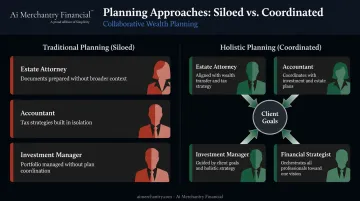
Traditional financial planning has a structural flaw most clients don't notice until something goes wrong. Each professional works from a partial view:
- Estate attorneys draft documents without knowing your tax situation
- Accountants file returns without knowing your insurance gaps
- Investment managers build portfolios without factoring in your estate plan
The client becomes the only person with visibility across the whole picture — and often, they don't see it clearly either.
A holistic approach addresses this gap. When an estate attorney, CPA, insurance professional, and financial strategist work from the same understanding of a client's goals and circumstances, decisions in one area stop creating unintended consequences in another.
Holistic Planning Isn't Reserved for the Wealthy
Sophisticated financial planning isn't a luxury for the affluent — demand for it spans income levels. McKinsey found that the share of investors seeking holistic advice jumped from 29% in 2018 to 52% in 2023, a shift that reaches well beyond high-net-worth households. Coordinated, integrated planning is what most people want. Access to it shouldn't depend on hitting an asset threshold.
The Core Components of a Holistic Financial Plan
No two holistic plans are identical — each is shaped by the client's goals, life stage, and specific circumstances. That said, the same foundational pillars appear across every well-constructed plan.
Investment and Portfolio Strategy
In a holistic context, investment management isn't just about returns. It's about aligning asset allocation with risk tolerance, time horizon, tax situation, and specific goals — whether that's funding a child's education, retiring at 60, or building a legacy. For firms like Ai Merchantry Financial, investment strategy flows through a network of qualified financial professionals, ensuring portfolio decisions connect to the broader plan rather than running on a separate track.
Tax Planning and Optimization
Holistic tax planning is a year-round discipline, not an April exercise. Key strategies include:
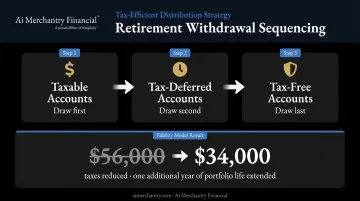
- Withdrawal sequencing — drawing from taxable, tax-deferred, and tax-free accounts in the order that minimizes lifetime tax liability
- Capital gains management — timing asset sales to stay within favorable tax brackets
- Charitable giving coordination — aligning donations with tax liability to maximize impact on both sides
The numbers behind this are meaningful. A Fidelity model showed that a coordinated withdrawal strategy for a 62-year-old retiree reduced modeled taxes from $56,000 to $34,000 and extended portfolio life by one year. Individual results vary, but the principle holds: coordinating withdrawals across account types consistently reduces what goes to taxes and extends how long the money lasts.
Retirement and Income Planning
Holistic retirement planning goes well beyond "save enough." It includes:
- Social Security timing — claiming at 62 permanently reduces monthly benefits by up to 30% for workers born in 1960 or later; delaying past full retirement age adds 8% per year up to age 70
- Healthcare cost planning — Fidelity estimates the average 65-year-old retiring in 2025 needs $172,500 in after-tax savings for healthcare alone
- Income stream mapping — planning how money flows from multiple account types throughout retirement, not just accumulating in one place
Risk Management and Insurance
A holistic plan treats life, disability, long-term care, and property insurance as integrated components — not products sold separately. One uncovered event can reverse significant financial progress, which is why coverage decisions belong inside the plan from the start.
Ai Merchantry Financial's We~LL Care Living™ program addresses long-term care specifically — covering extended care services not typically included in health insurance or Medicare, across settings from in-home care to assisted living. This kind of coverage belongs in the plan, not as an afterthought.
Estate and Legacy Planning
Estate planning ensures that everything built during a lifetime transfers, stays protected, or gets distributed according to your wishes. Wills, trusts, beneficiary designations, and powers of attorney are the tools that make that happen — yet Caring.com's 2025 survey found that roughly **56% of Americans have neither a will nor a living trust**.
For business owners, the estate component expands further. Succession planning, buy-sell agreements, key person insurance, and the tax implications of ownership transitions each require coordination between CPAs, business attorneys, and financial strategists. Ai Merchantry Financial's Collaborative Planning Network™ brings those professionals together — CPAs, attorneys, and financial strategists working from a shared plan rather than separate engagements.

How a Holistic Financial Plan Evolves Across Life Stages
Holistic planning doesn't end after the first meeting. Priorities shift — from debt management in your twenties to distribution strategy in your seventies — and the plan has to keep pace.
Early Career and Wealth-Building Years
Priorities at this stage:
- Building a 3-6 month emergency reserve before investing aggressively
- Establishing savings discipline early enough to benefit from compounding
- Securing foundational life and disability coverage while premiums are low
- Managing student loan or consumer debt alongside income growth
Mid-Life and Peak Earning Years
This is where competing priorities collide. College funding, mortgage payoff, accelerating retirement contributions, expanding insurance needs, and potentially supporting aging parents can all land at the same time.
A holistic advisor helps sequence these priorities. Not every goal can be funded simultaneously at maximum levels. Knowing which to address first — and which can wait — is where coordinated planning earns its keep.
Pre-Retirement and Retirement Transition
The shift from accumulation to distribution is more complex than most people expect. Key decisions include:
- When to claim Social Security and how spousal benefits interact
- How to bridge healthcare costs before Medicare eligibility at 65
- Which accounts to draw from first, second, and last to minimize taxes over a 20-30 year retirement
A misstep on any one of these — claiming Social Security too early, drawing from the wrong account first — can cost tens of thousands of dollars in avoidable taxes or lost benefits over a long retirement.
Retirement and Legacy Years
Retirement itself isn't a finish line — it's a new planning phase. Spending patterns shift, required minimum distributions begin around age 73, estate planning moves from theoretical to urgent, and portfolio risk needs regular recalibration.
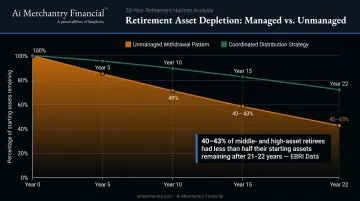
EBRI's longitudinal research found that 40-43% of middle- and high-asset retirees had less than half their starting assets remaining after 21-22 years of retirement. Managing distribution deserves the same rigor as building wealth — and for most retirees, it lasts just as long.
The Real Benefits of Holistic Financial Planning
Decisions Made in Context
The most practical benefit is this: when all parts of a financial life are coordinated, a client making a major decision — taking on a mortgage, receiving an inheritance, selling a business — already understands how that decision touches everything else. Costly mistakes are far more likely when financial decisions get made in isolation.
The Clarity Effect
CFP Board's 2026 research found that 94% of CFP professional-advised households reported confidence in meeting their financial goals, versus 81% of unadvised households. Separately, 59% of CFP professional clients said their advisor reduced financial anxiety, compared to 38% of clients of other advisors.
Ai Merchantry Financial's approach reflects this directly. Their core philosophy — "greater awareness leads to better decisions" — positions clarity as the foundation of confident financial action.
The Long-Term Compounding Effect
Over 20+ years, the compounding effect of coordinated planning changes retirement outcomes in ways no single product can replicate. The gains come from closing gaps that often go unnoticed:
- Avoiding tax inefficiencies through a coordinated withdrawal strategy that keeps income in a lower bracket
- Ensuring beneficiary designations align with the current estate plan
- Maintaining adequate long-term care coverage before it's needed
- Eliminating insurance gaps that expose assets to avoidable risk
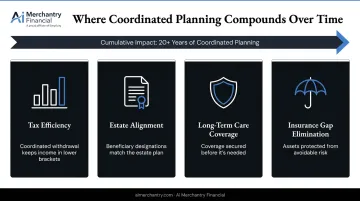
Each of these, addressed together and sustained over time, produces results that isolated decisions simply cannot.
How to Recognize (and Find) Genuinely Holistic Financial Advice
"Holistic" is an overused term in financial services. Many firms apply it to what is essentially investment management with some retirement projections attached.
What to Look For
Concrete signals of authentic holistic planning:
- The first meeting focuses on your life, not your portfolio — goals, family structure, concerns, and values before any product discussion
- The advisor proactively connects decisions across your financial life without being prompted
- The initial plan addresses insurance gaps, tax efficiency, estate priorities, and near-term needs — not just an investment proposal
- The advisor knows when to bring in other specialists and has those relationships in place
Kitces Research found that 54% of surveyed advisors deliver "Extensive" plans covering at least 13 components. The word "holistic" doesn't guarantee that breadth. The actual scope of planning does — and so does the advisor's willingness to bring in the right people when a decision requires it.
The Collaboration Signal
A genuinely holistic advisor doesn't pretend to cover every specialty alone. They know when a CPA, estate attorney, or insurance specialist needs to be at the table — and they make that happen.
Ai Merchantry Financial's Collaborative Planning Network™ operates on exactly this model. Clients connect with CPAs, estate planning attorneys, insurance professionals, and financial strategists who share a common understanding of the client's full picture. The Discovery → Diagnostic → Advancement framework keeps the process anchored in understanding before any recommendations are made.
Frequently Asked Questions
What is a holistic approach to financial planning?
A holistic approach integrates all dimensions of a person's financial and personal life (goals, values, risk tolerance, and life stage) into one coordinated strategy. Rather than addressing each financial area separately, it treats them as an interconnected system where decisions in one area affect all others.
What is the difference between holistic and comprehensive financial planning?
Comprehensive planning covers all financial topics: investments, taxes, insurance, estate planning, and retirement. Holistic planning includes all of that but grounds every decision in the client's personal values, goals, and life vision. The difference is in the reasoning behind decisions, not just the topics covered.
What is the 50/30/20 rule in financial planning?
The 50/30/20 rule allocates 50% of after-tax income to needs, 30% to wants, and 20% to savings or debt repayment. It's a useful starting point for budgeting, but holistic financial planning builds a more personalized structure around a client's actual goals, income trajectory, and circumstances.
What is the 7/7/7 rule for money?
The 7/7/7 rule isn't a standardized financial concept, but it's sometimes used informally to describe money doubling roughly every 7 years at a ~10% average annual return. Holistic planning incorporates growth assumptions like this alongside taxes, inflation, and withdrawal strategy — not as a standalone projection, but as one input within a coordinated plan.
Is $500,000 enough to work with a financial advisor?
Many holistic financial advisors work with clients across a range of asset levels. In CFP Board's 2024 survey, 42% of CFP professionals required no minimum investable assets. Holistic planning is about coordinating decisions well at any income level, not just managing large portfolios.
Does holistic financial planning include insurance and risk management?
Yes. Life, disability, long-term care, and property coverage are evaluated as protective layers within the broader plan. If an unexpected event disrupts income, health, or family stability, the right insurance structure keeps the rest of the financial strategy intact.