

Introduction
Here's something worth knowing before you start shopping: according to LIMRA's 2024 Insurance Barometer Study, 72% of Americans overestimate the cost of a basic term life insurance policy — and many base that estimate on nothing more than a gut feeling. A separate 2025 LIMRA study found that adults under 30 overestimated the cost of a $250,000 policy by 10 to 12 times the actual price.
That gap between perception and reality has consequences. People delay buying coverage, assume they can't afford it, or end up in the wrong product because they never stopped to compare.
Term life insurance rates in 2026 vary widely — a healthy 30-year-old non-smoker can pay as little as $15–$30 per month for $500,000 in coverage, while a 50-year-old smoker applying for the same policy could pay several times that. Age, health, gender, smoking status, coverage amount, and term length all move the number.
This guide covers:
- Real 2026 rate benchmarks across age groups and health classifications
- The factors that drive premiums up or down
- Common buying mistakes that cost people money
- How to find coverage that fits your actual situation
Key Takeaways
- A healthy non-smoking 30-year-old can pay as little as $15–$18/month for a $500,000, 20-year term policy
- Smokers pay 3.5 to 4.6 times more than non-smokers at the same age and coverage level
- Waiting until 40 instead of buying at 30 adds roughly $2,000+ in total premiums over a 20-year term
- No-exam policies cost 17–29% more than fully underwritten coverage for healthy applicants
- Term life is 5–15x cheaper than whole life for the same death benefit
How Much Does Term Life Insurance Cost in 2026?
Term life premiums vary widely. Two people applying for identical coverage on the same day can receive dramatically different quotes based on their health, age, lifestyle, and which insurer underwrites their policy.
Buyers who don't account for this variability tend to make predictable mistakes:
- Overpaying by purchasing permanent coverage they don't actually need
- Under-buying by choosing too little coverage or too short a term
- Getting blindsided after underwriting by tobacco surcharges or a substandard health rating they didn't anticipate
Rate Benchmarks by Coverage Tier
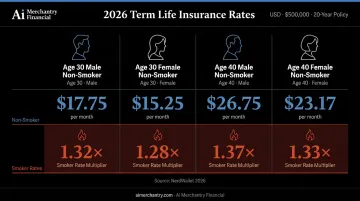
The table below uses verified 2026 data to give you a realistic sense of what coverage costs at different levels. All figures assume preferred-class, non-smoking applicants unless noted.
Standard Coverage — $500,000, 20-Year Term (Source: NerdWallet average rate data, June 2026)
| Age | Male Non-Smoker | Female Non-Smoker | Male Smoker | Female Smoker |
|---|---|---|---|---|
| 30 | $17.75/mo | $15.25/mo | $66.25/mo | $53.75/mo |
| 40 | $26.75/mo | $23.17/mo | $122.00/mo | $96.42/mo |
| 50 | $67.50/mo | $53.00/mo | — | — |
High Coverage — $1,000,000 Term Policy (Source: Forbes Advisor, June 2026, based on 9,526 rates from 26 insurers)
| Age | Gender | 20-Year Term | 30-Year Term |
|---|---|---|---|
| 30 | Male | $35/mo | $59/mo |
| 30 | Female | $28/mo | $46/mo |
| 40 | Male | $55/mo | $103/mo |
| 40 | Female | $45/mo | $80/mo |
Entry-Level Coverage — $250,000, 10-Year Term For younger buyers, supplemental coverage, or tighter budgets, a 10-year $250,000 policy is the most accessible entry point. Based on 2025 preferred-class data:
| Age Range | Male Non-Smoker | Female Non-Smoker |
|---|---|---|
| 20s–early 30s | ~$15–$17/mo | ~$15–$17/mo |
How Term Length Affects the Price
Coverage amount is only part of the pricing equation. Term length is equally significant — the longer the insurer carries your risk, the higher the premium. For the same healthy 40-year-old man seeking $500,000 in coverage:
| Term Length | Monthly Premium |
|---|---|
| 10 years | $16.75 |
| 20 years | $26.75 |
| 30 years | $47.83 |
A 30-year term costs roughly 2.85x the 10-year premium. This reflects the insurer carrying risk over a much longer window. The real question isn't which term is cheapest — it's which one covers you long enough to matter.
What these premiums include and exclude:
- Included: Pure death benefit protection for the policy term
- Included: Level premiums that don't increase during the term
- Not included: Cash value accumulation
- Added cost: Riders such as disability waiver, conversion, or accelerated death benefit
- Important: Coverage beyond the term requires a new application — at older, higher rates
Key Factors That Affect Term Life Insurance Rates
Insurers price term life premiums around one core question: how likely is this person to die during the policy term? Every personal factor that affects that probability affects your rate.
Age at Application
Age is the most predictable driver. The older you are when you apply, the higher your premium — life expectancy shortens, and the insurer's risk window narrows. The math compounds quickly: a 30-year-old locking in a 20-year policy at $17.75/month pays that rate for the full term. Someone who waits until 40 to buy the same coverage pays $26.75/month — and that rate holds for their entire term too.
The younger you lock in, the lower your cumulative cost over the full term.
Health and Medical History
Underwriters look at:
- Current metrics: height/weight ratio, blood pressure, cholesterol, blood sugar
- Pre-existing conditions: diabetes, heart disease, cancer history
- Family medical history: early-onset conditions in parents or siblings
This review determines your risk classification, which directly determines your rate:
| Risk Class | Description |
|---|---|
| Preferred Plus | Excellent health, ideal vitals, clean family history |
| Preferred | Good health, minor issues |
| Standard | Average health, some conditions present |
| Substandard | Significant health factors; rate-up or table rating applied |
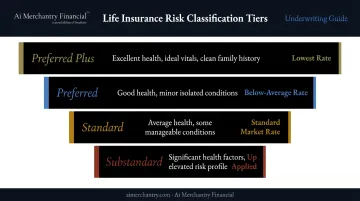
Well-managed conditions don't automatically push you into substandard territory. A diabetic with tight A1C control and no complications can still qualify for standard rates at many carriers.
Gender
Women statistically live longer than men. CDC's January 2026 mortality data puts the gap at 4.9 years — 76.5 years for males versus 81.4 years for females. That difference shows up directly in premiums: at age 30, male non-smoker rates run about 16% higher than female non-smoker rates for the same $500,000 policy. At 50, that gap widens to over 27%.
Smoking Status and Lifestyle
Smoking is one of the sharpest rate dividers in life insurance underwriting. Using 2026 data for a $500,000, 20-year term:
| Age & Gender | Smoker Multiplier vs. Non-Smoker |
|---|---|
| Male, age 30 | 3.73x |
| Female, age 30 | 3.52x |
| Male, age 40 | 4.56x |
| Female, age 40 | 4.16x |
Beyond smoking, lifestyle factors that can raise premiums or trigger exclusions include:
- High-risk hobbies: skydiving, BASE jumping, motorsports, deep-sea diving
- Hazardous occupations: offshore drilling, certain military roles, logging
- Driving record: DUIs or multiple moving violations flag elevated risk for underwriters
Not all of these result in flat premium increases — some trigger flat extras (a fixed dollar amount per $1,000 of coverage), and some can lead to outright decline depending on the carrier.
Coverage Amount and Term Length
More coverage costs more, but not always proportionally. Larger face amounts — particularly above $500,000 — can sometimes reduce the cost per $1,000 of coverage because of how insurers price their benefit thresholds.
Longer terms always cost more — but the bigger risk is choosing a term that's too short. A 10-year policy that expires when you still have 18 years left on your mortgage forces you to reapply at your then-current age and health. That could mean paying double or more for the same coverage, or finding you no longer qualify at preferred rates.
How to Estimate the Right Term Life Coverage Budget
Finding the cheapest policy isn't the goal. Finding the right amount of coverage for the right duration at the most competitive rate for your situation — that's the goal. Price is one variable, not the only one.
Before settling on a coverage amount or term length, work through these questions:
- How many years do your financial dependents rely on your income? If you have a 2-year-old and a 25-year mortgage, a 10-year term leaves significant gaps.
- What debts would survive you? Mortgage balances, business loans, and co-signed student loans all factor into the coverage floor.
- Does your employer provide group term coverage? Group policies typically end if you leave the job — they can supplement but shouldn't be your only coverage strategy.
- What's your income replacement goal? A common benchmark is 10–12x your annual income, though the right number depends on your specific obligations and timeline.
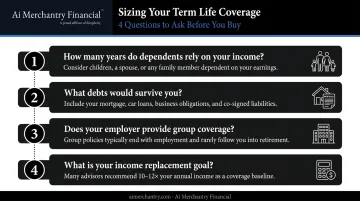
These answers shape whether a $250,000, 10-year policy makes sense or whether a $1,000,000, 30-year policy is the more appropriate fit.
Answering these questions honestly — ideally with a financial professional — shifts the conversation from what you can afford today to what your family actually needs long-term. Ai Merchantry Financial's Collaborative Planning Network™ connects individuals with insurance professionals, financial strategists, and CPAs who can model multiple coverage scenarios against your broader financial picture. You can schedule a consultation through their advisor booking portal.
What Most Buyers Get Wrong About Term Life Rates
Mistake 1: Optimizing for Monthly Premium, Not Total Cost
A 10-year policy that expires too early doesn't save money — it defers cost. If you reapply at a higher age with a new health condition, the "cheap" decision from a decade ago becomes one of the most expensive financial choices you made. Match the term to your actual obligations, not your current budget.
Mistake 2: Choosing No-Exam Policies Without Comparing Rates
No-exam convenience comes at a price. Using 2026 data for a $500,000, 20-year term:
| Profile | Exam Policy | No-Exam Policy | Difference |
|---|---|---|---|
| Male, 30 | $17.75/mo | $22.92/mo | +29.1% |
| Female, 30 | $15.25/mo | $17.92/mo | +17.5% |
| Male, 40 | $26.75/mo | $34.17/mo | +27.7% |
| Female, 40 | $23.17/mo | $28.33/mo | +22.3% |
Not all no-exam policies carry the same cost. The two main types work differently:
- Simplified issue: No exam, limited health questions — the insurer assumes more risk and prices premiums accordingly. These consistently cost more.
- Accelerated underwriting: Uses medical records and data to waive the physical exam while retaining fully underwritten pricing. Healthy applicants may qualify for rates close to the exam-based benchmark.
Mistake 3: Waiting to Buy
Premiums increase with every birthday, and any new health diagnosis can shift your risk class downward. The cost of waiting is concrete:
| Profile | Buy at 30 | Buy at 40 | Extra Cost Over 20 Years |
|---|---|---|---|
| Male non-smoker | $4,260 total | $6,420 total | +$2,160 (51% more) |
| Female non-smoker | $3,660 total | $5,560 total | +$1,900 (52% more) |
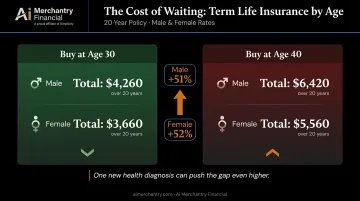
These figures apply the same 2026 published rates across 20 annual premiums — the policies cover different life stages, but the pricing gap is real and accumulates fast. A single new diagnosis between 30 and 40 — high blood pressure, elevated cholesterol, sleep apnea — can drop your risk class and push the actual gap well beyond these figures.
Conclusion
Term life insurance in 2026 is more affordable than most people expect — particularly for younger, healthier applicants who apply early, match the term length to their actual obligations, and go through full underwriting. The rates are real. The misperception is the bigger problem.
Understanding what drives your rate, choosing coverage that reflects your actual financial obligations, and acting before a birthday or health change shifts your pricing tier — those decisions matter more than chasing the lowest headline premium.
If you're ready to compare rates or want guidance on which term length and coverage amount fits your situation, a licensed advisor can walk you through your options without the guesswork.
Frequently Asked Questions
How much does a $500,000 term life insurance policy cost?
Based on 2026 data, a healthy non-smoking male pays approximately $17.75/month at 30, $26.75 at 40, and $67.50 at 50 for a $500,000, 20-year term. Females pay roughly 15–27% less at the same ages. Smokers and applicants with health conditions pay significantly more.
Can diabetics get term life insurance?
Yes — eligibility and rates depend on diabetes type, A1C levels, and complications. Well-managed Type 2 diabetes with A1C below 7.5 and no organ involvement can qualify for standard rates at some carriers, while Type 1 generally faces stricter classification and substandard rates across most of the market.
At what age should I buy term life insurance?
The best time to buy is when major financial obligations begin — mortgage, marriage, children. Every year of delay raises your premium, and a new health diagnosis can reduce eligibility or lock you into a higher risk class permanently.
Does term life insurance get more expensive as you age?
Yes. Premiums rise with age as life expectancy shortens and insurer risk increases. A level-term policy locks in your rate at the age you apply, which is why buying early — before the next birthday or a health event — makes a meaningful difference in what you pay over the full term.
What is the cheapest type of life insurance?
Term life is the most affordable option because it provides pure death benefit protection for a fixed period without building cash value. Whole life and universal life policies typically cost 5–15x more for the same death benefit — in some same-coverage comparisons, the difference reaches 17x or higher.
Is term life insurance worth it?
For most working adults with time-bound obligations — a mortgage, dependent children, business debt — yes. The protection cost is low relative to the financial risk it covers, and the locked-in premium delivers that coverage without the cost or complexity of permanent insurance.