
Introduction
Your business may be your most valuable asset — and one of your most financially exposed. With 5.5 million new business applications filed in 2023 alone, entrepreneurship is accelerating. Yet life insurance planning consistently lags behind.
When an owner dies without the right coverage in place, the consequences hit fast: outstanding business loans still come due, payroll doesn't pause, and family members may be forced to sell the company under pressure (often at a fraction of its value). Surviving partners can find themselves without funds to buy out a deceased owner's share.
The risks don't stop there. Losing a critical employee can permanently destabilize operations — a vulnerability many business owners overlook until it's too late.
This article breaks down the main types of life insurance available to small business owners, how each one works, and how to determine which type or combination fits your specific situation.
Key Takeaways
- Life insurance for business owners serves two distinct purposes: protecting your family and protecting the business from financial disruption.
- The five main types are term life, permanent life, key person insurance, buy-sell agreement insurance, and group life — each addressing a different risk layer.
- Key person and buy-sell coverage are planning strategies funded by traditional policies, not separate insurance categories.
- The right choice depends on your business structure, debt load, ownership complexity, and succession goals — not premium cost alone.
- Most owners need more than one policy to keep personal and business obligations separate.
What Is Life Insurance for Small Business Owners?
Business life insurance provides a financial payout when an owner, partner, or critical employee dies — with proceeds directed toward business continuity, ownership transitions, or operational stabilization rather than (or in addition to) supporting a personal household.
The key distinction from personal coverage comes down to who benefits and why:
- Personal life insurance: A spouse or dependent receives funds to cover living expenses
- Business life insurance: The beneficiary may be the company itself, a surviving partner, or co-owners using that payout to keep the business viable
That makes it a business continuity tool — as foundational to long-term planning as a succession strategy or operating budget.
Why Small Business Owners Need Life Insurance
The financial risks of operating without coverage aren't theoretical. When an owner dies unexpectedly, several problems emerge simultaneously:
- Business loans don't disappear. Lenders expect repayment regardless of what happened to the borrower.
- Payroll and vendor obligations continue. Operations don't pause for grief.
- Client relationships may collapse. Especially in service-based businesses where relationships are personal.
- Family members face rapid, high-stakes decisions. Selling or closing — often at a significant loss — becomes the default outcome.
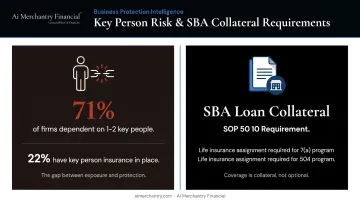
According to an NAIC-cited survey from the Insurance Information Institute, 71% of firms reported heavy dependence on one or two key people — yet only 22% had key person life insurance in place.
That coverage gap has real consequences beyond business continuity — lenders take it seriously too. Under SBA SOP 50 10, lenders are required to analyze whether a business's viability depends on a principal — and when it does, life insurance coverage is assigned as loan collateral. This applies to both 7(a) and 504 loan programs.
Types of Life Insurance for Small Business Owners
Business life insurance is not one-size-fits-all. The right type depends on your goal:
- Personal income replacement for your family
- Debt coverage for business loans
- Partnership continuity between co-owners
- Key talent protection for critical employees
- Employee benefits to attract and retain staff
Many owners need a combination of these.
Term Life Insurance
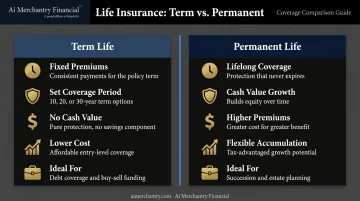
Term life provides a death benefit for a set period — typically 10, 20, or 30 years — at a fixed premium with no cash value component. If the insured dies during the term, the beneficiary receives the payout. It's the simplest structure and the most affordable starting point for most business coverage needs.
For a healthy, non-smoking 40-year-old, Guardian's 2025 rate guide reports average monthly premiums of $42.94 (male) and $35.27 (female) for a $500,000, 20-year term policy.
Best for small business owners when:
- Covering time-bound obligations like SBA loans or early-stage debt
- Cash flow is tight and affordable premiums are a priority
- Funding cross-purchase buy-sell agreements between co-owners
- A new business needs coverage before permanent options make financial sense
Limitations to know:
- Coverage expires — no payout if the insured outlives the term
- Renewal premiums increase significantly with age
- No cash value accumulates for future business needs
Permanent Life Insurance (Whole and Universal)
Permanent life insurance — including whole life and universal life — provides lifelong coverage as long as premiums are maintained. Both build cash value over time.
Whole life offers fixed premiums and a guaranteed death benefit. Universal life allows more flexibility on premiums and death benefit amounts, with cash value growth tied to interest rates or market performance.
More than one-fourth of small business owners hold whole life insurance, per ACLI's analysis of Federal Reserve survey data.
Best for small business owners when:
- Long-term succession planning requires guaranteed funds regardless of when death occurs
- Cash flow allows higher premiums and the business can benefit from policy loan access
- A mature business needs flexible coverage that scales with its growing value
- Estate planning requires coordination between life insurance and ownership transfer
Limitations to know:
- Premiums run significantly higher than term — straining smaller businesses with tight cash flow
- Universal life requires active management to prevent policy lapse
- Cash value withdrawals above cost basis are taxable; modified endowment contracts carry additional tax consequences under IRC Section 72
Key Person Life Insurance
The business owns the policy on the life of an owner or employee whose skills, client relationships, or institutional knowledge are critical to revenue. The company pays the premiums and is named as beneficiary, receiving the death benefit if that individual dies.
Best for small business owners when:
- The business depends heavily on a founder, top salesperson, lead technician, or CEO
- Lenders or investors need reassurance about operational continuity
- The business needs cash flow to cover lost revenue, recruit a replacement, and stabilize during transition
Limitations to know:
- Premiums paid by the company are generally not tax-deductible under IRC Section 264(a)(1) when the company is the beneficiary
- The 2024 Connelly v. United States Supreme Court ruling held that life insurance proceeds paid to a corporation must be included in the company's fair market value for estate tax purposes — the redemption obligation does not offset that increase. Business owners using entity-redemption structures should review this with a tax advisor before purchasing or renewing coverage.
Buy-Sell Agreement Life Insurance
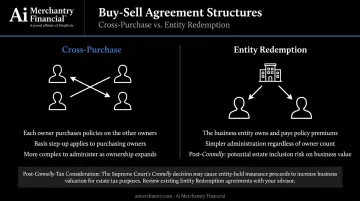
A buy-sell agreement is a legally binding contract between co-owners that pre-determines what happens to a deceased owner's share of the business. Life insurance funds the agreement — when an owner dies, the surviving partner(s) use the death benefit to purchase the deceased's stake from the estate at a pre-agreed valuation.
Two common structures:
- Cross-purchase: Individual owners insure each other; surviving owners receive proceeds directly
- Entity redemption: The business owns and is beneficiary of policies on each owner; company redeems the deceased's shares
A 2022 MassMutual study found that only 32% of business owners had a buy-sell agreement — and of those, 46% had funded it with life insurance. Perhaps more concerning: 47% of existing agreements had not been reviewed in over three years.
Best for small business owners when:
- The business has two or more co-owners
- Partners want to prevent forced sales or unwanted new partners entering the business
- A clean, pre-funded ownership transition is a priority
Limitations to know:
- The policy face amount must reflect current business valuation — a policy set at founding may be severely inadequate years later
- Entity redemption structures face additional scrutiny post-Connelly; cross-purchase is now receiving closer consideration as an alternative, though it carries its own drawbacks. Tax attorney or CPA review is essential before structuring either approach.
Group Life Insurance
Group life is employer-sponsored coverage offered as a workplace benefit — typically group term life. The employer pays some or all of the premiums, and employees receive a set death benefit (often a multiple of annual salary) without individual medical underwriting.
According to the Bureau of Labor Statistics' March 2025 data, only 27% of workers at establishments with 1–49 employees had access to life insurance — compared to 58% across all private industry. Offering group coverage gives small businesses a meaningful competitive edge in talent markets.
Best for small business owners when:
- Competing for talent against larger employers with richer benefits packages
- Employees with pre-existing conditions need access to coverage they couldn't obtain individually
- A cost-effective, tax-advantaged benefits component is needed
Tax note: Under IRC Section 79, employer-paid group term life premiums for the first $50,000 of coverage are excluded from employee income. Premiums are generally deductible as a business expense — but Section 264 denies deductions when the employer is also the policy beneficiary.
Limitations to know:
- Coverage ends when an employee leaves the company
- Benefit amounts are often lower than what individuals need for comprehensive family protection
- Very small businesses may face limited plan options or higher per-person costs
How to Choose the Right Type for Your Business
The right policy isn't the cheapest or most popular — it's the one that maps directly to your business structure, obligations, and goals.
Key factors to evaluate:
| Factor | Coverage Implication |
|---|---|
| Co-owners or partners | Buy-sell coverage is essential |
| Business depends on 1–2 people | Key person insurance is needed |
| Outstanding business debt | Minimum coverage must keep business solvent |
| Early-stage, tight cash flow | Term life is the most accessible starting point |
| Mature business with stable revenue | Permanent life offers long-term flexibility |
| Need to attract/retain employees | Group life as a benefits component |
| Estate and succession planning | Permanent life provides the most planning options |
These factors rarely point to a single solution. Most business owners end up with more than one policy: one for personal family protection, others for business-specific obligations. Mixing personal and business beneficiaries within the same policy can create tax complications and leave either your family or your business underprotected.
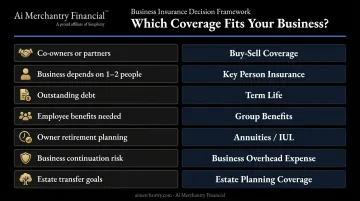
That's why coverage decisions benefit from coordinated input across financial, tax, and legal disciplines. Ai Merchantry Financial's Business Owners Solution System (BOSS™) is built around exactly this — connecting business owners with financial advisors, tax professionals, and estate planning attorneys through their Collaborative Planning Network™ to assess coverage needs across every layer of the business.
Common Mistakes to Avoid
Underestimating total coverage needed. The most costly error is calculating coverage based only on personal income replacement — and ignoring outstanding business loans, partner buyout obligations, key employee replacement costs, and operational continuity expenses. These require separate, additional coverage.
Letting buy-sell and key person coverage go stale. Business values grow. A policy that reflected your company's value at founding may cover only a fraction of what's needed five years later. Both your business valuation and your coverage amounts need regular review — a MassMutual study found nearly half of all buy-sell agreements hadn't been reviewed in more than three years.
Using personal life insurance to cover business obligations. Mixing personal and business beneficiary designations in a single policy creates tax complications and reduces payout efficiency — often leaving both your family and your business underprotected. Keep them separate.
Conclusion
Life insurance for small business owners is not a single product — it's a planning toolkit. Term life, permanent life, key person coverage, buy-sell agreements, and group life each address a different layer of business and personal risk.
Knowing how these types differ — and matching the right coverage to your business's obligations and growth stage — is where sound planning starts. Working with advisors who understand both the insurance and legal dimensions turns that clarity into a strategy you can act on with confidence.
Frequently Asked Questions
What is the difference between key person insurance and a buy-sell agreement?
Key person insurance protects the business against the financial loss caused by a critical employee's death — the company is the beneficiary. A buy-sell agreement uses life insurance to give surviving owners funds to legally purchase a deceased owner's stake. Both are planning strategies funded by traditional life insurance policies, not separate insurance products.
Can a small business owner have both personal and business life insurance?
Yes, and many need both. A personal policy protects the family's income and living expenses, while business policies cover partner buyouts, key person losses, or business debts. Keeping them separate ensures each obligation is properly funded without creating conflicting beneficiary designations.
How much life insurance does a small business owner need?
It depends on what each policy covers: buy-sell amounts should reflect business valuation, while key person coverage should reflect lost revenue and replacement costs. For personal protection, ACLI notes that some experts suggest 7–10 times annual income, though actual needs may be higher. Review coverage amounts regularly as the business grows.
Is life insurance for a small business tax deductible?
Employer-paid group term life premiums are often deductible as a business expense up to IRS limits. However, premiums for key person or buy-sell policies where the company is the beneficiary are generally not deductible under IRC Section 264, and tax treatment varies significantly by structure. Consult a CPA before purchasing.
Are small business owners required to have life insurance?
No federal or state law mandates it. However, SBA lenders may require proof of coverage as loan collateral when the business's viability depends on a principal. Regardless of legal requirements, the financial risks of operating without coverage far outweigh the cost of premiums.
What type of life insurance is best for a sole proprietor with no business partners?
Sole proprietors don't need buy-sell coverage but should prioritize individual term or permanent life insurance sufficient to replace their income, cover outstanding business debts, and give their family the funds to either continue or wind down operations without a financial crisis.