

Introduction
Most Americans expect retirement to last maybe a decade. The reality is closer to two. According to CDC data, a 65-year-old today can expect nearly 20 more years of life — and that's an average, meaning many people will need their savings to stretch well into their 80s and 90s.
Yet the Federal Reserve's 2024 survey found that only 35% of non-retirees feel their retirement savings are on track. That gap has real consequences — and it widens with every year of delayed action.
The good news is that retirement planning is not a one-time decision. It evolves at every stage of life — the right moves in your 30s look very different from the right moves in your 50s. The seven tips ahead cover both, so you can take action wherever you are right now.
Key Takeaways
- Experts recommend replacing 70–90% of pre-retirement income — Social Security covers roughly 40% for median earners
- Tax-advantaged accounts (401(k)s, IRAs, HSAs) are the most efficient savings vehicles available
- Starting at 25 instead of 45 can produce $764,700 more by retirement, even at the same monthly contribution
- Healthcare costs for a retired couple can reach $330,000 — and that figure excludes long-term care
- Coordinating tax, insurance, and estate planning through one advisory team consistently leads to stronger retirement outcomes than siloed advice
Why Retirement Planning Matters at Every Age
Retirement planning isn't something to revisit once a decade. Life changes — income shifts, new dependents, evolving goals — and a plan that made sense at 35 can leave real gaps at 55.
The financial stakes have grown significantly. Life expectancy has risen, which means retirement savings must sustain people through periods their grandparents never had to plan for. A 65-year-old today has roughly 19.7 additional years of expected life, according to CDC mortality data — and that number skews higher for women.
The Income Gap Nobody Talks About Enough
Social Security replaces approximately 40% of pre-retirement earnings for a median-wage worker. Standard planning benchmarks call for replacing 70–90% of that income to maintain a similar lifestyle. That leaves a gap of 30–50% that personal savings, investments, and other income sources must fill.
Closing that gap takes deliberate action — and the earlier those decisions get made, the more options remain on the table. The tips below break down what to prioritize at each stage.
Key variables that determine how wide that gap becomes:
- Account selection — tax-deferred vs. tax-free accounts affect long-term withdrawal flexibility
- Contribution timing — compounding rewards early action more than late catch-up contributions
- Pre-retirement decisions — the final 10 years before retirement carry outsized consequence for income strategy
7 Top Retirement Planning Tips for Every Age
Tip 1: Start Saving Now — The Earlier, the Better
Compound interest is the closest thing to a mathematical certainty in personal finance. Money saved early doesn't just grow — it generates its own growth, which generates more growth on top of that.
Consider a straightforward illustration: saving $500 per month at a 6% annual return, starting at age 25, produces approximately $995,700 by age 65. Starting the same strategy at 45 yields roughly $231,000. The 20-year head start adds nearly $764,700 in ending value, despite only contributing $120,000 more in actual deposits.
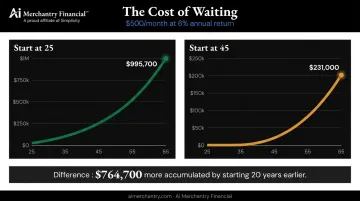
The "I'll start later" mindset is one of the most expensive financial habits a person can develop. Even modest contributions made consistently in your 20s outperform larger contributions started a decade later.
Starting from zero today? Here's where to begin:
- Open a workplace 401(k) or IRA as your first step
- Automate contributions so the decision is made once, not monthly
- Start with whatever you can — even 3% of your paycheck — and increase it annually
Tip 2: Know Your Retirement Number
Most financial planners use a benchmark of 70–90% of pre-retirement income as the total annual amount needed in retirement. The SSA's own guidance uses a narrower 70–80% formulation. Either way, these figures are starting points, not guarantees.
Your actual number depends on:
- Where you plan to live (cost-of-living varies dramatically by state and city)
- Whether you carry a mortgage into retirement
- How much you plan to travel or spend on leisure
- Whether you'll have dependents or ongoing financial obligations
Two free tools worth bookmarking for early estimates:
- SSA's Benefit Estimator — shows projected Social Security income based on your earnings record
- AARP's Retirement Calculator — helps estimate total savings needed against projected spending
These calculators won't replace a personalized plan, but they'll give you a useful baseline for where conversations need to go.
Tip 3: Maximize Tax-Advantaged Retirement Accounts
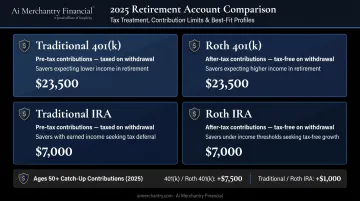
The accounts you use matter as much as how much you save. Here's a plain-language breakdown of the four most common options:
| Account Type | Tax Treatment | Best For |
|---|---|---|
| Traditional 401(k) | Pre-tax contributions; taxed on withdrawal | Those in a higher tax bracket now than in retirement |
| Roth 401(k) | After-tax contributions; tax-free withdrawal | Those expecting higher taxes later |
| Traditional IRA | Pre-tax (if deductible); taxed on withdrawal | Those without a workplace plan or below phase-out limits |
| Roth IRA | After-tax contributions; tax-free withdrawal | Younger savers or those with lower current income |
2025 contribution limits to know:
- 401(k) employee deferral: $23,500 (plus $7,500 catch-up if you're 50 or older)
- IRA (traditional or Roth): $7,000 (plus $1,000 catch-up if 50+)
- HSA (family coverage): $8,550 (plus $1,000 catch-up at 55+)
One point that's often overlooked: if your employer offers a 401(k) match, contribute at least enough to capture the full match before funding anything else. That match is an immediate 50–100% return on your contribution — no investment can reliably beat that.
Tip 4: Diversify Your Investments and Rebalance Over Time
How you invest is just as important as how much you invest. A portfolio sitting in cash or low-yield bonds throughout your 30s and 40s leaves substantial growth on the table. But a portfolio that's still 90% equities at 62 carries risks that could derail your timeline if markets drop.
Vanguard's research shows equities delivered 6.3% annualized real returns from 1960 to 2022, compared to just 0.7% for cash. That gap compounds into a meaningful difference over decades, though the volatility attached to equities matters most when you're close to needing the money.
A general age-based framework:
- In your 20s–40s: Heavier equity allocation (70–90% stocks) — time absorbs short-term volatility
- In your 50s: Begin gradually shifting toward a balanced allocation (60/40 or similar)
- Approaching retirement: Prioritize income stability over aggressive growth; reduce equity exposure gradually
Rebalancing matters too. A portfolio that started at 70/30 stocks-to-bonds can drift considerably after a strong equity run. Review your allocation at least annually and after major life events.
Tip 5: Leave Your Retirement Savings Alone
Early withdrawals from traditional retirement accounts come with two immediate costs: a 10% early withdrawal penalty (before age 59½) and ordinary income taxes on the full amount withdrawn. Beyond those direct hits, the real damage is the permanent loss of compound growth on that money.
Vanguard data shows 4.8% of plan participants initiated hardship withdrawals in 2024 — a sign that financial stress regularly pushes people toward this option. But cashing out or borrowing against retirement accounts is almost never the best available choice.
Better alternatives when facing financial pressure:
- Build an emergency fund (3–6 months of expenses) in a separate account, specifically to prevent raiding retirement savings
- If you change jobs, roll your 401(k) into your new employer's plan or an IRA — don't cash it out
- Contact your plan administrator about hardship withdrawal alternatives before taking action
The few hundred dollars you need today may cost you tens of thousands in retirement.
Tip 6: Plan for Healthcare and Long-Term Care Costs
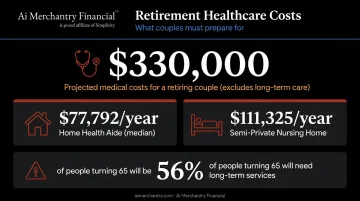
Healthcare is the retirement expense most people underestimate — sometimes dramatically. Fidelity estimates that a 65-year-old couple retiring today should expect to spend $330,000 on medical costs throughout retirement. And that figure excludes long-term care entirely.
On the long-term care front, AARP data indicates that 56% of people turning 65 between 2021 and 2025 are projected to need some form of long-term services and support. The median annual cost of a home health aide currently runs $77,792; a semi-private nursing home room averages $111,325 per year.
Three actions to take before you hit 65:
- Open or maximize an HSA — contributions are tax-deductible, growth is tax-free, and withdrawals for qualified medical expenses are tax-free. The 2025 family limit is $8,550.
- Understand Medicare's enrollment windows — the Initial Enrollment Period lasts 7 months, beginning 3 months before your 65th birthday month. Missing it has consequences.
- Evaluate long-term care insurance — ideally in your 50s, when premiums are lower and health qualifications are easier to meet
Tip 7: Work with a Trusted Financial Professional to Build a Holistic Plan
Retirement planning involves more moving parts than most people realize. Investment allocation, tax strategy, Social Security timing, Medicare enrollment, estate documents, and insurance coverage all interact — and decisions made in one area often affect the others.
Working with a single-discipline advisor means those connections can get missed. A financial planner who doesn't coordinate with a CPA may produce a tax-inefficient withdrawal strategy. An insurance agent who doesn't loop in an estate attorney may leave beneficiary designations misaligned with the broader plan.
That's the gap a coordinated advisory model is designed to close. Ai Merchantry Financial's Collaborative Planning Network™ connects clients with a coordinated team — CPAs, financial strategists, estate attorneys, and insurance specialists — rather than leaving clients to assemble those relationships on their own. Their model is built on the belief that greater awareness leads to better decisions, so advisors prioritize educating clients first rather than pushing product recommendations.
This multi-disciplinary approach is particularly valuable for decisions like:
- Roth conversion timing in pre-retirement years
- Social Security claiming strategy relative to other income sources
- Long-term care coverage that aligns with estate planning goals
- Beneficiary and trust structuring that holds up under scrutiny
How to Adjust These Tips Based on Your Life Stage
The seven tips above apply at every age. What changes is the urgency, the tools available, and the proximity of specific decisions.
| Life Stage | Primary Focus |
|---|---|
| 20s–30s | Start contributing, even modestly; build an emergency fund; open a Roth IRA if eligible |
| 40s | Accelerate contributions; review asset allocation; run a retirement income projection |
| 50s–60s | Max out catch-up contributions; stress-test your income plan; finalize healthcare and estate planning |

A few decisions become especially time-sensitive in your 60s:
- Social Security timing — claiming at 62 can reduce your benefit by as much as 30% compared to waiting until full retirement age. Delaying past full retirement age earns 8% in delayed credits per year until age 70.
- Required Minimum Distributions (RMDs) — currently begin at age 73 under IRS rules, with SECURE 2.0 raising that threshold to 75 for those reaching age 74 after December 31, 2032.
Both decisions reward careful modeling. Running the numbers with a qualified financial advisor — one who can account for your income sources, tax situation, and longevity — typically reveals options that aren't obvious on the surface.
Conclusion
Retirement security is built through decisions made consistently over years: starting early, choosing the right accounts, protecting what you've saved, and planning for costs that catch many people off guard.
Each tip in this article is a building block. None of them requires perfection, and none of them is out of reach regardless of where you're starting from.
If you're not sure where to begin — or whether your current plan is actually on track — Ai Merchantry Financial offers education-first planning support for individuals at every life stage.
Whether you're opening your first retirement account or building a drawdown strategy, the firm's network of advisors, CPAs, and estate professionals can help you understand your options and move forward with confidence.
Frequently Asked Questions
Frequently Asked Questions
Is it worth getting a financial advisor for retirement?
For most people, yes. A good advisor coordinates investment strategy, tax planning, Social Security timing, and estate documents together, and those decisions interact in ways that are easy to miss when handled separately. The value is highest for anyone with a complex income picture, significant assets, or multiple goals. Ai Merchantry Financial's Collaborative Planning Network™ connects clients with specialists across all of these areas through one coordinated relationship.
What is the 30 30 30 10 rule for retirement?
It's a budgeting framework: 30% of income to housing, 30% to living expenses, 30% to savings and investments, and 10% to discretionary spending. It's a reasonable starting point, but real retirement planning must account for individual income, debt, and goals. A rule of thumb rarely replaces a personalized plan.
How much should I have saved for retirement by age?
Fidelity's benchmarks suggest 1x your salary by 30, 3x by 40, 6x by 50, and 8x by 60. These are useful checkpoints, not hard rules. Your actual target depends on your expected retirement age, lifestyle spending, and other income sources like Social Security or pension income.
When is it too late to start saving for retirement?
It's never too late to improve your position. Late starters can use catch-up contributions (available at 50 for IRAs and 401(k)s), delay Social Security to increase their monthly benefit, reduce projected expenses, or work a few additional years — each option shifts the outcome in a meaningful direction.
What retirement accounts should I open if I don't have a 401(k)?
A traditional IRA or Roth IRA are the primary options. Traditional IRAs may offer upfront tax deductions depending on income; Roth IRAs provide tax-free growth and withdrawals, but have income phase-out limits ($150,000–$165,000 for single filers in 2025). Both have a $7,000 annual contribution limit, with a $1,000 catch-up available at 50 and older.