

The numbers reflect just how prominent annuities have become. U.S. retail annuity sales reached a record $434.1 billion in 2024, up 13% from the prior year, according to LIMRA. At the same time, only 14% of private-industry workers still have access to a defined-benefit pension plan, per the Bureau of Labor Statistics. Those two data points together tell a clear story: as predictable retirement income has become harder to come by, annuities have filled some of that void.
The problem isn't that people are buying annuities. It's that too many buy them without understanding the contract mechanics, payout structures, or real trade-offs involved — leading to frustration when products don't perform as expected.
This guide explains what annuities are, how they work from funding through payout, what types exist, and how to think about whether one belongs in your retirement plan.
Key Takeaways
- An annuity is a contract with an insurance company: you contribute capital, and the insurer delivers income — either immediately or at a future date
- The three main types — fixed, variable, and indexed — differ in risk and return; whether payments start now or later is a separate but equally important choice
- Annuities operate in two phases: accumulation (tax-deferred growth) and distribution (regular income payments)
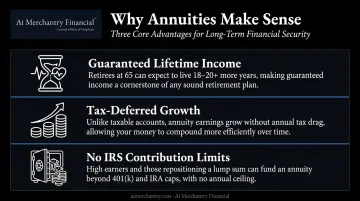
- Key advantages include guaranteed lifetime income, tax-deferred growth, and no IRS contribution limits
- Key drawbacks include surrender charges, limited liquidity, layered fees, and ordinary income tax on withdrawals
What Is an Annuity?
An annuity is a financial contract issued by an insurance company. You make a payment — either a lump sum or a series of contributions — and in return, the insurer agrees to make regular payments to you, beginning either immediately or at a future date you select.
Annuities are fundamentally a risk-transfer tool. The specific risk being transferred is longevity risk — the very real possibility that you'll outlive your savings.
How Mortality Pooling Works
Insurers pool longevity risk across thousands of contract holders. When an annuitant (the person receiving annuity payments) dies earlier than average, the assets associated with their contract are effectively redistributed as mortality credits to surviving annuitants. This pooling allows the insurer to guarantee lifetime income to everyone in the pool, regardless of how long any individual lives — something a personal investment account simply cannot do.
What Annuities Are Not
This distinction matters, because annuities are frequently confused with other financial products:
- Not life insurance — Life insurance pays a death benefit when you die; annuities pay income while you live
- Not FDIC-insured — The FDIC explicitly excludes annuities from deposit insurance; protection comes from the insurer's claims-paying ability and state guaranty associations (subject to state-specific limits)
- Not standard investment accounts — Annuities are contracts with binding terms, not flexible securities holdings
Understanding what annuities are not makes their core purpose clearer. As defined-benefit pensions have largely disappeared from private-sector employment, annuities have reemerged as one of the few tools that can replicate the steady, predictable income a pension once provided.
Types of Annuities Explained
Annuities are categorized along two separate axes: how returns are calculated (fixed, variable, or indexed) and when payments begin (immediate or deferred). You need to understand both axes to evaluate any specific product.
Fixed, Variable, and Indexed Annuities
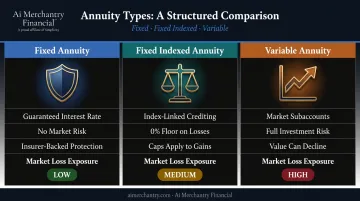
| Type | How Returns Work | Market Loss Exposure |
|---|---|---|
| Fixed | Insurer guarantees a set interest rate | No market risk; insurer-backed guarantee |
| Fixed Indexed | Credits interest based on an index formula (e.g., S&P 500), subject to caps and floors | 0% floor — index decline produces no credited interest, but no value loss from the index itself |
| Variable | Tied to investment subaccounts chosen by the owner | Owner bears full investment risk; value can decline |
Three regulatory and structural differences set these types apart:
- Fixed and fixed indexed annuities are regulated at the state insurance level
- Variable annuities are also regulated as securities by the SEC and FINRA
- Fixed indexed annuities offer a middle ground — some index-linked upside, with a floor that prevents direct market losses — but caps and participation rates limit how much of any index gain you actually receive
The second axis — timing — determines when those returns start paying out.
Immediate vs. Deferred Annuities
Immediate annuities are funded with a lump sum and begin paying income within 30 days to 12 months. They're designed for retirees who need income now.
Deferred annuities accumulate value over time — either through periodic contributions or a single premium — with payouts beginning at a future date the contract holder selects. Growth is tax-deferred during this waiting period, making them more suitable for those still 5–15 years from retirement.
How Do Annuities Work?
Every annuity contract operates through two defined phases: an accumulation phase and a distribution (annuitization) phase. Understanding both is essential before signing anything.
Funding and Contract Initiation
You fund an annuity either with a single lump-sum premium or through periodic payments over time. The funding method affects which products are available — for example, single premium immediate annuities (SPIAs) require a lump sum by definition.
At contract signing, the insurer locks in:
- The growth mechanism (fixed rate, index formula, or market subaccounts)
- The surrender charge schedule (typically lasting 6–10 years)
- The future payout terms and options
These terms are largely binding once the contract is executed. Most buyers don't fully appreciate how little flexibility they'll have once the ink is dry.
The Accumulation Phase
During accumulation, your contract value grows based on the annuity type — at a declared fixed rate, through index-linked crediting, or through market-linked subaccounts. Growth is tax-deferred: you owe no taxes on gains until withdrawals begin.
Surrender charges are the major liquidity constraint during this phase. Most contracts allow penalty-free withdrawals of up to 10% of the contract value annually. Withdrawing beyond that triggers surrender charges — typically 7–10% in year one — which decline gradually over the surrender period. These charges are contract-specific, not universal.
Annuitization and Payout
Annuitization is the moment you convert your accumulated contract value into a guaranteed income stream. Common payout options include:
- Life-only — Payments continue for your lifetime; nothing passes to heirs at death
- Life with period certain — Payments are guaranteed for a set number of years (e.g., 10 or 20) even if you die before that period ends
- Joint-and-survivor — Payments continue for the lifetime of you and a surviving spouse
Payout amounts depend on your contract's accumulated value, your age at annuitization, prevailing interest rates, and the payout option selected. Generally, the older you are when you annuitize, the larger the monthly payment.
Tax treatment is a separate consideration — and it differs depending on how the annuity was funded:
- Non-qualified annuities (after-tax money): Only the earnings portion of each payment is taxed as ordinary income; your original contributions come back tax-free via an exclusion ratio
- Qualified annuities (pre-tax money, such as inside an IRA): The full payment is taxable as ordinary income
Neither qualifies for long-term capital gains rates — a distinction that matters significantly for retirees in higher tax brackets.
The Pros and Cons of Annuities
Annuities involve genuine trade-offs, and any decision to purchase one should be driven by clear understanding — not sales pressure. Here's an honest look at both sides.
Key Advantages
- Guaranteed lifetime income — No other financial product promises income you cannot outlive. The SSA's actuarial life tables report remaining life expectancy at age 65 of 18.12 years for men and 20.66 years for women. Individual longevity can run well beyond those averages, which is precisely why longevity insurance has value.
- Tax-deferred growth — Unlike taxable brokerage accounts where gains are taxed annually, annuity earnings compound without annual tax drag. For those who have already maxed out IRA and 401(k) contributions, this adds a meaningful tax-advantaged accumulation vehicle.
- No IRS contribution limits — Non-qualified annuities carry no annual contribution cap, making them useful for high earners, business owners, or anyone managing a large lump sum (an inheritance, business sale proceeds) who needs a tax-efficient place to grow it.
Key Disadvantages
- Layered fees — Variable annuities carry multiple cost layers: mortality and expense charges, administrative fees, underlying fund expenses, and optional rider fees. Morningstar reports variable annuity costs can total nearly 2.5% or more annually — a drag that compounds against returns over time.
- Surrender charges and illiquidity — Accessing capital during the surrender period may trigger steep penalties, making annuities a poor fit for anyone who needs flexible access to funds.
- Ordinary income taxation — Withdrawals are taxed as ordinary income, not at long-term capital gains rates. For retirees in higher brackets, this can produce a larger tax bill than anticipated.
- Inflation risk in fixed annuities — A fixed payment that feels comfortable today can lose real purchasing power over a 20–30 year retirement. Cost-of-living adjustment (COLA) riders exist, but they reduce the initial payment and add cost.
Weighing these trade-offs against your full financial picture — income sources, tax situation, estate goals, and liquidity needs — is where professional guidance matters most. Ai Merchantry Financial's Collaborative Planning Network™ connects individuals with CPAs, financial professionals, and attorneys who can assess whether an annuity genuinely fits within a broader retirement strategy.
Who Should (and Shouldn't) Consider an Annuity?
Good Candidates
An annuity tends to make sense for someone who:
- Is at or within 5–15 years of retirement
- Lacks a pension and relies primarily on Social Security and personal savings
- Has already maximized contributions to tax-advantaged accounts (IRAs, 401(k)s)
- Wants a guaranteed income floor to cover essential monthly expenses
- Is willing to accept limited liquidity in exchange for guaranteed income
If you fit several of these criteria, the practical framework recommended by the Society of Actuaries applies directly: use guaranteed lifetime income to cover the gap between fixed income sources (Social Security, any pension) and essential monthly expenses. Don't annuitize all assets — retain liquidity for emergencies, healthcare, and flexibility.
Poor Candidates
Annuities are not a good fit for:
- Individuals in poor health (shorter life expectancy reduces the longevity insurance value)
- Those who need flexible, accessible capital
- Younger investors in early accumulation who have better growth options available
- Anyone unwilling to work through complex contract terms before signing

Whether an annuity makes sense comes down to one question: does guaranteed income solve a real gap in your retirement plan? If it does, it's worth exploring. If it doesn't, your money likely works harder elsewhere.
Frequently Asked Questions
How much does a $100,000 annuity pay per month?
A May 2025 Kiplinger illustration showed a $100,000 life-only immediate annuity at age 65 paying approximately $629 per month for a man and $599 for a woman. These figures are general illustrations only — actual payouts vary by state, insurer, interest rates, birth date, and payout option selected. Get current quotes directly from insurers or through a licensed advisor.
What do financial experts say about using annuities for retirement?
Most financial experts support annuities for covering essential retirement expenses — but consistently caution that fees, complexity, and illiquidity require careful product selection. The consensus: annuities work best as one component of a diversified retirement income plan, not a complete solution.
What is the difference between a fixed, variable, and indexed annuity?
Fixed annuities guarantee a set interest rate and predictable payments. Variable annuities tie returns to investment subaccounts, so payments rise and fall with the market. Indexed annuities sit in between — crediting interest based on a market index, with a cap on gains and a 0% floor protecting against losses.
Are annuities a good investment for retirement?
Annuities suit retirees who want guaranteed lifetime income and have covered liquidity needs elsewhere. They're less appropriate for those in poor health, those needing flexible access to capital, or anyone unwilling to accept the fee and complexity trade-offs. The right fit depends on your income needs, health, and timeline.
What happens to an annuity when you die?
It depends on the payout option selected. Life-only annuities end at death with no payment to heirs. Period-certain or joint-and-survivor contracts continue payments to a beneficiary or spouse. Some contracts include a death benefit or return-of-premium feature that protects the original principal for heirs.
Can you lose money in an annuity?
It depends on the type. Fixed and fixed indexed annuities protect your principal — a bad market year produces zero credited interest, not a loss. Variable annuities carry full market risk and can lose value. In any annuity, excessive fees or early withdrawal penalties can erode your overall return.
Conclusion
Annuities exist to solve one problem: the risk of outliving your income. They work by pooling longevity risk across thousands of contract holders, which allows the insurer to guarantee payments no matter how long any individual lives. Once you understand that core mechanic, evaluating any specific product becomes far more straightforward — you can separate genuine income protection from unnecessary complexity.
The right annuity, properly structured, can be a valuable part of a retirement income plan. It should be one part, not the whole strategy. Before committing to any contract, work with qualified professionals who can evaluate the fit against your complete financial picture:
- Current and projected income sources
- Tax situation and bracket considerations
- Liquidity needs and access to cash reserves
- Legacy and estate planning goals