

Key Takeaways
- Group term life insurance covers employees under a single employer-arranged policy, often at no direct cost for basic coverage
- Basic coverage (typically 1x salary or $20,000) rarely meets most families' actual financial needs
- Employer-paid coverage up to $50,000 is tax-free; amounts above that threshold create taxable imputed income
- Coverage generally ends when employment ends; portability and conversion rights depend on your specific plan
- Supplemental or individual coverage layered on top of group benefits is the most reliable long-term protection strategy
What Is Group Term Life Insurance?
Group term life insurance provides death benefit coverage to a defined group of people — most commonly employees at the same company — under an arrangement organized by an employer, union, professional association, or similar organization.
The name itself explains the structure:
| Component | What It Means |
|---|---|
| Group | Coverage extended to multiple people under one employer or organizational arrangement |
| Term | Protection lasts for a defined period, typically renewed annually while you remain eligible |
| Life Insurance | Pays a death benefit to your named beneficiaries when you die |
How It Differs from Individual Coverage
Unlike a policy you purchase on your own, group term life pools risk across all covered members. That collective structure produces lower premiums and, most importantly, eliminates the need for a medical exam during basic enrollment. Your individual health history doesn't determine whether you qualify — membership in the group does.
Two Main Employer Designs
Most employers offer one or both of the following:
- Basic group term life — Employer-paid coverage, typically equal to one year's salary or a flat dollar amount. Enrollment is often automatic for eligible employees.
- Supplemental (voluntary) group term life — Employee-paid additional coverage, usually available in salary multiples (1x, 2x, 3x annual income). Requires an active election during open enrollment or after a qualifying life event.
Who Else Has Access
Group coverage isn't exclusive to traditional employees. Veterans can access Veterans' Group Life Insurance (VGLI) through the VA. AARP members can obtain group term coverage underwritten by New York Life. Union members may qualify through Union Plus plans. What each of these arrangements shares is the same core advantage: access to coverage through a group, without individual underwriting barriers.
How Does Group Term Life Insurance Work?
Enrollment and Coverage Amounts
Basic employer-paid coverage is often automatic when you're hired, though this varies by plan. Supplemental coverage requires you to actively elect it — typically during open enrollment or within a window following a qualifying life event.
Coverage amounts follow one of two formulas:
- Flat dollar amount — A fixed benefit such as $20,000 or $50,000 regardless of salary
- Salary multiple — One year's income, or supplemental tiers at 2x, 3x, or more of annual salary
According to LIMRA's 2025 workplace data, the median basic employer benefit is $20,000 or 1x salary — explicitly described as "far less than experts recommend."
Higher supplemental tiers may require evidence of insurability (a medical questionnaire or exam) if your election exceeds the plan's guaranteed-issue limit or if you enroll late. That threshold is plan-specific, so check your benefits documentation.
Premiums and Age Bands
Employers pay most or all of the basic premium. Supplemental premiums come out of your paycheck, often pre-tax.
Rates increase with age, structured in five-year brackets. A Lincoln Financial voluntary plan uses bands from ages 25–29 through 70+, with per-$1,000 biweekly rates ranging from $0.030 to $1.218 — costs that can more than quadruple over a career.
Portability and Conversion
Understanding your costs and coverage is one thing — knowing what happens to that coverage when you leave is another. This is where many employees get caught off guard. When you leave a job:
- Basic employer-paid coverage typically ends — and may not be portable
- Supplemental coverage may offer a portability option (continuing term coverage at group rates) or a conversion option (moving to an individual permanent policy without a new medical exam)
Both rights generally require you to act within 31 days of your coverage ending — though this is contract language, not a federal rule. Your actual plan certificate controls the timeline and conditions.
Benefits and Limitations of Group Term Life Insurance
Why Group Term Life Has Real Value
Group term life removes two of the biggest barriers to getting covered: cost and health status.
- No medical exam for basic enrollment — Coverage is guaranteed issue, meaning people with pre-existing conditions or high-risk occupations can access protection they might be denied or priced out of individually
- Low or zero cost to employees — Employers pay the basic premium; employees participate without a direct expense
- Automatic participation — Eligible employees are often enrolled without having to take any action
- Tax-free death benefit — Beneficiaries receive the full payout free from income tax — no reduction, no delay
Where Group Term Life Falls Short
Coverage ends with employment. An employee who loses their job, changes careers, or retires loses their basic coverage at the same time — frequently at the moment when financial pressure is already mounting.
Basic coverage is rarely sufficient. Guardian's 12th Annual Workplace Benefits Study found that nine in 10 workers have insufficient life insurance coverage — yet only 36% believe they're underinsured. LIMRA's research adds another sobering data point: 49% of households with only employer-provided life insurance say they would struggle financially within six months of a wage earner's death.
One year's salary, or a flat $20,000 benefit, won't replace decades of income, pay off a mortgage, or fund a child's education. That's why most financial advisors recommend adding supplemental or individual coverage on top of whatever an employer provides — group term alone is a starting point, not a complete plan.
Group Term Life Insurance Tax Implications
The $50,000 Exclusion (IRS Section 79)
Employer-paid group term life coverage up to $50,000 is excluded from your taxable income. You owe no income tax on those premiums, and your beneficiaries receive the death benefit tax-free.
When Coverage Exceeds $50,000
Once employer-paid coverage crosses the $50,000 threshold, the IRS requires you to include the imputed cost of the excess in your taxable wages — reported on your W-2 in boxes 1, 3, and 5 (and in box 12 with code C). That taxable amount is calculated using IRS Table I rates — not what your employer actually pays.
Current IRS monthly rates per $1,000 of coverage above $50,000:
| Age at Year-End | Monthly Cost per $1,000 |
|---|---|
| Under 25 | $0.05 |
| 25–29 | $0.06 |
| 30–34 | $0.08 |
| 35–39 | $0.09 |
| 40–44 | $0.10 |
| 45–49 | $0.15 |
| 50–54 | $0.23 |
| 55–59 | $0.43 |
| 60–64 | $0.66 |
| 65–69 | $1.27 |
| 70 or older | $2.06 |
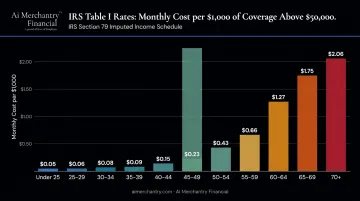
These rates feed directly into your imputed income calculation, which is also subject to Social Security and Medicare taxes. For employees under 45 with coverage only modestly above $50,000, the added tax burden is small — but it compounds quickly as both age and coverage amount increase.
Spouse and Dependent Coverage
Employer-paid coverage on a spouse or dependent with a face value of $2,000 or less is generally excludable as a de minimis fringe benefit. Above that amount, it may become taxable. If your plan includes family coverage above $2,000, a tax advisor can calculate the exact imputed income so there are no surprises on your W-2.
How Much Group Term Life Coverage Do You Actually Need?
Basic group term life is a starting point. For most families, it's not a finish line.
Life insurance professionals commonly reference coverage ranging from seven to ten times annual income as a general guideline. Two frameworks help get more specific:
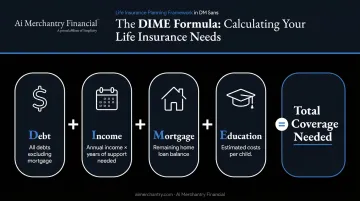
The DIME Formula
Add up four categories:
- Debt — All outstanding debts excluding the mortgage
- Income — Annual income multiplied by the number of years your dependents need support
- Mortgage — Remaining balance to pay off your home
- Education — Estimated costs for each child's education
Total those figures and compare the result against your existing coverage. The gap is how much additional protection your family needs.
The Salary Multiple Approach
Multiply your annual income by 7–10 as a baseline. This method is faster but less precise — it doesn't account for debt levels, the number of dependents, or specific long-term obligations.
Getting It Right
Neither formula replaces a personalized conversation. Debts change, income grows, and family circumstances shift — determining the right amount means evaluating all of these moving parts together, not just running a single calculation.
Ai Merchantry Financial's Collaborative Planning Network™ connects you with financial professionals who map your complete picture — existing coverage, dependents, income replacement needs, debts, and long-term goals — before recommending anything. The conversation starts with understanding, not a sales pitch. Reach the team at (844) 626-2246 to get started.
Group Term Life Insurance for Employers
The Business Case
Life insurance benefits carry real weight in hiring and retention decisions. LIMRA's 2025 workplace research found that 55% of workers consider life insurance an important benefit — and when offered access, take-up rates are exceptionally high: 97–99% across workforce segments, per BLS March 2025 data.
Access varies sharply by company size:
- 42% of employees in companies with fewer than 100 workers have access
- 79% of employees in larger companies (100+ workers) have access
For smaller employers, offering group term life is one of the more cost-effective ways to close a competitive gap against larger organizations.
Cost Structure and Tax Treatment
Group term life premiums tend to deliver strong perceived value at a low cost per employee — often making them one of the most efficient benefits in a total compensation package. Actual rates depend on the group's age distribution and plan design, so employers should request proposals based on their specific workforce.
On the tax side, employer-paid premiums are generally deductible as a business expense, provided the employer is not named as a policy beneficiary. Consult a tax professional to confirm how this applies to your organization's structure.
Design Flexibility
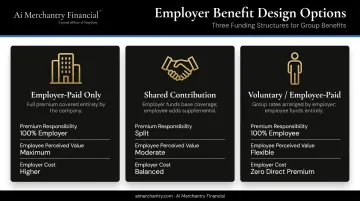
Once cost and tax considerations are clear, the next decision is how to structure the benefit itself. Employers have several options:
- Employer-paid only — Full premium paid by the company; maximum perceived value for employees
- Shared contribution — Company and employee split costs, with the employer covering basic and employees funding supplemental tiers
- Voluntary (100% employee-paid) — Employer arranges access to group rates; no direct premium cost to the business
Benefit amounts can be structured as a flat dollar amount, a salary multiple, or a combination. For business owners navigating these design choices alongside retirement and risk planning, Ai Merchantry Financial's Business Owners Solution System (BOSS™) framework integrates employee benefits decisions into a broader, coordinated financial strategy.
Frequently Asked Questions
What is a group term life insurance policy?
It's life insurance coverage arranged by an employer or organization that extends to a defined group (typically employees) under a shared plan. It pays a death benefit for a defined period (usually renewed annually) and typically requires no medical exam for basic enrollment.
Is group term life insurance a good idea?
For most people, yes — especially when the employer covers the premium at no cost to you. That said, the coverage has real limits worth understanding:
- Coverage ends when employment ends
- There's no cash value accumulation
- Basic amounts rarely cover long-term family needs
It works best as a starting point alongside individual or supplemental coverage.
Why am I getting paid for group term life insurance?
You're not receiving a payment. What you're seeing is imputed income. When employer-paid coverage exceeds $50,000, the IRS treats the value of the excess as taxable income, calculated using IRS table rates and reported on your W-2 as a tax liability.
Is group term life insurance over $50,000 taxable?
Per IRS Section 79, the first $50,000 of employer-paid coverage is tax-free. Anything above that generates imputed income subject to income tax, Social Security, and Medicare taxes calculated using IRS Premium Table I rates, not the actual premium your employer pays.
Can I keep my group term life insurance if I leave my job?
Basic employer-paid coverage typically ends with employment. Supplemental policies often allow portability or conversion to an individual policy (usually without a new medical exam), but you generally must act within 31 days. Check your plan documents or HR department for the exact terms.
How much group term life insurance do I need?
Basic coverage (usually 1x salary or $20,000) is rarely enough for most families. Common guidelines suggest 7–10x annual income as a starting point. The DIME formula (Debt, Income replacement, Mortgage, and Education) provides a more personalized calculation based on your actual obligations.