

Introduction
Running a business means carrying a tax burden employees never see. You pay both sides of self-employment tax — 15.3% on net earnings — make quarterly estimated payments, and bear full responsibility for compliance. Miss a deadline or overlook a deduction, and the cost comes directly out of your pocket.
According to a 2024 NFIB Tax Survey, 82% of small business owners had not discussed the potential TCJA sunset with a tax professional — despite 90% using a professional preparer. That gap between filing and planning is where money gets left behind.
This guide covers the strategies that close that gap. You'll find guidance on choosing the right business structure, maximizing deductions and credits, using retirement accounts as tax tools, applying the 5 D's framework, and building an advisory team that works with you year-round — not just at tax time.
Key Takeaways
- Entity structure (LLC, S-Corp, C-Corp) is the single highest-leverage tax decision most owners delay too long
- Deductions and credits for home office, equipment, R&D, and hiring incentives cut taxable income when tracked systematically
- Retirement plans like Solo 401(k)s and SEP-IRAs reduce your tax bill and build personal wealth at the same time
- The 5 D's framework (Deduct, Defer, Divide, Discount, Donate) gives you a practical lens for evaluating any tax move
- Year-round planning with qualified advisors prevents the costly errors that filing-season-only approaches miss
Choosing the Right Business Structure for Tax Efficiency
Entity selection isn't a one-time administrative task. It determines how your income is taxed, which deductions apply, and what self-employment obligations you carry. Getting this wrong early costs you every year you stay in the wrong structure.
Sole Proprietorship and Single-Member LLC
Both structures pass all income through to your personal return. Net self-employment earnings (calculated at 92.35% of net profit) are subject to the full 15.3% SE tax — 12.4% Social Security (capped at $176,100 in 2025) plus 2.9% Medicare with no ceiling.
These structures work for very early-stage businesses or those with low net profit, but the SE tax burden grows fast as income scales.
S Corporation: Splitting Salary and Distributions
Pay yourself a reasonable salary (subject to payroll taxes), then take remaining profits as distributions, which are not subject to self-employment tax. That split is the core of the S-Corp tax advantage.
Here's what that looks like on $150,000 of net profit:
| Scenario | FICA Paid | Savings vs. Schedule C |
|---|---|---|
| Schedule C (sole prop) | ~$21,194 | — |
| S-Corp, $60,000 salary | ~$9,180 | ~$12,014 |
| S-Corp, $80,000 salary | ~$12,240 | ~$8,954 |
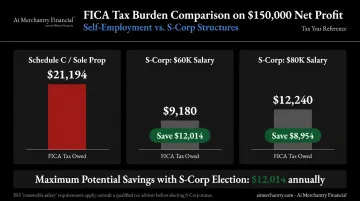
The IRS requires that owner-salaries be "reasonable" based on duties, experience, time, and comparable market pay. Underpaying to maximize distributions is a known audit trigger. An LLC can elect S-Corp tax treatment without changing its legal structure, making it a practical option for most LLCs.
C Corporation and QSBS
A C-Corp pays a flat 21% corporate rate and creates the potential for double taxation on dividends. That tradeoff can be worth it for founders planning a sale within 3–5 years.
Under P.L. 119-21 (the One Big Beautiful Bill), Qualified Small Business Stock (QSBS) acquired after July 4, 2025 now qualifies for:
- 50% exclusion after 3 years
- 75% exclusion after 4 years
- 100% exclusion after 5 years
The per-issuer limit is the greater of $15 million or 10x basis, with a gross-assets ceiling of $75 million. For qualifying founders, this can shelter significant capital gains from a business sale, making C-Corp status worth modeling carefully before committing to another structure.
Pass-Through Entity (PTE) Tax Election
The SALT deduction cap limits individual deductions to $10,000 for state and local taxes. The PTE election works around this: 36 states now allow S-corps, partnerships, and LLCs taxed as partnerships to pay state income tax at the entity level, generating a federal deduction that individual owners aren't subject to the cap on.
Quick example: a 5% PTET on $200,000 of business income creates a $10,000 entity-level deduction, reducing pass-through income to $190,000 before other items. State rules on owner credits and addbacks vary significantly, so verify your state's specific mechanics before electing.
Qualified Business Income (QBI) Deduction
Pass-through business owners can deduct up to 20% of qualified business income from taxable income. P.L. 119-21 made this deduction permanent starting in 2026.
Phase-out thresholds for 2025 are:
- Single filers: $197,300–$247,300
- Married filing jointly: $394,600–$494,600
Specified service trades (law, medicine, accounting, consulting, financial services, and others) lose the deduction above these thresholds. Below them, even SSTBs may qualify. Confirming eligibility requires working through your specific income level and entity structure with a tax advisor.
Key Tax Deductions and Credits for Business Owners
Deductions reduce the income your tax is calculated on. Credits reduce the actual tax owed, dollar-for-dollar. Most business owners underuse both — not because they don't know they exist, but because recordkeeping gaps leave money on the table.
High-Impact Business Deductions
Commonly overlooked deductions that require specific IRS documentation:
- Home office — must be used regularly and exclusively for business; IRS Publication 587 governs the rules. Inventory storage and daycare use have separate exceptions
- Vehicle expenses — standard mileage rate is 70 cents/mile in 2025 (up from 67 cents in 2024); actual cost method requires detailed logs either way
- Business meals — generally 50% deductible when directly business-related and not lavish; receipts and business purpose required
- Professional services — legal, accounting, and consulting fees are fully deductible; keep invoices
- Employee compensation and benefits — wages, health coverage, and qualifying fringe benefits
- Business insurance premiums — deductible as an ordinary business expense
Section 179 and Bonus Depreciation
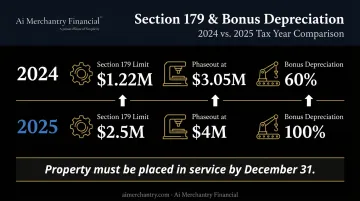
Both provisions allow you to expense the cost of qualifying business property immediately rather than depreciating it over years.
| Tax Year | Section 179 Limit | Phaseout Starts | Bonus Depreciation |
|---|---|---|---|
| 2024 | $1.22M | $3.05M | 60% |
| 2025 | $2.5M | $4M | 100% |
P.L. 119-21 permanently restored 100% bonus depreciation for qualifying property acquired and placed in service after January 19, 2025. The critical rule: property must be placed in service by December 31 — purchase alone doesn't qualify. Both new and used assets are eligible.
Self-Employed Health Insurance and HSA Contributions
Self-employed owners can deduct 100% of health insurance premiums for themselves, their spouse, and dependents directly from gross income — not as an itemized deduction. The deduction is limited to business earned income and unavailable in months when you're eligible for a subsidized employer or spouse-employer plan.
Pairing health coverage with a Health Savings Account (HSA) adds a triple tax benefit: contributions are pre-tax, growth is tax-free, and qualified medical withdrawals are tax-free.
2025 HSA contribution limits:
- Self-only: $4,300
- Family: $8,550
- Age 55+ catch-up: $1,000 additional
Key Tax Credits for Business Owners
| Credit | What It Covers | Value |
|---|---|---|
| R&D Credit (Sec. 41) | New products/processes meeting 4-part test; small businesses may apply up to $500K against payroll tax | Varies |
| WOTC | Hiring from 10 qualifying target groups (veterans, ex-felons, SNAP recipients, etc.) | Generally $2,400; up to $9,600 for certain veterans |
| Small Business Health Care | <25 FTEs, avg wages below $67K, 50%+ employer premium payment via SHOP | Up to 50% of premiums (2 years) |
| Disabled Access Credit | Making business accessible; prior-year receipts ≤$1M or ≤30 FTEs | Up to $5,000 |
Hiring Family Members Strategically
Paying a spouse or minor children for legitimate, documented work creates a deductible business expense while shifting income to lower tax brackets. The IRS requires bona fide work, reasonable compensation, and proper payroll records.
One important rule: wages paid to a child under 18 employed by a parent's sole proprietorship — or a partnership where each partner is a parent — are exempt from FICA. Children under 21 are exempt from FUTA in these same structures. Corporations and partnerships with a non-parent partner receive no exemption. Verify payroll compliance before implementing.
Retirement Plans and Health Benefits as Tax Reduction Tools
Retirement contributions are unusual among tax strategies: they reduce your current-year tax bill and build long-term wealth. Unlike most deductions, you can often make meaningful contributions after the tax year ends, giving you flexibility to manage estimated taxes.
Solo 401(k) for Self-Employed Business Owners
The Solo 401(k) is designed for self-employed individuals and business owners with no employees other than a spouse. You contribute in two capacities:
- Employee deferral (2025): up to $23,500
- Employer contribution: up to 25% of net self-employment income
- Combined maximum (2025): $70,000
- Age 50+ catch-up: additional $7,500
- Age 60–63 catch-up: $11,250 (new under SECURE 2.0)
Roth Solo 401(k) designations are permitted if the plan document allows, which is useful for owners who expect to be in a higher bracket in retirement.
SEP-IRA and SIMPLE IRA
| Feature | SEP-IRA | SIMPLE IRA |
|---|---|---|
| Who contributes | Employer only | Employee + employer |
| 2025 contribution limit | Up to 25% of compensation (max $70,000) | Employee deferrals up to $16,500 |
| Age 50+ catch-up | N/A | $3,500 (age 60–63: $5,250) |
| Best for | High earners, few or no employees | Businesses with up to 100 employees |
| Setup deadline | Tax return due date (with extensions) | Generally October 1 of that year |
| Admin complexity | Minimal | Low to moderate |
Defined Benefit Plans for High-Income Owners
High-income owners — especially those 50 and older — can often contribute far more through a defined benefit or cash balance plan than a 401(k) alone allows. The annual benefit limit is $280,000 in 2025, but actual contribution levels depend on age, compensation, benefit formula, and actuarial assumptions. For some owners, annual contributions can reach six figures.
These plans require an enrolled actuary to determine funding and file Schedule SB. If you're consistently earning more than a 401(k) can shelter, a defined benefit plan is worth a detailed conversation with a financial advisor who can model the contribution levels specific to your age and income.
The 5 D's of Tax Planning: A Framework for Business Owners
Tax professionals use a mental framework called the 5 D's to evaluate any tax planning decision. Understanding it helps you spot opportunities and have sharper conversations with your advisors.
| D | What It Means | Business Owner Example |
|---|---|---|
| Deduct | Reduce taxable income through eligible expenses | Expensing equipment under Section 179 rather than depreciating over 7 years |
| Defer | Delay income or accelerate deductions to push tax to future years | Delaying December invoicing until January; maximizing retirement contributions before year-end |
| Divide | Split income among family members, entities, or accounts to access lower brackets | Paying a college-aged child a reasonable wage for legitimate work in the business |
| Discount | Capture lower long-term capital gains rates instead of ordinary income rates | Holding an appreciated business asset for more than one year before selling |
| Donate | Use charitable contributions to generate deductions while fulfilling philanthropic goals | Donating appreciated stock to avoid capital gains while still claiming fair market value |
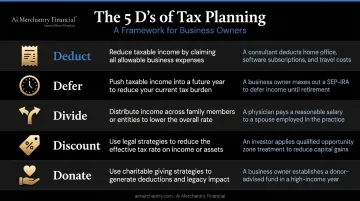
The right combination depends on your income level, entity structure, growth trajectory, and personal financial goals — no single D wins in every situation. The framework's real value is pushing you to evaluate all five dimensions, not just deductions, before making major decisions.
Year-End Strategies and Recordkeeping
Timing: Defer Income, Accelerate Deductions
Cash-basis businesses have meaningful flexibility at year-end:
- Defer income by delaying invoicing or holding off on collecting payments until January — but note that constructive receipt applies. If a check is already available to you, delaying deposit doesn't defer the income
- Accelerate deductions by prepaying legitimate business expenses before December 31, subject to the IRS 12-month rule: the benefit must not extend beyond the earlier of 12 months after it begins or the end of the next tax year
This strategy is most valuable when you expect to be in a lower bracket next year. Accrual-basis businesses follow different recognition rules and have less flexibility here.
Quarterly Estimated Tax Payments
Business owners must pay estimated taxes quarterly to avoid underpayment penalties. The 2025 safe harbor rules:
- Pay at least 90% of your 2025 tax liability, OR
- Pay 100% of your 2024 tax (substitute 110% if 2024 AGI exceeded $150,000)
2025 due dates: April 15 · June 16 · September 15 · January 15, 2026
If your income varies significantly quarter to quarter, recalculate estimates each quarter rather than annualizing from Q1 — overpaying early is an interest-free loan to the IRS.
Staying current on payments is only half the picture. Keeping clean records and avoiding procedural missteps protects everything you've calculated.
Recordkeeping and Avoiding Common Mistakes
The three most costly compliance errors:
- Missing filing deadlines: Failure to file carries a 5% monthly penalty (maximum 25%). Failure to pay runs 0.5% monthly (maximum 25%). Filing on time — even without full payment — limits the damage
- Misclassifying workers as contractors: The IRS applies a three-factor test (behavioral control, financial control, relationship type). Misclassification triggers back employment taxes, penalties, and audit exposure
- Commingling personal and business finances: Mixed accounts make it nearly impossible to substantiate deductions under audit
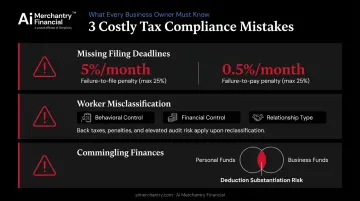
Practical fix: dedicated business checking and credit accounts, accounting software (QuickBooks, Xero, or FreshBooks), and a monthly reconciliation routine.
Building Your Tax Planning Team Year-Round
Tax planning works best as a year-round discipline. Business owners who consistently pay less in taxes engage their advisors between returns — reviewing their position, adjusting strategy, and staying ahead of what's coming.
What proactive engagement actually looks like:
- Mid-year tax projections to catch surprises before Q4
- Entity structure reviews after meaningful income changes or business growth
- Strategic timing of equipment purchases to optimize Section 179 and bonus depreciation
- Coordination between retirement contributions and estimated tax payments — reducing taxable income through contributions directly lowers the following year's quarterly obligations
Getting all of these moving parts aligned requires more than a single advisor. That's the model behind Ai Merchantry Financial's Collaborative Planning Network™ — connecting business owners with CPAs, tax strategists, financial professionals, and estate planning attorneys who work together rather than in silos. A filing-only relationship captures what already happened. This kind of coordinated planning determines what happens next.
If you're not sure where to start, reach the team at (844) 626-2246 or schedule a consultation at aimerchantry.com to connect with the right professionals for your situation.
Frequently Asked Questions
How do I plan for taxes as a small business owner?
Start with the right entity structure, track all deductible expenses throughout the year, make quarterly estimated payments, and maximize retirement contributions before deadlines. Treat taxes as a year-round exercise, not a once-a-year filing task. A qualified advisor can proactively adjust your strategy as income changes throughout the year.
What are the 5 D's of tax planning?
The 5 D's (Deduct, Defer, Divide, Discount, and Donate) give tax professionals a structured way to reduce a business owner's overall liability. In practice, a well-built plan draws on multiple D's simultaneously — for example, deferring income while splitting it across family members to reduce the effective rate.
What is the $400 rule for self-employed people?
Self-employed individuals with $400 or more in net self-employment earnings must file a federal return and pay self-employment tax. Under P.L. 119-21, beginning in 2026 there is also a new $400 minimum QBI deduction for taxpayers with at least $1,000 in aggregate qualified business income from active businesses in which they materially participate.
What is the difference between a tax deduction and a tax credit?
A deduction reduces the amount of income subject to tax — its value scales with your tax bracket. A credit reduces the actual tax owed dollar-for-dollar, making credits generally more valuable for those who meet the criteria. A $1,000 deduction at a 24% bracket saves $240; a $1,000 credit saves $1,000.
When should a business owner consider switching to an S corporation?
As net profit grows, the S-Corp salary-plus-distributions structure generates meaningful FICA savings. The break-even point depends on your defensible salary, payroll administration costs, state taxes, and QBI interactions rather than any universal income threshold. A CPA can model the actual numbers for your situation.
How much should a small business owner set aside for taxes each quarter?
A general starting point is 25–35% of net profit, but the precise amount varies based on entity type, available deductions, and retirement contributions. Having an advisor calculate your actual estimated payments each quarter, rather than relying on a fixed percentage, prevents year-end surprises and underpayment penalties.