
Only 24% of U.S. adults report having a will, according to Caring.com's 2025 study — and the largest group without one is parents of minor children. Courts don't wait for families to be ready. Without documented wishes, a judge who has never met your family will make decisions about your children's future.
Estate planning isn't morbid. It isn't complicated. And it's not reserved for the wealthy. It's a set of documents that protects the people you love most from outcomes you'd never choose for them.
This article walks through five essential questions every young family needs to answer — not because the answers are easy, but because having clarity on them is the most important first step you can take.
Key Takeaways
- Young parents with minor children have the most urgent need for an estate plan — not the least.
- Without a named guardian, a court appoints one based on state law, not your values or relationships.
- A will, a trust, powers of attorney, and healthcare directives each serve distinct roles — most families need all of them.
- Beneficiary designations on retirement accounts and life insurance override whatever your will says.
- Coordinating an estate attorney, financial advisor, and insurance professional delivers stronger protection than any single advisor can.
Question 1: Who Will Take Care of My Children If Something Happens to Me?
Naming a legal guardian is the single most consequential estate planning decision a parent can make. Without a nomination in your will, a family court judge determines who raises your children — based on state law and judicial discretion, not your relationships, values, or preferences.
The process isn't simple or fast. In most states, the court requires a petition, formal notice to interested parties, an investigation, and a best-interest hearing. During that time, children may be placed with a temporary guardian — or, in some situations, in foster care — while the case resolves.
Colorado, for example, permits emergency guardianships for up to 60 days. That means "temporary" can easily stretch for months before a permanent arrangement is established.
Choosing the Right Guardian
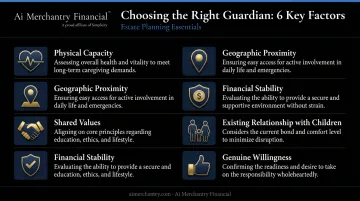
This decision deserves more thought than most parents give it. Key factors to evaluate:
- Physical capacity to raise children to adulthood (age and health matter)
- Geographic proximity or willingness to relocate
- Shared values and compatible parenting philosophy
- Financial stability — consistent enough to support additional dependents
- Existing relationship with your children
- Genuine willingness to take on the role — never assume
Name both a primary guardian and a successor. If your first choice becomes unable or unwilling to serve, you need a backup. Have a direct conversation with your chosen guardian before anything is documented. This person is being asked to step into a permanent parenting role, and that deserves an honest, direct conversation.
Family members who aren't selected may feel hurt. That's understandable. Think of it as an act of protection, not a ranking. Guardian designations can also be revisited after major life changes — a move, a divorce, or a shift in someone's health or circumstances.
A Note on Divorced and Blended Families
For divorced parents, custody typically defaults to the surviving biological parent. But naming a backup guardian still matters if that parent is also unable to care for the children.
Blended families face a sharper risk: stepchildren are not automatically protected under estate law. In Texas and most other states, an unadopted stepchild has no legal right to inherit from a stepparent who dies without a will — because no legal relationship exists. A properly structured estate plan — including explicit trust provisions and guardian designations — can close that gap.
Question 2: Does My Family Have Enough Life Insurance?
Life insurance inside an estate plan does specific work: it replaces lost income, pays off the mortgage and other debts, funds the children's ongoing expenses, and can cover future education costs. Life insurance proceeds also pass directly to named beneficiaries — bypassing probate entirely, which means faster access for your family when they need it most.
The 2023 Insurance Barometer Study found that 59% of parents with minor children owned life insurance — but 47% of those parents said their coverage was insufficient. Owning a policy and owning enough coverage are two very different things — and that gap is exactly what estate planning needs to close.
Don't Name Minor Children Directly
This is one of the most common mistakes young parents make. Insurers generally cannot pay proceeds directly to a minor — so when a child is named as a direct beneficiary, a court may appoint a financial guardian to manage the funds instead.
The bigger issue comes later: when the child reaches the legal age of majority (which varies by state), they receive the full amount at once, regardless of maturity or circumstances.
A better approach: name a trust as the beneficiary. A trustee then distributes funds according to your specific terms, such as:
- Releasing funds at a set age (such as 25 or 30) rather than at 18
- Restricting distributions to education, medical, or housing expenses
- Staggering payments over time to prevent a single lump-sum transfer
Don't Forget Disability Insurance
Life insurance answers the question "what if I die?" Disability insurance answers a different one: "what if I can't work?" LIMRA's 2024 research found 46% of adults said they needed disability insurance, but only 18% reported having it. A parent who becomes too sick or injured to work — but doesn't die — creates a financial crisis that life insurance alone cannot solve. Income replacement planning needs to account for both scenarios.
Question 3: Do I Need a Will, a Trust, or Both?
Most young families need both a will and a trust — not one or the other. Each document serves a distinct purpose, and together they cover gaps the other leaves open.
What a Will Does
A last will and testament names who receives your property, designates your executor, and — critically — is the document where you officially nominate a guardian for your minor children. Without a will, that guardian decision goes to a court.
A will goes through probate: a court-supervised process that validates the document, settles debts, and distributes assets. Probate is public, and according to ACTEC, estates typically remain open for at least several months, often longer. For families with limited assets and straightforward situations, a will may be the right starting point.
What a Trust Does
A revocable living trust allows assets to pass to heirs outside of probate. Assets held in a properly funded trust transfer through the successor trustee — faster, privately, and without court supervision. ACTEC confirms that a trust remains private, while a probated will becomes a public record.
A trust also lets parents specify not just who receives assets, but when and for what purpose — whether that means distributions at age 25, funds restricted to education and healthcare, or access staggered across multiple milestones.
A trust makes particular sense when a family:
- Owns real estate
- Has children from a prior relationship
- Has a beneficiary with special needs
- Wants to prevent a young heir from receiving a large lump sum all at once

The Pour-Over Will
If you establish a trust, you still need a will — specifically a pour-over will. This document directs any assets held outside the trust at the time of death to flow into it, so nothing falls through the cracks. The pour-over will is also where guardian nominations are recorded, making it an essential companion document regardless of your trust's structure.
Question 4: Who Will Manage My Assets — and What Happens to My Property?
The Executor's Role
Your executor is the person named in your will to carry out its instructions: inventorying assets, paying outstanding debts and taxes, and distributing property to heirs. Choose someone trustworthy, organized, and financially literate. Proximity matters too — handling an estate from another state adds real friction. Your executor can be a spouse, adult child, trusted friend, or a professional such as an attorney or accountant.
Beneficiary Designations Override Your Will
This point cannot be overstated. Retirement accounts (401(k)s, IRAs), life insurance policies, and certain bank accounts with transfer-on-death designations pass directly to whoever is named on the account form — and the ABA confirms these designations override conflicting instructions in a will or trust. A will that says one thing and a 401(k) beneficiary form that says another will resolve in favor of the form, every time.
Reviewing and updating beneficiary designations after major life events — marriage, divorce, birth of a child, death of a named beneficiary — is one of the most actionable steps families can take immediately, and one of the most frequently overlooked.
Digital Assets
Beneficiary forms cover financial accounts, but they don't touch your digital life. Most young families don't think of their digital accounts as estate assets — but they are. Your estate includes:
- Online banking and investment accounts
- Cloud-stored photos and documents
- Email and social media accounts
- Streaming subscriptions with transferable value
- Domain names and intellectual property with resale value
Create a secure inventory of accounts with access information and store it somewhere trusted — but never inside the will itself. A will becomes a public document upon death, and exposing login credentials publicly creates real risk.
Getting these details right requires more than a checklist. Through Ai Merchantry Financial's Collaborative Planning Network™, families work alongside estate attorneys, financial advisors, and insurance professionals who coordinate around a shared view of the plan — so nothing falls through the gaps between disciplines.
Question 5: Who Makes Medical and Financial Decisions If I'm Incapacitated?
Estate planning isn't only about death. It's equally about what happens if you're alive but unable to make decisions — after a serious accident, a sudden illness, or a medical emergency that leaves you incapacitated. Without the right documents, your family may face court proceedings just to manage basic financial and medical matters.
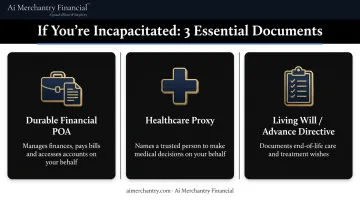
Three documents address this directly:
- Durable financial power of attorney — designates someone to manage your finances (paying bills, accessing accounts, handling investments) if you're incapacitated
- Healthcare proxy (or healthcare power of attorney) — names someone to make medical decisions on your behalf
- Living will (or advance directive) — documents your specific wishes on life-sustaining treatment, organ donation, and end-of-life care
Without a durable financial POA, a family member may need to petition a court to establish guardianship over your finances. That process requires medical evidence, legal notice, court-appointed counsel in some states, and a formal hearing — a slow and costly burden during an already difficult time.
The healthcare proxy and living will work together. They relieve family members of guessing what you would have wanted — and they protect those decisions from being made by strangers or courts.
A 2017 systematic review of 150 U.S. studies found that only 36.7% of adults had completed any advance directive. More than six in ten adults have no documented guidance for their families — leaving those decisions to conflict, uncertainty, or a judge.
How to Start — and When to Review
The First Steps
Starting an estate plan doesn't require perfect answers to every question. It requires action on a few key items:
- Take inventory: List all assets — home, vehicles, retirement accounts, life insurance, bank accounts, and digital assets
- Identify your five answers: guardian choice, insurance adequacy, will vs. trust decision, executor, and incapacity documents
- Engage the right professionals: an estate planning attorney drafts the documents, a financial advisor aligns the plan with your goals, and an insurance professional identifies coverage gaps
Estate planning doesn't have to be expensive to begin. A basic will with a guardian designation, updated beneficiary forms, and two incapacity documents is a meaningful foundation.
When to Update
Caring.com's 2025 data found that nearly 1 in 4 respondents with wills had never updated them after creation. Estate plans become stale. Review yours after any of these events:
- Birth or adoption of a child
- Marriage, divorce, or remarriage
- Death of a named guardian, executor, or beneficiary
- Significant change in assets (buying property, receiving an inheritance)
- Moving to a new state (estate laws vary)
- Major shift in a beneficiary's financial or personal situation
ACTEC recommends reviewing your plan after marriage, divorce, relocation, or changes in your chosen executors or trustees — and most estate attorneys suggest a general review every three to five years regardless.
Navigating these decisions is easier with the right team behind you. Ai Merchantry Financial connects families with vetted estate planning attorneys, financial strategists, and insurance specialists through its Collaborative Planning Network™. The process starts with education — understanding your options clearly before any documents are drafted.
Frequently Asked Questions
At what age should young parents start estate planning?
Estate planning should begin as soon as you have dependents, own property, or reach adulthood. For parents with minor children, the urgency is immediate. Don't wait for finances to feel settled or life to feel more stable.
What happens to my children if I die without a will?
A court will appoint a guardian based on state law, not your preferences or relationships. Your assets will be distributed according to intestacy laws, which may not reflect your intentions and cannot account for your children's specific needs.
Is a trust necessary if I don't have significant assets?
A trust isn't exclusively for the wealthy. It gives you control over how and when assets reach your children, and prevents a court from managing an inheritance until a child reaches legal age. In most states, that means your child receives everything at once, with no conditions attached.
Who should I choose as guardian for my children?
Choose someone willing and able to raise your children long-term: someone who shares your values, maintains financial stability, and already has a relationship with your kids. Have that conversation directly before finalizing anything.
Do beneficiary designations on retirement accounts override my will?
Yes. Beneficiary designations on retirement accounts and life insurance policies take legal precedence over a will. Keeping these designations current after every major life event (marriage, divorce, birth, death) is a critical and often overlooked part of estate planning.
How often should I update my estate plan?
Review your plan every three to five years or after any major life event: birth of a child, divorce, a move to a new state, or the death of a named executor or guardian. Life changes faster than most estate documents get updated.