

Introduction
A funeral with burial now carries a national median cost of $8,300, according to 2023 NFDA data. Cremation with a viewing runs $6,280. For families without dedicated savings, that bill arrives during one of the hardest weeks of their lives.
Final expense insurance — also called burial or funeral insurance — is a permanent life insurance policy designed specifically for that gap. It carries a smaller face value than traditional life insurance and skips the medical exam entirely. The death benefit pays out tax-free, directly to your beneficiary.
This guide covers everything you need to make an informed decision:
- What final expense insurance actually covers
- The two main plan types and how they differ
- What you'll pay based on age and health
- Who this coverage makes sense for
- How to choose the right plan
Key Takeaways
- Final expense insurance is a permanent policy — typically $2,000 to $50,000 — built for seniors and those with health conditions
- Two plan types: simplified issue (health questions, lower premiums) and guaranteed issue (no health questions, higher premiums, possible waiting period)
- Premiums are locked in at approval and never increase with age or health changes
- The death benefit goes directly to your named beneficiary and can cover any expense — not just funeral costs
- Qualifying earlier, while health is still stable, generally locks in lower premiums
What Is Final Expense Insurance and What Does It Cover?
Final expense insurance is a permanent whole life policy with a lower face value, designed to help older adults cover end-of-life costs without a medical exam. Unlike term insurance, it doesn't expire as long as premiums are paid.
What the Death Benefit Can Cover
The payout goes directly to your named beneficiary — not a funeral home — and they can use it for any purpose. Common uses include:
- Funeral home service fees
- Casket or cremation costs
- Burial plot and grave marker
- Embalming and transportation
- Officiant fees, flowers, and ceremony costs
- Outstanding medical bills and hospice care
- Credit card or auto loan balances
- Everyday living expenses for a surviving spouse
That flexibility matters. Beneficiaries can address whatever financial gaps arise — not just the costs a funeral home will accept.
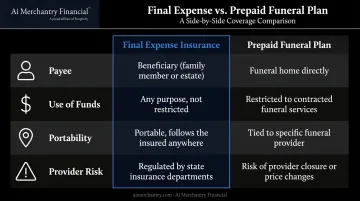
Final Expense Insurance vs. a Prepaid Funeral Plan
These are frequently confused, but they work very differently:
| Feature | Final Expense Insurance | Prepaid Funeral Plan |
|---|---|---|
| Payee | Named beneficiary | Funeral home directly |
| Use of funds | Any purpose | Specific funeral services contracted |
| Portability | Not tied to one provider | Dependent on the funeral home |
| Provider risk | None | Funds at risk if funeral home closes |
How It Differs from Traditional Life Insurance
Final expense policies typically carry $2,000–$50,000 in coverage — far less than traditional whole or term policies. Qualification is significantly easier by design:
- No medical exam required
- In some cases, no health questions at all
- Approval is accessible for seniors with pre-existing conditions
Premiums per dollar of coverage run higher than a fully underwritten policy, but the targeted purpose and accessibility make it a practical fit for most applicants.
To put coverage needs in context, the 2023 NFDA median is $8,300 for burial and $6,280 for cremation — a modest policy can fully absorb those costs without touching other assets or burdening family members.
Types of Final Expense Insurance Plans
Both plan types are permanent coverage with fixed premiums — no expiration, no age-based rate increases. The core difference is how much health information the insurer requires before approving you.
According to LIMRA, 85% of final expense policies sold in 2024 were simplified issue, with guaranteed issue making up the remaining 15%.
Simplified Issue Life Insurance
Simplified issue requires answering a health questionnaire — but no medical exam. The insurer uses your answers (sometimes combined with database checks) to assess risk and set your rate.
Who it's best for: Seniors with minor or manageable health conditions who want the most affordable coverage available.
Advantages:
- Lower premiums compared to guaranteed issue
- Higher available coverage amounts
- Often approved quickly — sometimes same day
- Many carriers offer immediate, full-benefit coverage from day one
Average face amounts for simplified issue policies ran $14,535 in 2024, per LIMRA data.
Guaranteed Issue Life Insurance
Guaranteed issue asks nothing about your health. No questionnaire, no exam, no declination based on medical history. If you're within the eligible age range — typically 45 to 85, varying by carrier — you're approved.
Who it's best for: Individuals with serious or multiple health conditions who have been declined for other coverage.
Guaranteed issue comes with three consistent tradeoffs:
- Premiums are higher relative to the coverage amount
- Most carriers cap benefits at $25,000 (Gerber and Mutual of Omaha both top out here)
- Nearly all guaranteed issue policies include a 2-year graded benefit period
During that waiting period, if the insured passes away from natural causes, beneficiaries receive a return of premiums paid plus interest — not the full death benefit. Accidental death typically pays the full amount from day one.
Level vs. graded benefit: Some simplified issue policies also offer graded benefits, depending on health answers. Applicants who answer "no" to all health questions generally qualify for level (immediate, full) coverage.
Those with certain conditions may be placed in a graded class or steered toward guaranteed issue. Confirming which benefit structure applies to your specific policy — before you sign — determines when your family actually receives full coverage.
How Much Does Final Expense Insurance Cost?
Several factors shape your premium:
- Age at application — the single biggest driver
- Gender — women typically pay less
- Health status — affects simplified issue rates; not a factor for guaranteed issue
- Coverage amount selected
- Plan type — simplified issue is generally cheaper per dollar of coverage
- The specific carrier
Representative Monthly Premium Ranges
The following figures for $10,000 of coverage come from MoneyGeek's 2026 rate analysis for nonsmoking applicants in average health:
| Age | General Average (Female/Male) | Guaranteed Issue (Female/Male) |
|---|---|---|
| 55 | $36 / $46 | $27 / $34 |
| 60 | $42 / $53 | $34 / $43 |
| 65 | $50 / $66 | $43 / $55 |
| 70 | $64 / $84 | $55 / $72 |
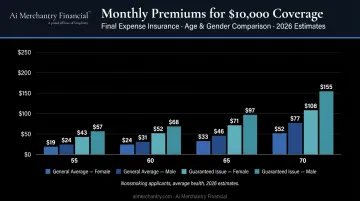
Mutual of Omaha's published guaranteed issue rates for $10,000 run $42.70 (female) / $56.90 (male) at age 60 and $63.90 / $86.70 at age 70 — consistent with the above ranges.
These rates don't increase after issuance. Both Transamerica and Mutual of Omaha confirm their final expense premiums are contractually level for the life of the policy — which means your $50/month payment today stays $50 ten years from now, regardless of age or health changes.
Once you know what rates look like, the next step is landing on the right coverage amount.
Estimating Your Coverage Amount
Start with the NFDA medians as a baseline ($8,300 for burial, $6,280 for cremation), then add:
- Outstanding medical bills or hospice costs
- Any debts you want paid off
- A buffer for cost increases or inflation
Round up to the next coverage tier. Most carriers offer increments like $10,000, $15,000, $20,000, and $25,000.
Who Should Consider Final Expense Insurance?
Final expense insurance makes the most sense for specific situations — and isn't necessary for everyone.
Strong candidates include:
- Adults 50 and older without dedicated funeral savings
- Those whose term life policy has expired or employer group coverage has ended
- Individuals who don't qualify for traditional underwritten coverage due to age or health
- Anyone who wants to keep their primary life insurance benefit intact for income replacement — not consumed by funeral costs
That last point is worth pausing on. If you have a $250,000 whole life policy earmarked for your spouse's income and mortgage, a separate $15,000 final expense policy means those funeral bills don't erode the benefit you intended for long-term support.
Who probably doesn't need it:
- Those with liquid savings specifically set aside for end-of-life costs
- Individuals who still qualify for and can afford a fully underwritten whole life policy with a larger benefit
The decision comes down to your health, existing coverage, available savings, and what you want your family navigating during an already difficult time.
Working with a knowledgeable advisor helps prevent both over-coverage and under-coverage. Ai Merchantry Financial's Collaborative Planning Network™ brings together licensed insurance professionals, financial strategists, and estate planning specialists to evaluate your full picture — so the recommendation fits your family's actual needs, not just the product available.
How to Choose the Right Final Expense Insurance Plan
The selection process has a few clear decision points.
Step 1: Assess your health honestly. If you can answer health questions favorably, simplified issue will almost always be cheaper and offer higher benefit amounts. If you've been declined before or have serious ongoing conditions, go straight to guaranteed issue.
Step 2: Set your coverage target. Use the NFDA cost benchmarks plus any debts or obligations you want covered. Don't underestimate — funeral costs have increased steadily, and a policy that seems adequate today may fall short in 10 years.
Step 3: Compare carriers. Look beyond premium price alone. Evaluate:
- Graded vs. level benefit structure
- The exact waiting period terms and how premiums are returned
- Whether beneficiary designation is flexible (person vs. funeral home)
- The carrier's financial strength rating (AM Best A- or better is a sound minimum)
Step 4: Read the full policy before signing. Pay close attention to waiting period language, what constitutes an accidental vs. natural death, and any exclusions. Free-look periods (typically 30 days) give you time to review and return a policy if it doesn't fit.
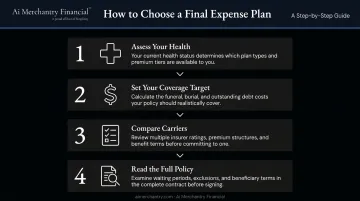
Once you've worked through these steps, the application itself moves quickly. Most policies require no medical exam and can be approved within days or even hours. That speed is convenient, but it puts the evaluation work on you upfront — graded benefit terms, benefit limits by age, and carrier-to-carrier differences are real distinctions that matter before you sign.
Frequently Asked Questions
What is the best final expense insurance plan?
For most applicants, simplified issue is the stronger choice — lower premiums, higher benefit limits, and immediate coverage. Guaranteed issue fits those with serious conditions or prior declinations. When comparing carriers, weigh benefit structure and financial strength alongside premium price.
Can I get final expense insurance if I have lupus?
Having lupus doesn't automatically disqualify you. Depending on severity and complications, a simplified issue policy may still be available. Those with more serious cases may need guaranteed issue coverage, which approves applicants regardless of health history but carries a graded benefit period.
Is a $50,000 final expense benefit real?
Yes. Some simplified issue products, such as Transamerica's Final Expense Immediate Solution, go up to $50,000 for qualifying ages. Guaranteed issue policies typically cap at $25,000. Limits vary by carrier and age.
Does final expense insurance require a medical exam?
No. Simplified issue requires answering health questions but no exam. Guaranteed issue requires no health information at all — just age eligibility.
Is there a waiting period for final expense insurance?
Simplified issue policies typically provide full benefits from day one. Guaranteed issue policies include a 2-year graded benefit period — during that window, natural-cause deaths pay returned premiums plus interest rather than the full benefit amount.
How is final expense insurance different from whole life insurance?
Both are permanent policies. Final expense insurance has a much lower face value (built specifically for end-of-life costs), easier qualification, and higher premiums relative to the death benefit than a fully underwritten whole life policy. The tradeoff is access — final expense policies are available to people who can't qualify for traditional coverage.