

Introduction
Most people avoid thinking about long-term care until a health event forces the conversation — and by then, the options narrow quickly.
According to a 2025 Congressional Research Service brief, 56% of Americans who survive to age 65 will develop a disability serious enough to require long-term services and supports. The costs are significant: CareScout's 2025 Cost of Care Survey reports median monthly costs of $6,200 for assisted living, $9,581 for a semi-private nursing home room, and $10,798 for a private room.
Traditional long-term care insurance creates a real psychological hurdle: pay premiums for decades, and if you never need care, you walk away with nothing. That feels like a losing bet.
Hybrid long-term care insurance was built to solve that problem. By combining LTC coverage with a life insurance death benefit, these policies ensure some benefit is paid whether care is needed or not. What follows breaks down how these policies work, what they actually cost, and how to decide whether one belongs in your financial plan.
Key Takeaways
- Hybrid LTC insurance pairs life insurance with long-term care coverage — value flows in both directions.
- Two primary structures exist: linked-benefit policies and life insurance with an LTC rider.
- Hybrid policies cost more upfront but lock in fixed premiums, a death benefit, and often a return-of-premium option.
- The early-to-mid 50s is generally the best time to buy — lower premiums, easier health qualification.
- The right choice depends on your retirement goals, legacy priorities, and budget — no single answer fits everyone.
What Is Hybrid Long-Term Care Insurance?
Hybrid long-term care insurance — also called linked-benefit, asset-based, or combo LTC insurance — combines long-term care coverage with either a permanent life insurance policy or an annuity. Benefits flow in two directions: LTC coverage if you need care, and a death benefit to your beneficiaries if you don't.
What "Long-Term Care" Actually Means
Long-term care refers to services needed when a person can no longer independently manage daily activities. Tax-qualified policies use six standard Activities of Daily Living (ADLs) as the measurement:
- Bathing
- Continence
- Dressing
- Eating
- Toileting
- Transferring
Most policies require a licensed health care practitioner to certify the insured cannot perform at least two of the six ADLs without substantial assistance, and that the need is expected to last at least 90 days. Severe cognitive impairment — such as Alzheimer's disease — serves as an alternative trigger under most contracts.
One important distinction: the 90-day requirement refers to the expected duration certified by a practitioner. A policy's elimination period is a separate contractual provision.
The Problem Hybrid Policies Solve
Traditional standalone LTC insurance carries two notable drawbacks:
- Use-it-or-lose-it structure: Premiums are paid over many years, and if care is never needed, no benefit is returned.
- Premium instability: Legacy standalone policyholders have faced significant rate hikes over the years — NAIC research documents notices of 80% and over 100% for some policyholders.
Hybrid policies address both issues by guaranteeing that premiums aren't "wasted" and, in most cases, locking in rates at purchase.
Hybrid Has Become the Market Standard
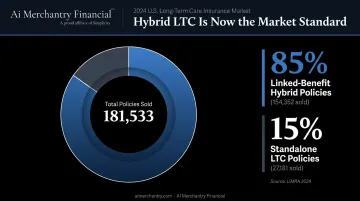
The shift away from traditional standalone coverage is well-documented. LIMRA data from a 2024 industry presentation shows 154,352 linked-benefit policies sold versus 27,181 standalone policies — an 85%/15% split. Hybrid coverage is no longer a niche alternative.
What Medicare Does (and Doesn't) Cover
Medicare is not a long-term care solution. In 2026, Medicare Part A covers skilled nursing facility care under specific qualifying conditions:
- Days 1–20: $0 cost-sharing
- Days 21–100: $217 per day
- After day 100: No coverage
Medicare explicitly excludes long-term custodial care — meaning assistance with ADLs that doesn't require skilled medical personnel. That gap falls to personal savings, family support, or insurance.
How Hybrid LTC Insurance Works: The Two Main Policy Types
Two primary structures exist for hybrid LTC coverage. Each has different mechanics, payment options, and trade-offs. The right fit depends on whether you already need life insurance, your budget, and how you want benefits paid.
Linked-Benefit Long-Term Care Insurance
A linked-benefit policy is a standalone product that combines LTC coverage with a life insurance death benefit. - LTC benefits are drawn from the death benefit pool as care is needed
- If care is never needed, beneficiaries receive the full death benefit
- Some policies guarantee a residual death benefit — typically 5–10% of the original amount — even if all LTC benefits are exhausted
- Many linked-benefit policies use a cash-indemnity payment model, meaning the monthly maximum is paid without requiring receipts, offering flexibility to pay informal or family caregivers
Funding typically works through a single lump-sum premium or a limited multi-year option (such as a 10-pay plan) — not ongoing lifetime premiums. Key funding details:
- The LTC benefit pool is typically two to three times the premium paid
- An inflation protection rider can grow that pool further
- Most policies include a return-of-premium feature if the policy is cancelled
Life Insurance with a Long-Term Care Rider
This approach adds an LTC rider to an existing permanent life insurance policy, allowing the death benefit to be accessed early to pay for care.
- Each dollar used for LTC reduces the death benefit dollar-for-dollar
- Example: Using $200,000 of a $500,000 policy for care leaves a $300,000 death benefit for heirs
- Best suited for someone who already needs life insurance and wants the option to redirect that coverage toward care if needed
On cost, this option typically lands between two benchmarks: less expensive than a standalone linked-benefit policy, but more expensive than traditional standalone LTC insurance. The trade-off is coverage depth — riders generally provide less dedicated LTC coverage, but they make one policy do two jobs, which simplifies both planning and premiums.
Not all hybrid policies pay benefits the same way — and the distinction matters when comparing options:
- Cash-indemnity design: Pays the monthly maximum directly, no receipts required (example: Nationwide CareMatters)
- Reimbursement design: Pays only for documented, qualified LTC expenses (example: Lincoln MoneyGuard Fixed Advantage)
Confirm the payment model before purchasing. It affects how much flexibility you have, especially if you plan to use informal or family caregivers.
Key Benefits and Potential Drawbacks of Hybrid LTC Insurance
Key Benefits
Guaranteed return on premiums. Unlike traditional LTC insurance, a hybrid policy ensures that either you or your beneficiaries receive value — care benefits if needed, or a death benefit if not. That built-in guarantee is why hybrid products now hold the largest share of new LTC sales in the U.S.
Premium stability. Most hybrid policies lock in premiums at purchase with no risk of rate increases , which is a real advantage given the rate-increase history of legacy standalone policies. Some can be fully paid up by a set age (such as 65), eliminating ongoing payments during retirement entirely.
Estate planning value. The tax treatment alone makes hybrid policies worth examining closely:
- Death benefits are generally income-tax-free to beneficiaries under IRC 101(a)
- LTC benefits from qualified contracts are typically excludable from income under IRC 7702B
- Some policies can be structured inside irrevocable trusts for added asset protection
Beyond the tax advantages, having LTC coverage protects retirement assets from being drained by care costs, preserving more wealth for the next generation.
Potential Drawbacks
Higher upfront cost. Hybrid policies cost considerably more than traditional standalone LTC policies — often two to four times more — because they deliver dual benefits. For buyers who need high monthly benefit amounts, this cost gap can be substantial. The key question is whether the added cost is justified by the guaranteed value, or whether a standalone policy better fits the budget.
Death benefit reduction trade-off. When LTC benefits are accessed, the death benefit available to heirs is reduced : dollar-for-dollar in an LTC rider model, or proportionally in a linked-benefit model. Buyers should think through both care needs and legacy goals honestly. Fully optimizing both at the same time usually involves trade-offs.
How Much Does Hybrid Long-Term Care Insurance Cost?
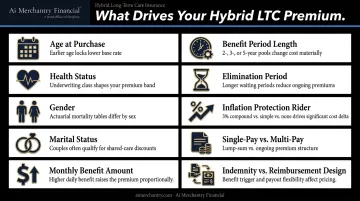
Hybrid LTC premiums vary widely based on your age, health, and the benefits you choose. Key pricing factors include:
- Age at purchase — the single largest driver
- Health status and underwriting class
- Gender (women typically pay more due to longer life expectancy and higher claim rates)
- Marital status (couples may qualify for joint or shared-benefit designs)
- Monthly benefit amount desired
- Benefit period length
- Elimination period chosen
- Inflation protection rider (adds cost but protects purchasing power)
- Single-pay vs. multi-pay funding
- Indemnity vs. reimbursement design
The Cost of Waiting
Timing matters more than most buyers realize. AALTCI's 2024 data indicates that waiting from age 55 to 65 makes the same initial traditional standalone LTC coverage cost approximately 49.9% more. That figure applies to standalone policies, but hybrid coverage follows the same logic: every year of delay raises premiums and narrows your health qualification options.
No public survey currently provides apples-to-apples hybrid premium benchmarks across age groups and genders. Carrier-specific illustrations are the only reliable way to assess your actual cost — which makes working with an advisor who can pull quotes from multiple insurers a practical necessity, not just a recommendation.
Practical Ways to Reduce Cost
- Buy in your early-to-mid 50s while premiums are lower and health qualification is more straightforward
- Make a lump-sum payment rather than spreading premiums over years, which often reduces total outlay
- Qualify for preferred health discounts where available — underwriting class significantly affects pricing
- Work with an independent advisor who can compare multiple insurers rather than being limited to one carrier's product
Is Hybrid Long-Term Care Insurance Right for You?
Who Typically Benefits Most
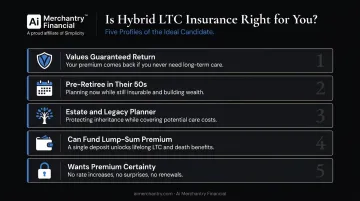
Hybrid LTC insurance tends to be a strong fit for:
- People who want guaranteed value from their premiums and won't accept a use-it-or-lose-it structure
- Pre-retirees in their 50s who want to lock in lower rates before health changes complicate underwriting
- Individuals with legacy or estate planning goals who want a tax-free death benefit alongside care protection
- Those who can fund a larger upfront or lump-sum premium without impairing retirement liquidity
- Buyers who value premium certainty and want to eliminate rate-increase risk
When Alternatives May Make More Sense
Hybrid isn't the right answer for everyone:
- Tighter budgets may be better served by a standalone traditional LTC policy with lower initial premiums
- Those who don't need a death benefit might consider an annuity with an LTC rider instead
- Individuals with significant retirement assets may prefer to self-insure a portion of care costs rather than tying capital to a product
- Anyone who needs immediate liquidity should weigh the opportunity cost of a large lump-sum premium carefully
The right choice depends on your full retirement picture — income sources, assets, estate goals, and health history. That's exactly where professional guidance makes a measurable difference.
Why Professional Guidance Matters
Hybrid LTC policies vary significantly across carriers in their payment models, benefit structures, guarantees, and costs. A single-carrier recommendation won't give you an accurate picture of what's available or appropriate.
Ai Merchantry Financial's Collaborative Planning Network™ connects you with insurance professionals, financial strategists, and planning specialists who evaluate options across multiple carriers. Through the We~LL Care Living™ planning solution and Advisor iMatch™ platform, you're matched with advisors who coordinate LTC planning alongside:
- Retirement income strategy
- Estate and legacy planning
- Tax optimization
This multi-discipline approach ensures hybrid LTC decisions are made in context — not in isolation.
To explore your options, visit aimerchantry.com/collaborativeplanningnetwork or call (844) 626-2246.
Frequently Asked Questions
How does a hybrid long-term care life insurance policy work?
A hybrid LTC policy combines life insurance with long-term care coverage. If care is needed, benefits are drawn from the policy's death benefit pool. If care is never needed, the death benefit passes to beneficiaries — so no premium is lost regardless of whether care is ever used.
How much does a hybrid long-term care life insurance policy cost?
Costs vary based on age, health, gender, benefit amount, and coverage design. Hybrid policies generally run two to four times more upfront than traditional standalone LTC policies. Carrier-specific illustrations are the only reliable way to get an accurate figure, since no universal benchmark applies across buyers.
Is a hybrid long-term care life insurance policy worth it?
For people who want premium certainty, guaranteed value, and a legacy component, hybrid coverage is often worth the added cost. Whether it's the right fit depends on individual goals, budget, and retirement plan. Working with an advisor before purchasing helps you compare options and avoid costly mismatches.
What is the difference between hybrid and traditional long-term care insurance?
Traditional LTC insurance is use-it-or-lose-it — no benefit is returned if care is never needed, and premiums have historically been subject to increases. Hybrid LTC guarantees either care benefits or a death benefit, and typically offers fixed premiums set at the time of purchase.
When is the best time to buy hybrid long-term care insurance?
The early-to-mid 50s is generally the optimal window. Premiums are lower, health qualification is easier, and inflation protection riders have more time to compound the benefit pool before care is likely needed.
Does using long-term care benefits reduce the death benefit?
Yes. Accessing LTC benefits typically reduces the available death benefit — dollar-for-dollar in an LTC rider model, or proportionally in a linked-benefit model. Some policies do guarantee a minimum residual death benefit even if all LTC benefits are exhausted.