

Introduction
Most people buy life insurance to protect their families. Far fewer realize it also functions as one of the most tax-advantaged financial tools available under the U.S. tax code — and that gap in awareness has real financial consequences.
According to the ACLI's 2024 Fact Book, U.S. life insurers paid $89.07 billion in death benefits in 2023 — the vast majority of which transferred to beneficiaries free of federal income tax. That's a massive, largely unrecognized transfer of tax-free wealth — and most beneficiaries never realize they were protected by the tax code at all.
This guide breaks down the real, practical tax benefits of life insurance: which provisions of the Internal Revenue Code create them, when they apply, what can go wrong, and how business owners access an additional layer of advantages. Whether you're evaluating a policy for the first time or reviewing one you've held for years, knowing these rules — from IRC Section 101(a) to the Modified Endowment Contract thresholds — directly affects how much you keep.
Key Takeaways
- Death benefits paid to named beneficiaries are generally excluded from federal income tax under IRC Section 101(a)
- Permanent life insurance cash value grows tax-deferred — no annual tax bill while the policy stays in force
- Policy loans from non-MEC policies are generally not treated as taxable income by the IRS
- Certain scenarios do trigger tax liability, including surrenders, MEC status, estate inclusion, and interest on installment payouts
- Business owners access additional tax-advantaged strategies through key-person coverage, buy-sell funding, and COLI
Life Insurance as a Tax Strategy: The Basics
Life insurance is a contract: you pay premiums, and a death benefit is paid to named beneficiaries when the insured dies. For most policyholders, that's the whole story. For those using life insurance as a planning tool, it's just the beginning.
Two categories matter for tax purposes:
- Term life insurance — temporary coverage with no cash value component; the tax advantage is limited to the income-tax-free death benefit
- Permanent life insurance (whole life, universal life, variable universal life) — includes a cash value component that carries additional tax advantages during the policyholder's lifetime
The distinction matters because the most powerful tax benefits — deferred growth and tax-advantaged access to funds — exist only inside permanent policies.
That's what makes permanent life insurance a versatile planning tool — not just protection. Depending on how it's structured and funded, a well-designed policy can:
- Preserve estate value across generations
- Supplement retirement income through tax-advantaged withdrawals
- Reduce taxes on long-term savings growth
- Ensure beneficiaries receive the full death benefit without a taxable event
Key Tax Advantages of Life Insurance
The advantages below are grounded in specific provisions of the Internal Revenue Code. Each one translates into a measurable financial outcome.
Tax Advantage 1: Income Tax-Free Death Benefit
Under IRC Section 101(a), life insurance death benefits paid to a named beneficiary are generally excluded from the beneficiary's gross income. They receive the full payout — no federal income tax deduction applied.
In practice: a $500,000 death benefit goes to the beneficiary as $500,000. Compare that to an inherited traditional IRA or pre-tax 401(k), where the IRS requires beneficiaries to include distributions in gross income — meaning a significant portion of the inherited balance goes to taxes before it reaches the family.
That makes life insurance one of the most capital-efficient wealth transfer tools available — the death benefit bypasses the income tax erosion that reduces most other inherited assets.
This benefit is most relevant in these situations:
- High-net-worth estates where other assets carry significant embedded tax liability
- Families with large pre-tax retirement accounts (IRAs, 401(k)s) who want to pass at least some wealth to heirs without creating a tax event
- Business owners who need to equalize inheritance across heirs without liquidating business assets or triggering taxable distributions
One important note: IRC Section 101(j) limits the income-tax exclusion for employer-owned contracts unless specific notice, consent, and exception requirements are met. The exclusion isn't automatic for every policy type or ownership structure.
Tax Advantage 2: Tax-Deferred Cash Value Growth
Permanent life insurance policies accumulate cash value. A portion of each premium grows in an account not subject to annual income tax while the policy remains in force. The statutory basis for this treatment comes from IRC Sections 72 and 7702.
The practical difference between taxable and tax-deferred growth compounds significantly over time. In a taxable brokerage account, dividends, interest, and capital gains are taxed each year, reducing the amount available to reinvest. Inside a qualifying life insurance policy, that annual tax drag disappears and growth compounds on the full balance uninterrupted.
For high earners who have already maxed out their qualified retirement accounts, this is particularly relevant:
| Account Type | 2024 Annual Contribution Limit |
|---|---|
| IRA | $7,000 ($8,000 age 50+) |
| 401(k) elective deferral | $23,000 ($30,500 age 50+) |
| Permanent life insurance | Policy-specific (IRC 7702 test governs, no flat dollar cap) |
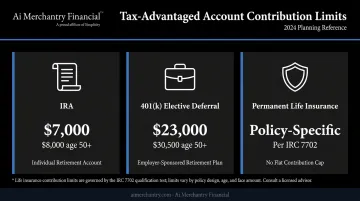
While life insurance doesn't offer unlimited contributions — premium capacity is governed by IRC Section 7702's qualification tests, not a universal annual limit — it does provide meaningful additional tax-deferred savings capacity beyond what qualified plans allow.
The tax-deferral benefit is most significant for:
- High-income earners in elevated tax brackets
- Individuals who've already maxed qualified retirement accounts
- Long-term savers who can leave funds undisturbed for decades
Tax Advantage 3: Tax-Advantaged Policy Loans and Withdrawals
Policyholders with sufficient cash value can borrow against their policy or make withdrawals — and when structured correctly, these transactions can be taken without triggering a taxable income event.
The mechanics differ by transaction type:
- Policy loans from non-MEC contracts are generally treated as debt against the policy, not as a distribution of earnings. They don't create taxable income in the year they're taken. However, if the policy lapses or is surrendered while a loan is outstanding, the gain can become taxable.
- Withdrawals up to the policyholder's cost basis (total premiums paid) are tax-free. Amounts exceeding the cost basis may be taxable.
The retirement income angle is significant. A taxable IRA distribution increases adjusted gross income — which can push retirees into higher tax brackets, increase the taxable portion of Social Security benefits, and trigger Medicare IRMAA surcharges, which begin for single filers with income above $103,000 and joint filers above $206,000 in 2024.
A policy loan that isn't included in gross income doesn't affect any of those thresholds. For retirees managing income carefully across multiple account types, that distinction can mean real dollars preserved.
Structured policy access works best for:
- Retirees diversifying income across taxable, tax-deferred, and tax-free sources
- High earners near Medicare IRMAA thresholds
- Estates needing liquidity without forcing asset sales to cover costs or obligations
When Life Insurance Proceeds Can Be Taxable
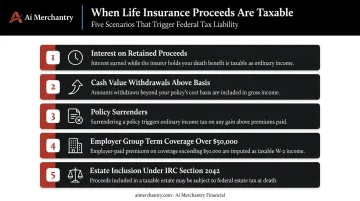
The phrase "life insurance is tax-free" is overbroad. Several specific scenarios can result in all or part of the proceeds becoming taxable:
- Interest on retained proceeds — Death benefits remain excluded, but interest paid on proceeds left with the insurer is taxable income
- Cash value withdrawals above basis — Amounts exceeding total premiums paid are included in ordinary income
- Policy surrenders — Cash received above the policy's cost triggers income tax on the gain
- Employer group term coverage over $50,000 — IRC Section 79 excludes the cost of up to $50,000 of employer-provided group coverage; imputed income on the excess is taxable to the employee
- Estate inclusion — Under IRC Section 2042, proceeds receivable by the estate or payable to others when the decedent held incidents of ownership can be included in the taxable estate; the 2024 federal basic exclusion was $13.61 million, but large estates can exceed it
Understanding Modified Endowment Contracts (MECs)
Overfunding a policy too quickly triggers a permanent tax reclassification that strips away most of the planning advantages permanent life insurance offers.
When premiums paid during the first seven policy years exceed the IRS's 7-pay test threshold under IRC Section 7702A, the policy is reclassified as a Modified Endowment Contract (MEC). This changes the tax treatment materially:
- Loans and withdrawals are subject to gain-first treatment — meaning earnings come out before basis, and those earnings are taxable as ordinary income
- A 10% early withdrawal penalty applies to taxable amounts taken before age 59½ (with limited exceptions)
- The key tax advantages that make permanent life insurance attractive as a planning vehicle are largely eliminated
MEC status is irreversible once triggered. Avoiding it requires funding premiums within policy-specific limits set by the 7-pay test — a calculation that varies by policy design, insured age, and coverage amount. Coordinating this correctly upfront is far simpler than managing the tax consequences afterward.
Tax Benefits of Life Insurance for Business Owners
Life insurance isn't only a personal planning tool. For business owners, it supports several tax-advantaged strategies that address real operational risks.
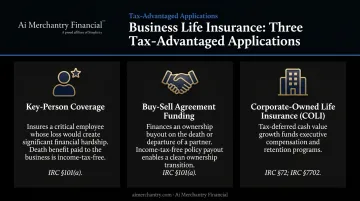
Three Primary Business Applications
- Key-person coverage insures a critical employee or owner. The company receives the death benefit income-tax-free under IRC Section 101(a) — provided the notice, consent, and exception requirements of IRC Section 101(j) are met. That capital helps absorb the financial impact without disrupting operations.
- Buy-sell agreement funding uses life insurance to finance the buyout of a deceased partner's or shareholder's interest. When 101(j) requirements are satisfied, the payout is income-tax-free, enabling a clean ownership transition without forced asset liquidation.
- Corporate-owned life insurance (COLI) allows cash value inside a qualifying contract to grow tax-deferred under IRC Sections 72 and 7702. Companies often use COLI to informally fund executive compensation arrangements and deferred benefit plans.
The Critical Limitation
Business owners often assume business-owned premiums are tax-deductible. In most cases, they are not. IRC Section 264(a)(1) denies a deduction for premiums when the taxpayer is directly or indirectly the beneficiary.
Employer-owned contracts carry additional compliance requirements: employees must receive written notice before the policy is issued, provide written consent, and the employer must file Form 8925 annually. Skipping any of these steps can eliminate the income-tax exclusion on the death benefit entirely. Working with a qualified advisor during the structuring phase is what keeps those tax protections intact.
How to Maximize the Tax Benefits of Your Life Insurance Policy
Life insurance tax advantages aren't automatic. They depend on how the policy is structured, funded, and integrated into a broader financial plan. Getting any of these wrong can erode or eliminate the benefits entirely.
The conditions under which the tax benefits work as intended:
- Premiums are funded within IRS limits to avoid MEC reclassification under IRC 7702A
- The right policy type (term vs. permanent, whole life vs. variable universal) is matched to the individual's actual financial objectives
- Beneficiary designations are current and aligned with the estate plan
- Policy performance is reviewed regularly to monitor cash value trajectory and confirm the policy won't lapse
- For business-owned policies, 101(j) notice and consent requirements are documented and maintained
Getting these elements right is difficult to do alone. Life insurance tax strategy sits at the intersection of insurance law, income tax planning, and estate law. A gap in any one of those areas can create unintended consequences.
That's where coordinated professional guidance makes a measurable difference. Ai Merchantry Financial's Collaborative Planning Network™ connects individuals, families, and business owners with insurance professionals, tax advisors, and estate planning attorneys who can review policies across all three disciplines and confirm the strategy is properly structured from the start.
Frequently Asked Questions
What is considered a major tax advantage of life insurance?
The income tax-free death benefit under IRC Section 101(a) stands as the primary advantage: beneficiaries receive the full payout without federal income tax. For permanent policyholders, tax-deferred cash value growth and tax-advantaged policy loans supplement that benefit further.
Are life insurance premiums tax-deductible?
For personal life insurance policies, premiums are not tax-deductible — the IRS treats them as a personal expense. Certain business-owned policies may have limited deductibility depending on structure and beneficiary designation. Consulting a tax professional before purchasing business-owned coverage is essential.
Do beneficiaries pay taxes on life insurance payouts?
In most cases, no. Death benefits paid to a named beneficiary are excluded from gross income under IRC Section 101(a). Interest earned on proceeds paid in installments is taxable, and estate taxes may apply if the policy is included in a taxable estate exceeding the federal exemption.
What is a Modified Endowment Contract (MEC) and why does it matter?
A MEC is a policy that fails the IRC 7702A 7-pay test , typically by being overfunded too quickly. Once reclassified, loans and withdrawals are taxed as income first and may carry a 10% early withdrawal penalty before age 59½.
Can life insurance be used as a tax-free retirement income source?
Yes. Permanent policyholders can take loans against their cash value in retirement that are generally not treated as taxable income. These loans also don't affect Social Security taxation thresholds or Medicare IRMAA calculations, making them a practical complement to traditional retirement accounts.
Are the tax benefits of life insurance different for business owners?
Business owners can access additional tax-advantaged strategies, including key-person insurance, buy-sell agreement funding, and COLI with tax-deferred cash value growth. However, these require careful structuring , including meeting IRC 101(j) notice and consent requirements, to preserve the income-tax exclusion on death benefits.