

Introduction
Only 41% of women feel confident they can retire at their target age, compared to 58% of men — and Transamerica's 2025 survey found that 38% of women workers have no retirement strategy at all. That gap comes down to structure, not effort.
Women face a genuinely different set of financial pressures in retirement: longer lifespans, higher healthcare costs, caregiving interruptions that hollow out earning years, and Social Security benefits that reflect a lifetime of pay inequity. These aren't abstract risks — they build on each other over decades and arrive with full force when there's no plan in place.
This article breaks down what's working against you, what you can do about it, and how to find the right support to move from intention to an actual retirement plan.
Key Takeaways
- Women live ~5 years longer than men on average — savings must stretch further, often without a partner's income
- Caregiving gaps reduce lifetime wages, Social Security credits, and pension accumulation
- Tax-advantaged accounts, HSAs, and Social Security timing decisions are among the highest-leverage planning tools available
- Working with a financial professional is associated with significantly higher retirement preparedness among women
- Catching up is possible — but it requires deliberate strategy, not just good intentions
Why Retirement Planning Is Different for Women
The Caregiver Penalty
Women represent 61% of U.S. family caregivers, according to AARP's 2020 National Caregiving Study. That caregiving responsibility translates into reduced hours, unpaid leave, or leaving the workforce entirely — with consequences that ripple across decades.
A 2011 MetLife analysis estimated that a female caregiver loses an average of $324,044 over her lifetime in combined wage losses, reduced Social Security benefits, and forfeited pension income. That figure is over a decade old and likely understates today's reality, but no current preferred-source estimate has replaced it.
Transamerica's data adds another dimension: 13% of women caregivers quit a job because of caregiving responsibilities, compared to 7% of men. Each exit resets the contribution clock.
The Longevity and Healthcare Cost Gap
Per CDC 2024 mortality data, U.S. women live to 81.4 years on average, compared to 76.5 years for men — nearly a five-year gap. That gap means a woman retiring at 65 may need to fund 16+ years of retirement, often as a surviving spouse on a single income.
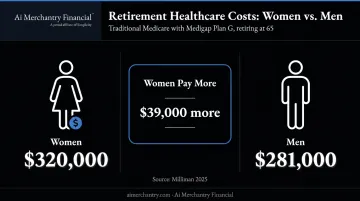
Longer lives also mean higher medical bills. Milliman's 2025 Retiree Health Cost Index projects that a woman retiring healthy at 65 will spend approximately $320,000 on healthcare through retirement under traditional Medicare with Medigap Plan G — versus $281,000 for a man under the same assumptions. That $39,000 difference reflects longer utilization periods, not higher per-visit costs.
The Pay Gap's Long Reach
Lower wages mean lower Social Security benefits. The SSA's 2024 data reveals a clear income disparity between retired men and women:
| Average Monthly Benefit | |
|---|---|
| Retired women | $1,714 |
| Retired men | $2,106 |
| Monthly gap | $392 |
That $392 monthly shortfall adds up to nearly $4,700 annually — and compounds over a retirement that could last two decades.
Vanguard's 2025 analysis of defined-contribution plans found that women and men save at similar rates, and women sometimes save at slightly higher rates at higher income levels. The retirement gap is driven more by pay inequality and workforce interruptions than by savings behavior — which means the fix starts with income equity and career continuity planning, not just contribution rates.
Smart Retirement Savings Strategies for Women
Maximize Tax-Advantaged Retirement Accounts
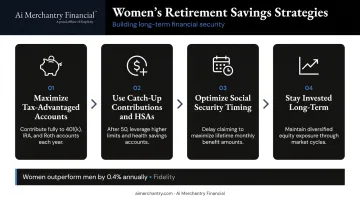
The foundation of any retirement plan is straightforward: contribute to employer-sponsored plans first, especially up to the full employer match. That match is compensation — leaving it unclaimed is the equivalent of declining part of your paycheck.
2025 IRS contribution limits (subject to change annually):
| Account Type | 2025 Limit |
|---|---|
| 401(k) / 403(b) employee deferral | $23,500 |
| Traditional or Roth IRA (combined) | $7,000 |
| HSA — self-only coverage | $4,300 |
| HSA — family coverage | $8,550 |
For women in lower-income years — whether due to caregiving, part-time work, or a career transition — a Roth IRA or Roth 401(k) deserves serious consideration. Contributing after-tax dollars now locks in tax-free growth for a longer retirement horizon, and Roth IRAs carry no required minimum distributions, giving you more control over taxable income in your later years.
Leverage Catch-Up Contributions and HSAs
If you're 50 or older, the IRS allows additional contributions beyond standard limits:
- 401(k) catch-up (age 50+): An extra $7,500 annually
- SECURE 2.0 enhanced catch-up (ages 60–63): $11,250 instead of $7,500
- IRA catch-up (age 50+): An extra $1,000 annually
These provisions exist specifically to help late starters close the gap — and the SECURE 2.0 enhanced window at ages 60–63 is an opportunity worth planning around before it arrives.
Health Savings Accounts deserve special attention for women. HSAs carry a triple tax advantage: contributions are pre-tax (or tax-deductible), growth is tax-free, and withdrawals for qualified medical expenses are tax-free. Given that women face an estimated $39,000 more in retirement healthcare costs than men, maxing out an HSA each year is one of the most efficient moves available.
Optimize Your Social Security Strategy
Social Security timing is one of the highest-stakes decisions in retirement planning. Delaying benefits past full retirement age increases your monthly payment by 8% per year until age 70. For a woman who may spend 20+ years in retirement, that difference is substantial.
Women should also understand benefits they may be entitled to but rarely claim:
- Spousal benefits: Up to 50% of a spouse's full retirement age benefit, if that's higher than your own earned benefit
- Survivor benefits: Available as early as age 60 for widows (50 if disabled), based on the deceased spouse's record
- Divorced spouse benefits: Available if the marriage lasted at least 10 years, you're unmarried, and you're at least 62
Invest Early and Stay Invested
Compound growth is unforgiving of late starts. A $200/month contribution beginning at 35 will outperform a $500/month contribution starting at 50 in most market scenarios — because time is the primary input.
Beyond structure and timing, behavior matters. A Fidelity analysis of 5.2 million customer accounts found that women outperformed men by 0.4 percentage points annually over a 10-year period, with lower trading frequency cited as a key factor. Staying invested through volatility, rather than reacting to it, is a genuine and measurable edge.
Building a Reliable Retirement Income Stream
A retirement built on a single income source is fragile. Most women benefit from building multiple streams that function independently, so that one disruption doesn't create a crisis.
Common retirement income sources to map:
- Social Security (your own earned benefit, and potentially spousal or survivor benefits)
- 401(k) and IRA distributions
- Pension income, if applicable
- Annuity payments
- Personal savings and taxable investment accounts
- Part-time or consulting income during early retirement years
Mapping these sources side by side, and projecting when each starts, how long it lasts, and whether it adjusts for inflation, helps identify income gaps before they become emergencies.
Planning Benchmarks to Know
The $1,000-a-month rule, as described by Kiplinger, offers a simple starting benchmark: for each $1,000 per month of desired retirement income, you may need approximately $240,000 in savings, based on a 5% annual withdrawal rate. It's a rough heuristic, not a precise target — it doesn't account for taxes, inflation, or individual circumstances.
The 4% rule, derived from William Bengen's 1994 research, suggests withdrawing 4% of your portfolio in year one and adjusting for inflation thereafter, historically sustaining a portfolio through a 30-year retirement.
Women with retirement horizons extending well beyond 30 years face sequence-of-returns risk: a significant market decline early in retirement can permanently impair a portfolio's ability to recover, because withdrawals continue even as balances fall.
Starting with a more conservative withdrawal rate, building in flexibility, and incorporating guaranteed income sources can reduce dependence on market performance alone.
Annuities can serve a specific role here — providing guaranteed lifetime income regardless of market conditions. They're not the right tool for every situation, but for women facing longevity income risk, a portion of assets in an income annuity can reduce the risk of outliving savings.
Protecting Your Retirement: Insurance and Emergency Planning
Long-Term Care: The Risk Most Women Underestimate
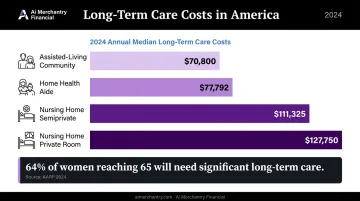
According to AARP's 2024 analysis, 64% of women who reach age 65 will need significant long-term care at some point — compared to 49% of men. And national median care costs are steep:
| Care Setting | Annual Median Cost (2024) |
|---|---|
| Assisted-living community | $70,800 |
| Home health aide | $77,792 |
| Nursing home, semiprivate | $111,325 |
| Nursing home, private room | $127,750 |
Medicare does not cover long-term or custodial care when that is the only care needed. The gap is real and potentially catastrophic without a plan.
AARP identifies ages 60–65 as the optimal window to purchase long-term care insurance for most people — early enough to qualify medically while still paying manageable premiums. Waiting much past 65 raises both costs and rejection risk.
Schedule an annual insurance review — covering health, life, disability, and supplemental coverage — particularly after major life transitions like divorce, a job change, or the death of a spouse.
Emergency Fund as Retirement Protection
Insurance coverage handles long-term risks — but short-term disruptions need a different kind of protection. Keeping three to six months of living expenses in a liquid, interest-bearing account, separate from retirement savings, shields those accounts from premature withdrawals.
Without that buffer, unexpected events can force costly decisions:
- A medical emergency triggers a taxable retirement distribution
- Job loss depletes savings meant to compound for decades
- A home repair pulls funds that carry early withdrawal penalties
- Each unplanned withdrawal sets back retirement timelines by more than the dollar amount withdrawn
How to Catch Up If You've Started Late
Starting late is common — and it's recoverable. The path forward requires being deliberate rather than just optimistic.
High-impact catch-up strategies:
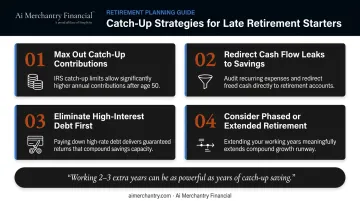
- Max out catch-up contributions — IRS provisions for ages 50+ and 60–63 exist precisely for this moment
- Identify where monthly cash flow is leaking and redirect it to savings
- Audit current insurance policies with a professional — premium reductions often surface that can fund additional contributions
- Pay off high-interest debt first — eliminating 20%+ APR debt delivers a guaranteed return most investments can't match
Working two or three extra years past your original retirement target produces a compounding effect: more contribution years, higher Social Security benefits from delayed claiming, and fewer years your savings must cover. For someone behind, that combination can be as powerful as sustained catch-up saving on its own.
Phased retirement — reducing to part-time work before fully stopping — offers a middle path. It maintains income, delays Social Security, allows continued contributions, and reduces financial pressure without requiring an abrupt full stop.
Getting the Right Guidance: Working with a Financial Professional
Research from LIMRA found that 40% of women working with a financial professional felt very prepared for retirement, compared to 27% of those without one — a 13-point difference that represents real confidence, not just comfort.
That gap reflects something practical: retirement planning for women involves more moving parts than a simple investment account. Social Security spousal strategies, caregiving gap documentation, Roth conversion timing, long-term care coordination, and estate planning all interact — and each decision affects the others. Choosing the right advisor means finding someone equipped to manage that full picture.

What to Look for in a Retirement Advisor
- Fiduciary status — a fiduciary is legally required to act in your interest, not earn commissions on products that may not suit you
- Experience with women's planning challenges — caregiving gaps, divorce, survivor benefits, and longevity income strategies require specialized knowledge
- Holistic scope — investment management alone isn't enough; look for integration of tax planning, insurance review, and estate strategy
How to verify credentials:
- CFP Board's verification tool — confirms certification status and disciplinary history for Certified Financial Planners
- SEC's IAPD — provides Form ADV disclosures for registered investment advisers, including fees, conflicts, and disciplinary history
- FINRA BrokerCheck — covers broker registration, employment history, and complaints
- LicenseeCheck™ — Ai Merchantry Financial's free tool for verifying licensing status, credentials, and regulatory history of insurance professionals
Ai Merchantry Financial's Collaborative Planning Network™ brings together fiduciary advisors, CPAs, attorneys, and insurance specialists to build coordinated retirement plans. For women navigating caregiving gaps, divorce, late-stage planning, or estate coordination, that coordination across disciplines matters — one advisor rarely covers all the ground. To connect with a team matched to your situation, contact Ai Merchantry Financial at (844) 626-2246 or partnerships@aimerchantry.com.
Frequently Asked Questions
What is the most accurate retirement planner?
Accuracy depends on the quality of your inputs, not the tool itself. The Social Security Administration's calculator at ssa.gov, AARP's retirement tools, and a personalized analysis from a fiduciary CFP using your actual income, expenses, and goals tend to produce the most reliable projections.
What is the biggest mistake most people make regarding retirement?
Starting too late and underestimating healthcare costs are consistently cited as the two most common errors. For women specifically, failing to account for the full length of retirement — given a longer life expectancy — makes both mistakes considerably more costly.
What is the $1,000-a-month rule for retirees?
This rough benchmark estimates that each $1,000 per month of desired retirement income requires approximately $240,000 saved, based on a 5% annual withdrawal rate. Use it as an opening reference point, since it doesn't factor in taxes, inflation, or your individual circumstances.
How much should a woman have saved for retirement by age 50?
Fidelity's benchmark suggests six times your annual salary by age 50. Many women fall short of this due to caregiving interruptions and pay gaps — but consistent saving combined with catch-up contributions can close a meaningful portion of that gap in the years that follow.
Can a woman retire comfortably on Social Security alone?
No. Social Security is designed to replace roughly 40% of pre-retirement income on average. Given longer life expectancy and higher healthcare costs, most women need substantial supplemental savings to maintain financial stability throughout retirement.