

Introduction
For most people, the retirement savings conversation starts and ends with a 401(k) or IRA. Those accounts work well — but they come with ceilings. In 2025, the 401(k) employee deferral limit is $23,500, and the combined IRA limit holds at $7,000. For high earners who've already hit those caps, the question becomes: what's next?
That's where a Life Insurance Retirement Plan (LIRP) enters the conversation. A LIRP works alongside standard retirement accounts as a supplemental strategy, layering additional tax-advantaged savings on top of existing plans through the cash value component of a permanent life insurance policy.
This guide covers what a LIRP actually is, how it works mechanically, which policy types qualify, the real benefits and drawbacks, who it makes sense for, and how it compares to 401(k)s, IRAs, and Roth IRAs.
Key Takeaways
- A LIRP uses the cash value of a permanent life insurance policy to build tax-deferred savings alongside a death benefit
- LIRPs work best for high earners who have already maxed out 401(k) and IRA contributions
- Cash value grows tax-deferred, and policy loans are generally tax-free — provided the policy remains in force
- Whole life, indexed universal life (IUL), and variable life are the three most common LIRP vehicles
- Overfunding a policy too aggressively can trigger Modified Endowment Contract (MEC) status, eliminating most tax advantages
What Is a Life Insurance Retirement Plan (LIRP)?
A LIRP is a planning strategy, not a standalone product or IRS-designated account. The IRS does not recognize "LIRP" as a retirement account category the way it recognizes 401(k)s or IRAs. What it recognizes is the permanent life insurance contract underneath — and the specific tax treatment that contract receives under the Internal Revenue Code.
Term vs. Permanent Life Insurance
The LIRP strategy only works with permanent life insurance. Here's why:
| Term Life | Permanent Life | |
|---|---|---|
| Duration | Fixed period (10–30 years) | Lifelong coverage |
| Cash value | None | Accumulates over time |
| LIRP eligible | No | Yes |
Term policies provide a death benefit for a set period and nothing more. Permanent policies — whole life, universal life, variable life — stay in force for life and build cash value the policyholder can access during their lifetime.
The Overfunding Concept
A LIRP works by paying premiums above the minimum required to maintain coverage. That excess flows directly into the cash value account, accelerating its growth. The goal is to maximize cash value accumulation while keeping the policy's insurance component active.
The line not to cross: Modified Endowment Contract (MEC) status. Under IRC 7702A, if cumulative premiums paid during the first seven contract years exceed what the IRS considers appropriate under the seven-pay test, the policy becomes a MEC. Once that happens, the tax advantages a LIRP is designed to deliver largely disappear:
- Loans and withdrawals are treated as income-first distributions
- A 10% penalty applies to the taxable portion before age 59½
- Tax-free access to cash value — the strategy's core benefit — is eliminated
Getting the premium structure right from the start is what separates a tax-advantaged LIRP from an expensive mistake.
How Does a LIRP Work?
When you pay a premium, two things happen:
- A portion covers the policy's insurance costs (mortality charges and administrative fees)
- The remainder flows into the cash value account
That cash value grows tax-deferred — no annual tax drag on gains as long as they remain inside the policy.
Three Ways to Access Cash Value in Retirement
Policy Loans You borrow against the cash value rather than withdrawing it. The IRS does not treat these loans as taxable income for non-MEC policies. Interest accrues on the outstanding balance, and while repayment isn't required, unpaid loans reduce the death benefit.
One critical risk deserves attention: if the policy lapses with an outstanding loan, the discharged debt becomes taxable as ordinary income — a point confirmed by the Tax Court in Fugler v. Commissioner (2025).
Withdrawals Up to Cost Basis Under IRC 72(e), withdrawals from a non-MEC policy are tax-free up to the amount you've paid in premiums (your cost basis). Amounts above that threshold are taxable as ordinary income.
Premium Offset Accumulated cash value can be directed to pay future premiums. For retirees managing fixed income, this eliminates an out-of-pocket expense without triggering a taxable event.
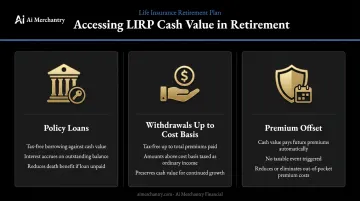
These access options only deliver full value if the policy stays intact long enough for cash value to accumulate — which is why time horizon matters.
A Note on Time Horizon
Cash value builds slowly in early years. Front-loaded insurance charges and fees consume a larger share of early premiums. The NAIC notes that some policies have low cash values in early years and build more substantially over time. LIRPs require a long commitment — cutting the policy short, whether by lapsing or surrendering, can result in unexpected taxes and lost value.
Types of Life Insurance Policies Used in a LIRP
Whole Life Insurance
Whole life offers the most predictability. Premiums are fixed, cash value grows at a guaranteed minimum rate, and the death benefit stays level. Dividends may be paid but are not guaranteed.
Best for: Individuals who prioritize certainty over growth potential and want a straightforward, stable foundation.
Universal Life Insurance (Including IUL)
Universal life introduces flexibility — premiums and death benefit amounts can be adjusted within limits. Indexed Universal Life (IUL) is the most widely used LIRP vehicle. IUL links cash value crediting to an external market index (commonly the S&P 500), subject to:
- A floor (often 0%) that limits negative index crediting
- A cap that limits the credited upside
One important clarification from the NAIC: a 0% index floor limits negative crediting, not policy charges. Cash value can still decline if ongoing policy charges exceed credited interest. Caps, participation rates, and floors vary by contract and can change over time.
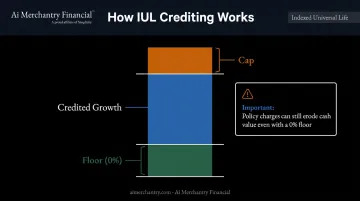
Best for: Individuals who want premium flexibility and index-linked growth potential with downside protection, and who understand that policy charges can still erode cash value.
Variable Life Insurance
Variable life allows cash value to be allocated among investment sub-accounts like mutual funds. FINRA classifies variable life as a security — cash value moves directly with market performance. Higher growth potential comes with direct market risk. This is the highest-risk LIRP option and suits only those with a long time horizon and genuine tolerance for market volatility.
Best for: Individuals with a long investment horizon who can absorb market-driven fluctuations and want maximum growth potential within a life insurance structure.
Benefits and Drawbacks of a LIRP
Potential Benefits
- Tax-deferred growth, tax-free access — Cash value compounds without annual tax drag. Policy loans from non-MEC policies are excluded from gross income, so they won't affect AGI-based thresholds like Social Security taxation or Medicare IRMAA surcharges.
- No IRS contribution limits — Unlike 401(k)s and IRAs, there are no annual caps on premium payments into a life insurance policy, subject only to MEC testing. For high earners already hitting qualified plan limits, this matters.
- Lifelong death benefit — The policy provides family protection and supports legacy goals while simultaneously functioning as a retirement savings vehicle.
No strategy is without trade-offs. The drawbacks below are worth weighing carefully before committing to a LIRP.
Potential Drawbacks
- Cost structure — Permanent life premiums are significantly higher than term coverage because the policy continues for life and builds cash value. Per FINRA, insurance charges can erode returns, particularly as the insured ages.
- Lower returns than direct market investing — Whole life and traditional universal life growth rates have historically been modest. Variable life may narrow the gap but introduces market risk. No single benchmark applies across all policy types.
- Lapse risk — Missed premiums, excessive withdrawals, or over-borrowing can exhaust cash value and terminate the policy. Any outstanding loan balance at lapse is treated as a taxable distribution, and amounts above your cost basis are taxed as ordinary income. (This is also why carefully managing the policy over time matters — a point worth revisiting if the tax-free access benefit is a primary motivation.)
Who Is a LIRP Best Suited For?
A LIRP is not the right tool for everyone. It works best in specific circumstances.
Strong candidates:
- High-income earners who have maxed out 401(k) and IRA contributions and want additional tax-advantaged savings
- Business owners with variable income who value flexible premium payment options (universal life in particular)
- Individuals focused on legacy planning who want both retirement income and a tax-efficient death benefit
- Those with a long time horizon — at minimum a decade, ideally longer — to allow cash value to develop meaningfully before retirement
Generally not a good fit:
- Individuals who need affordable life insurance coverage (term is far more cost-efficient)
- Those just beginning their retirement savings journey — standard accounts should come first
- Anyone who cannot commit to sustained premium payments over many years
Determining whether a LIRP fits your situation means examining your current tax bracket, existing retirement assets, income trajectory, estate goals, and risk tolerance together — not in isolation. Ai Merchantry Financial's Collaborative Planning Network™ brings licensed insurance professionals, financial advisors, CPAs, and estate planning attorneys into a single coordinated review, which is exactly the kind of cross-disciplinary perspective a LIRP decision calls for.
LIRP vs. Other Retirement Strategies
LIRP vs. 401(k) and Traditional IRA
| 401(k) / Traditional IRA | LIRP | |
|---|---|---|
| Tax on contributions | Pre-tax (deductible) | After-tax |
| Tax on withdrawals | Ordinary income tax | Tax-free (policy loans, non-MEC) |
| Contribution limits | $23,500 / $7,000 (2025) | None (subject to MEC rules) |
| RMDs | Yes — age 73 or 75 | No |
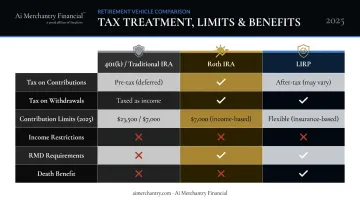
The RMD distinction is significant. Under SECURE 2.0, Required Minimum Distributions begin at age 73 for those born 1951–1959, and age 75 for those born in 1960 or later (with age 75 taking effect in 2033). LIRPs carry no RMD requirement, giving retirees more control over income timing.
LIRP vs. Roth IRA
Both use after-tax dollars and offer tax-free retirement income. The key differences:
- Roth IRA income limits: Direct contributions phase out at $150,000–$165,000 (single) and $236,000–$246,000 (married filing jointly) in 2025. High earners may be excluded entirely.
- LIRPs have no income restrictions — making them an accessible option when Roth IRA direct contributions aren't available.
- Roth IRAs typically carry lower fees and offer a broader investment universe than permanent life insurance policies.
High earners often use a LIRP to complement a Roth IRA — or as a primary vehicle when income limits cut off Roth access entirely.
LIRP vs. Annuities
Unlike the tax-treatment comparison with a Roth IRA, the LIRP-vs.-annuity distinction is structural. Annuities offer tax-deferred growth and can generate guaranteed income streams, but they don't include a death benefit. A LIRP provides family financial protection alongside retirement savings — annuities don't. Retirees who want guaranteed income and a legacy component sometimes hold both, using an annuity for income floor coverage and a LIRP for tax-free flexibility and the death benefit.
Frequently Asked Questions
Is a life insurance policy a good retirement plan?
A permanent life insurance policy can serve as a valuable supplemental retirement savings tool through its cash value component. It is not a replacement for primary retirement accounts like a 401(k) or IRA, and works best for high earners who have already maximized those options.
Who benefits most from a LIRP?
LIRPs are best suited for high earners who have already maxed out their 401(k) and IRA contributions and want additional tax-advantaged growth. Business owners, professionals seeking tax diversification, and those with a long-term need for life insurance coverage tend to get the most value from this strategy.
What is the difference between a LIRP and a Roth IRA?
Both use after-tax dollars and offer tax-free income in retirement, but Roth IRAs cap contributions at $7,000 (2025) and phase out for high earners. LIRPs have no income limits or contribution caps — though they come with higher costs and greater complexity.
What happens if my LIRP policy lapses?
If the policy lapses (due to unpaid premiums or a cash value exhausted by over-borrowing), any outstanding loans and accumulated gains above your cost basis become taxable as ordinary income in that year. This can produce a substantial, unexpected tax bill.
Can a LIRP replace my 401(k) or IRA?
No — most financial professionals recommend maximizing 401(k) and IRA contributions first. A LIRP works best as a supplemental strategy once those primary accounts are fully funded.
What is a Modified Endowment Contract (MEC) and why does it matter?
A MEC occurs when a policy is funded too rapidly, exceeding IRS thresholds under the seven-pay test. Once classified as a MEC, loans and withdrawals become subject to income tax and a potential 10% penalty before age 59½ — eliminating the primary tax advantages a LIRP is structured to deliver.